
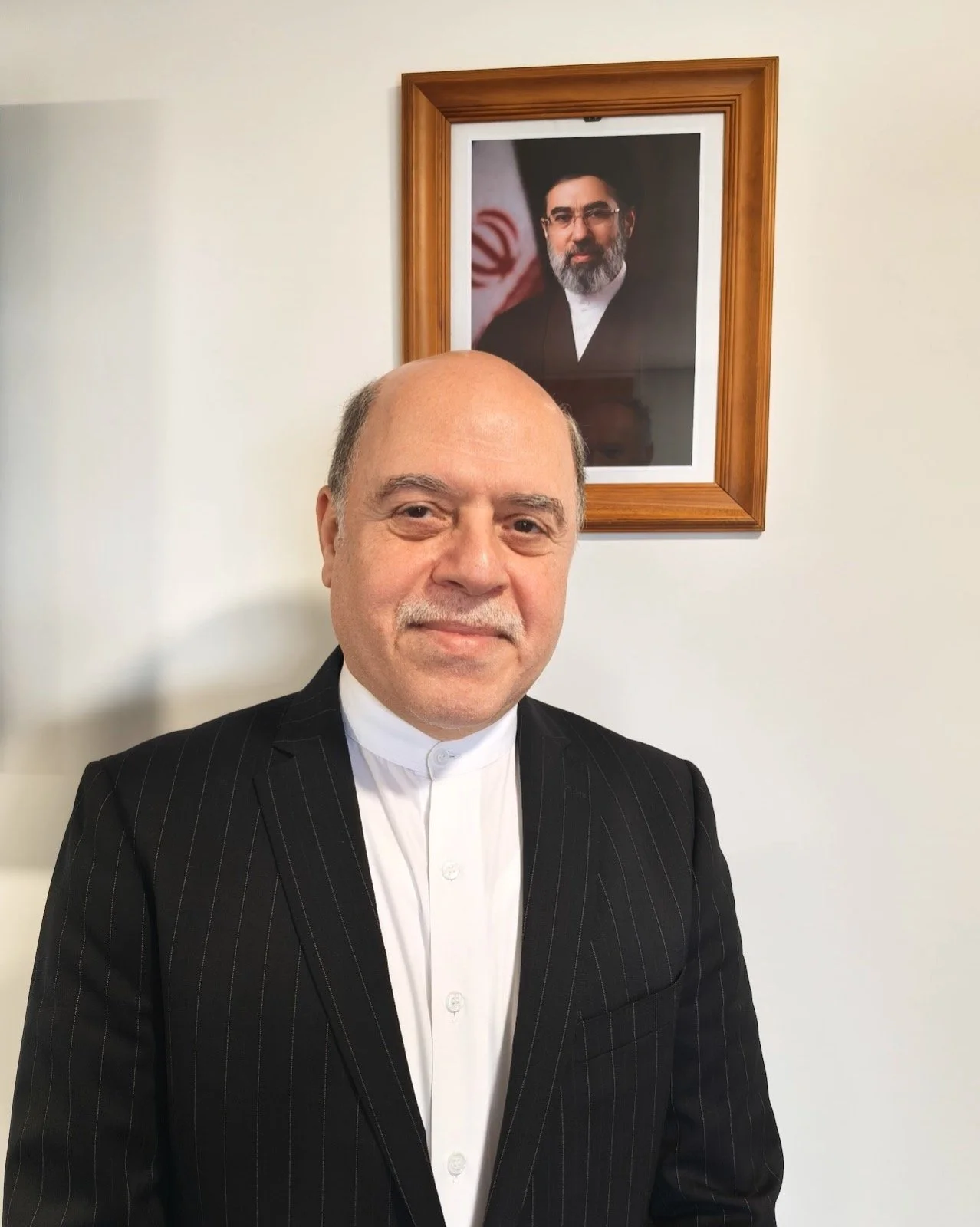
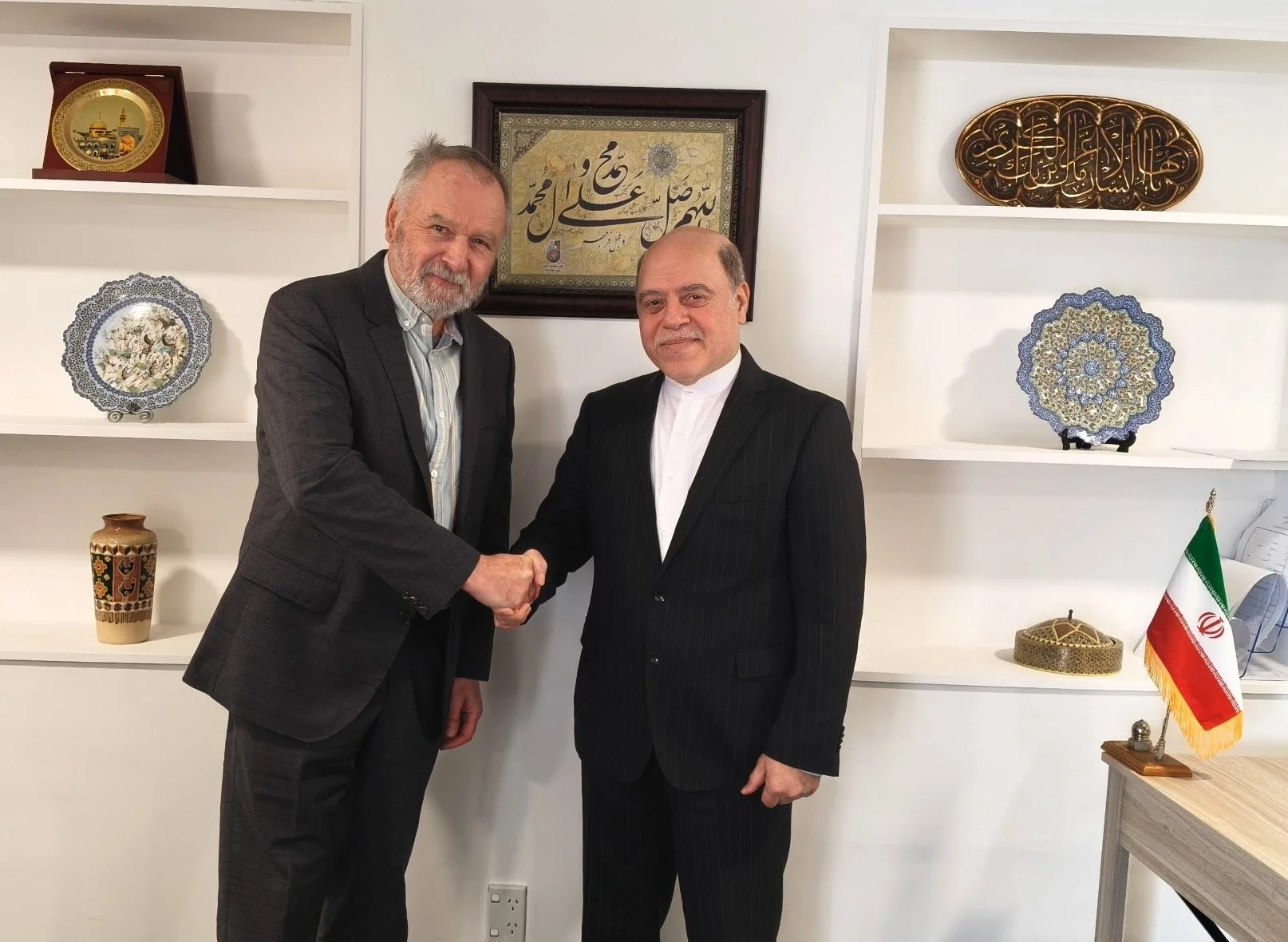
In this interview with His Excellency Reza Nazar Ahari, the Iranian Ambassador to Wellington, we discussed the war, the state of diplomacy with the West, issues of sovereignty, defence and the internal politics of Iran. He provided some fascinating analysis into why the Western strategy on Iran has been so disastrously flawed.
The US has stated many objectives, many reasons for launching the war. For Iran, what is at stake?
The Americans have come to take control of all things in Iran – not just the oil of Iran and the land of Iran, but to take control of Iranians’ own identity, our independence and our way of life.
President Trump said once during the war, “a whole civilization will die tonight, never to be brought back again”. In spite of having suffered enormous damage and paid a heavy price, Iran has to defend itself because otherwise there will be no Iran.
Especially in the West, the way to eliminate your enemy is not only by hard power, by artillery, by guns. There are many other means: by the media, by demonising, by culturally attacking a country, by imposing sanctions. In the last decades we have been under all of these types of attacks. We are one of the best in the world in knowing how to counter all of these attacks.
What we’re seeing from Iran is you are very powerfully standing up for Iranian sovereignty in the face of an astonishing assault.
National identity is the main asset of any nation and it should be studied first. When President Trump said, “Iran must unconditionally surrender”, it suggests he has not read the history of this nation. Surrender is the worst thing for us. It’s the same with calling for zero enrichment, giving up our missiles and our allies – they don’t understand the identity of the Iranian people. We fought against Saddam Hussein for 8 years to ensure we did not lose a centimetre of our land. When you don’t understand things like that, it can cause many mistakes, as we have seen.
This brings us to the important role that diplomats and analysts should play in helping foreign states understand the unique culture, political dynamics, and so on, of a country.
When you look back a century, when the British Empire wanted to have influence in our region, they sent their scholars, their scientists, their researchers to our countries. They lived with us, and understood the identity of the people. I’m not arguing about bad decisions or good decisions, but the decisions were always made through that very close study. Today “expert” Americans just sit at their desks looking at the internet without knowing what happens in the heart of Iranians, in the mind of Iranians.
What you are suggesting is that an at-distance unfamiliarity with Iranian culture has led to strategic blunders that have hurt not just Iranians but Americans and the West.
Exactly. Americans started their war against Iran on the basis of what they did in Venezuela, and also what they were told by Israelis – “You target this, you kill these people, and all the people will come out to change their government.” It was very simplistic, very superficial, which helps explain why they failed.
Another mistake by Americans is that they think they can solve their problems with guns and missiles. They think that solves all problems, without the need to rethink, to analyse and to take a more profound approach.
How should the war launched by the US and Israel on 28 February be viewed through the lens of the United Nations Charter and its core principles, for example, the prohibition on the use of force and the respect for the territorial integrity of states?
There are obvious positions stated in the Charter of the United Nations that when a country is attacked or invaded by any country, it is the responsibility of other countries to condemn the attack and to help to stop that. New Zealand did so in the Russia–Ukraine case. It immediately condemned Russia and imposed sanctions. However, when it came to Iran, there was no condemnation of the United States or the Israeli regime, nor were any sanctions imposed on them.
In the case of Iran, some countries even expressed positions in support of the aggressor rather than the country that had been attacked.
The West loves to talk about the international rules-based order, but as you said, we seem to be moving to the rule of the gun which is a tragedy for all of us. What would your advice be to medium-sized powers like New Zealand? How should they respond to that situation?
It is strange if a country – any country – makes their policies exactly like a country on the other side of the world just because they are allied nations. I believe each country should live according to their identity, not according to their alliances.
Each country has a unique identity, has unique geography, has unique capabilities, unique history, and according to them they should identify their unique foreign policy.
When we looked back in time at New Zealand, we found a sense of independence, making your own identity. In the past, for example, I think New Zealand very correctly believed that no nuclearisation should happen around its waters from both an environmental and from an international political point of view.
What is your rapport with the Ministry of Foreign Affairs?
Actually, it was strange to me, because after the US broke the ceasefire, the Ministry of Foreign Affairs called me in. When the United States attacked Iran, they didn’t call in the American ambassador; they called me in! But it was an opportunity for me to explain the reason for the recent developments in the Persian Gulf and the Strait of Hormuz.
Your posting here may finish at the end of this year. Any regrets? Any final impressions?
I actually love New Zealand because it gave a very peaceful experience for me and my family. Definitely when I leave New Zealand, I will miss this country and its very good people. I have one regret in regard to my time in New Zealand. I tried but I failed to encourage a think tank in international and political affairs, a space for very serious but informal dialogue with scholars focusing on the Middle East region, diplomats, foreign policy people. This is called Track Two Diplomacy – it is very active in many countries, including Iran. I would encourage something like this in the field of international relations and diplomacy with Iran.
Eugene Doyle
Eugene Doyle is a writer based in Wellington, New Zealand. He has written extensively on the Middle East, as well as peace and security issues in the Asia Pacific region. He hosts solidarity.co.nz.
This article may be reproduced without permission but with suitable at
His final point is worth serious consideration: https://modeldiplomat.com/learn/glossary/track-ii-diplomacy
This operating format uses network theory: weak ties at the margins apply optimal leverage on change. You can reframe this as bottom-up self-organising capacity, so it is Deep Green. Yet since geopolitics is driven by top-down inertial systems any organic function must rely on collective resonance to cohere folk into sync. We have no cultural shared history with Iran so must rely on some kind of pan-cultural framework as a basis for grasping potential mutuality. Collaborative peace-making is a way into ethos.
What a golden opportunity to inquire why Iran has been financing the terror groups Hamas, Hezbollah, and the Houthis for the past 47 years.
Or ask him anything about Iran's treatment of women, gays, Christians, Sikhs, Hindus, or who ever protested against the state, all other Muslims, the disabled, and the mentally ill.
A great moment to ask his government to release those being tortured.
Hopefully Mr Doyles next interview is with Amnesty International.
We already know that!
Noting that totalitarian, failing, and/or repressive Governments often start wars to unite the country against a common enemy, and take the focus away from their own Government.
Trump oblidged for the Iranian Government, just as Argentina did for Thatcher, while trying to prop up their own, internal support
Now. Iran is even less likely to get better Government.
Colonial powers have always labelled anti colonial resistance as terrorism.
https://aboujahjah.substack.com/p/vichy-in-beirut
Thanks for the wee history reminder.
"A terrorist is someone with a bomb that doesn't have an airforce." I heard that first from Michael Franti.
A very flawed analogy.
The proxy fronts of Iran in Yemen, Lebanon and Iraq do not serve the people of those nations and their cause in any way. They are undermining national sovereignty to serve an imperial cause – which is the IRGC reason for being (one that places Iran under a theocracy – and defines the the nations cause as the Moslem end time mahdi one).
The terrorist designation is a statement that an armed group is using violence without being a nation state actor. A nation state confronting the violence or the international community noting the source of extra-territorial violence against a nation state (or nation states) is what it is.
Associating the actions of Iranian proxy's with those of liberation movements is dubious.
Sorry but Iran has not invaded Lebanon. It has supported its independence struggle against Israeli, US supported, occupation. It is the occupiers that are the invaders. Positing Iran as the imperial invading force is ludicrous.
The right to self determination has the corollary of the right to resist occupation. these rights come before any concept of the state and no state can extinguish these fundamental rights of indivduals or groups.
https://aboujahjah.substack.com/p/vichy-in-beirut
A number of governments of Lebanon have called for Hezbollah to be disarmed many times over the years.
The government of Iraq is now calling for its Shia militias to be disarmed.
The recognised government of Yemen has the same right as the one in Syria (which asked Russia to assist it fight off rebels) to seek assistance against the Houthi, whether from Saudi Arabia, or any other nation.
Iran is not fighting to liberate Palestine, it is fighting to end a recognised member nation of the UN – a breach of the UN Charter. And apparently aiming to be some hegemon in the Gulf charging shipping.
I understand that its difficult for you to accept the legitimacy of Lebanese resistance to the Israeli occupation since acceptance completely blows away your house of cards. However, It is not possible for the collaborationist Lebanese government to legislate away the right of Lebanese to resist Israeli occupation and to choose the form that resistance takes. Perhaps you should re read the last paragraph of the above quote?
I appreciate that this probably does not fit comfortably within your reflexive anti-imperialism. But again: imperialism by whom, exactly?
Iran is funding, arming, and directing a non-state militia that claims the right to override the institutions of another sovereign country. Simply labelling every Lebanese institution that resists Hezbollah as "collaborationist" does not answer that problem. It merely assumes that Iranian-backed coercion cannot itself be imperial because it is conducted under the banner of "resistance."
The argument then becomes completely circular: Hezbollah represents the Lebanese people because Hezbollah says it does, while any Lebanese institution that disagrees has betrayed them. In other words, the Lebanese people are sovereign only when they agree with Hezbollah.
That is not self-determination. It is a permanent veto by one armed faction over the political choices of the country it claims to be liberating. Once a militia claims the right to use force against its own state to impose its preferred political settlement, the distinction between legitimate resistance and coercive political violence becomes very difficult to sustain.
The right of peoples to resist foreign occupation does not automatically become the right of one of many armed factions to decide, indefinitely and by force, the political future of the nation it claims to represent. That is especially true when the elected government, parliament, and many other Lebanese political actors reject that claim.
Self-determination belongs to the Lebanese people as a whole. Not to whichever faction possesses the greatest military power or has the best anti-American/Israeli street cred.
All groups in Lebanon disarmed when asked by the government decades ago, bar Hezbollah.
It remained armed in the years without any IDF occupation, it incites the return of the IDF by firing missiles into Israel – to do what, justify its claim to be necessary for the defence of Lebanon?
Hezbollah is the Iranian front based in Lebanon, doing what the PLO wanted to do there after being kicked out of Jordan (for trying to take over the government) fight the Israeli state (that Iran wants to end).
Its work for Iran included defending the Assad regime in Syria.
As for a real occupation of land of Lebanon, Syria used to occupy the Shebaa farms (as part of their Golan Heights region).
Israel now occupies this area via occupying the Syrian Golan Heights since 1967.
Its claim of annexation is not recognised. Hezbollah has not fought Israel for the Sheeba Farms.
Interesting interview, and I have no objection to hearing directly from the Iranian ambassador. Diplomats exist to explain and advocate for their country's worldview, and understanding how Iran sees itself is genuinely important for anyone interested in international relations.
What concerns me is the lack of critical scrutiny.
Many of the ambassador's points deserve serious consideration. Western policymakers have often underestimated Iranian nationalism, misunderstood the country's political culture, and overestimated the ability of military force to produce political change.
But those observations don't relieve Iran of the same scrutiny we apply to everyone else.
The ambassador speaks passionately about sovereignty and non-interference yet represents a state that has consistently projected influence throughout the region by supporting and arming non-state militant groups. He condemns external coercion while his government exercises coercive power beyond its own borders. He invokes international law abroad while the regime he is a member of faces well-documented criticism over its treatment of political dissent and civil liberties at home.
None of that makes US or Israeli military action legitimate or acceptable. States should be judged by the same standards regardless of who they are.
That's precisely why I found the interview frustrating. Good journalism doesn't simply provide a platform for a government's preferred narrative: it tests it. It asks where principles and practice diverge. It explores contradictions. It challenges assumptions.
That standard should apply whether the interviewee is an Iranian ambassador, an American general, an Israeli minister, or a Chinese diplomat. Understanding another state's perspective is valuable. Accepting its framing without rigorous examination is not.
That standard should apply whether the interviewee is an Iranian ambassador, an American general, an Israeli minister, or a Chinese diplomat. Understanding another state's perspective is valuable. Accepting its framing without rigorous examination is not.
If Eugene wants to be taken seriously as a commentator on international affairs, he needs to demonstrate that same intellectual rigour. That means engaging critically with the evidence, challenging the claims of all sides, and being willing to follow the facts even when they cut against a preferred narrative.
intellectual rigour
I agree that such mental enterprise is helpful, whilst noting a general tendency toward aridity in the application. Aeshetes freak out at any hint of ascetic attitudes.
Could be Eugene is an empath. If so, he is guided by emotional intel instead of reason. Such folk use an operating stance of open-mindedness, despite the natural tendency of the ambience to waft in passing thoughts. Distraction can become endemic.
Your point about framing can be embellished by reframing diplomacy. It now requires competitive framing, to be done as performance artistry. Yet the kiss principle applies, so the simpler the better is a constraint upon biological signalling complexity.
The constraint upon biological signalling simplicity comes from several factors usually being most salient in any situation or topic. Severality is thus emergent via the goldilocks principle (3) but ecosystemic grounding in context is essential to form systems (4). These numbers make most of our world work the way it does.
So for diplomats, you must transcend the binary via medial relating, then anchor into geopolitics via topic context. It would help to generalise this into diplomatic praxis.
I don't disagree that empathy, framing and context all have a place in diplomacy. In fact, understanding how other actors see the world is often essential.
Where I'd differ is that I don't think those things replace strategic analysis—they support it.
For me, the central questions are still: What are the state's interests? What outcome is it trying to achieve? What resources does it have? And does its diplomatic approach actually advance those objectives?
Good diplomacy absolutely requires understanding people. But it also requires intellectual discipline. Otherwise it's easy to mistake understanding an actor for agreeing with them, or an elegant narrative for an effective strategy.
Ultimately, I judge foreign policy by outcomes rather than by the sophistication of its framing.
Yeah, sensible, can't disagree with any of that. Yet when states are so little-linked, personal chemistry between their reps can alchemise situations nicely.
We can readily use intellect to specify state interests in geopolitical contexts, yet there's a bit of a paradox when you consider that specificity must be generalised somewhat to encompass a variety of interest-groups, sufficient to get most folk on board – rather militating against nuance!
Severality features in mutual-interest situations: a state has sovereign interests and common interests simultaneously, when genuinely representative of members. Diplomatic alignments & global trade extend state interest toward multiple optionality via liaison. The Commonwealth has long been a basis of geopolitical reliance and operation for us. So medial systems link state interests to scale up influence, and skill-sets that weave collaborative endeavour accordingly bridge 1 state to several, and then to many via networks of influence. Your final point re outcomes is contingent on framing usage (oft psych warfare)…
From the brilliant , inimitable and very courageous writer Arundhati Roy:
https://zeteo.com/p/iran-is-not-gaza-read-arundhati-roys?utm_source=publication-search
Thanks for the exchange, it is refreshing to hear about these events from a different lens.
As is stated above, "Understanding another state's perspective is valuable. Accepting its framing without rigorous examination is not." Unfortunately every news cycle, the 6 pm news bulletins and print media repeat the US view of events.
Too many of our pollies, especially those 'in charge' are incapable of criticism and their silence implies our consent.
This contributes to the stark contrast of what this ambassador has to say.
I would look forward to hearing the US ambassador called in, taken to task and have his government's actions tested, and challenged.