The left bloc and polls
Labour was polling strongly earlier in the year, before a Curia-Taxpayers Union poll showed a stark, non-causal reversal, with those headlines echoed across all media outlets, and setting off a trend of falling opinion polls.
Newsroom has explored how unscientific polls can. and are, used to manipulate voter perception, but at this point, it is neither here or there.
i.e. It is done.
Some of Labour’s pain is certainly self inflicted, but a lot of it is due to the nature of media coverage in the country.
Take, for example, former Newstalk ZB Political Editor and now 1News Business Correspondent, Jason Walls’ business reports. For months, Walls has told Kiwis it’s the oil crisis that is the primary reason for one of our largest economic downturns in recent history.
The truth is the economic news story had been very depressed before that, with Treasury downgrading economic forecasts in consecutive quarters, as the videos below show.
We’ve also seen 1News put the public health crisis down to “successive governments” this month, omitting key facts, including National’s hiring of only 54 FTE nurses, the frontline hiring freeze, the $1 billion plus in public health cuts, and significant privatisation of our health budget.
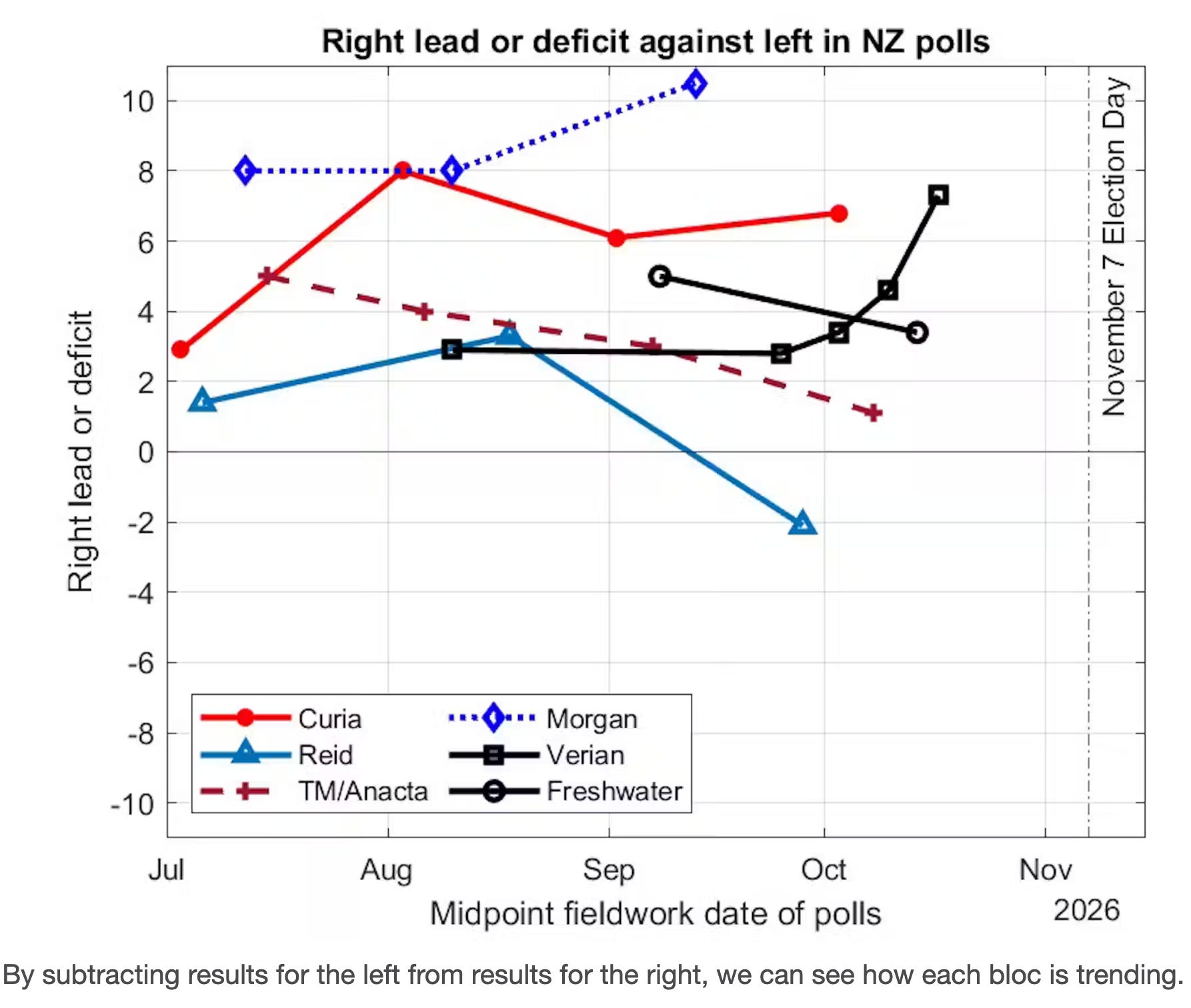
Still, the political position is clear –
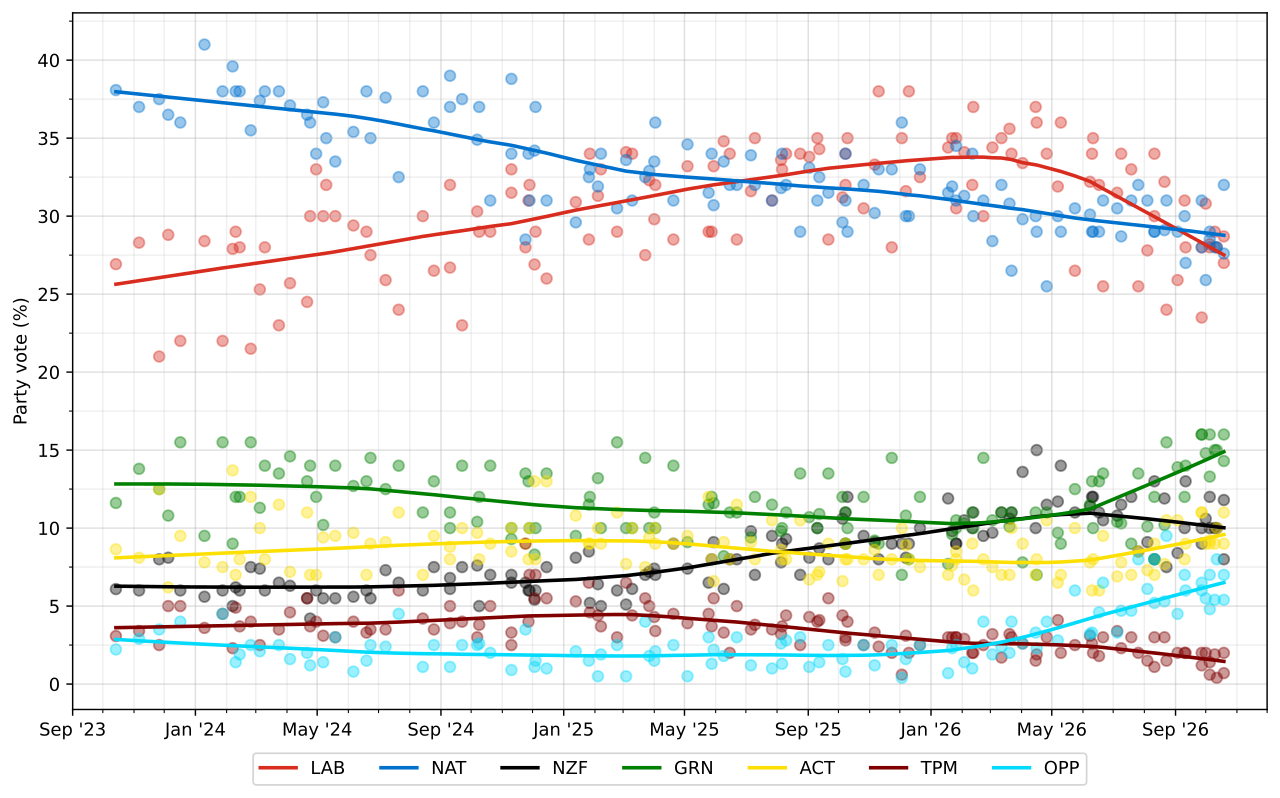
Despite the significant surge in Green Party popularity recently to ~16%. the left bloc cannot win without Labour also winning the most electorate seats.
Why?
The wildcard
That is because of the Opportunity Party, which has not only split the left vote, but has chosen a unique calling card approach.
It will try its best to form Government with whichever major party has the most electorate seats, which on current trends looks increasingly to be National, and therefore, along with them, ACT and NZ First.
On current polls, a win for the left bloc is looking increasingly out of reach, although still within the realms of possibility.
Touted as the new, potential “Kingmaker” of New Zealand politics, the party have usurped the title from New Zealand First, after Winston Peters ruled out1 working with a Hipkins led Labour Government.
Hipkins did the same in August 2026.
By the way, Winston isn’t going anywhere. At 8-10% of the electorate, NZ First is still assured of a place in a National Party government. 2

Opportunity is viewed, legitimately, by both right and left, as a wildcard.
Will Luxon work with Opportunity?
For months, Luxon has claimed he will “never” work with Opportunity, a claim viewed with intense skepticism by many, including Opportunity leader Qiulae Wong.
‘He will pick up the phone when he needs us,’ she mused at one point, before telling Ryan Bridge this month that she will call Luxon herself if National win the most seats.
Whichever major party has the highest number of electorate seats is who Opportunity will seek to form government with That is determined by party votes in the election.
Last week, David Seymour also changed his tune on the Opportunity party, saying he would welcome them to the fray if they got over 5%, and that working with Opportunity would be a “good outcome” if it stopped Labour from forming Government with the Green Party.
On the same day, Luxon told media he would work with “whoever I have to” to ensure a second term of Government.
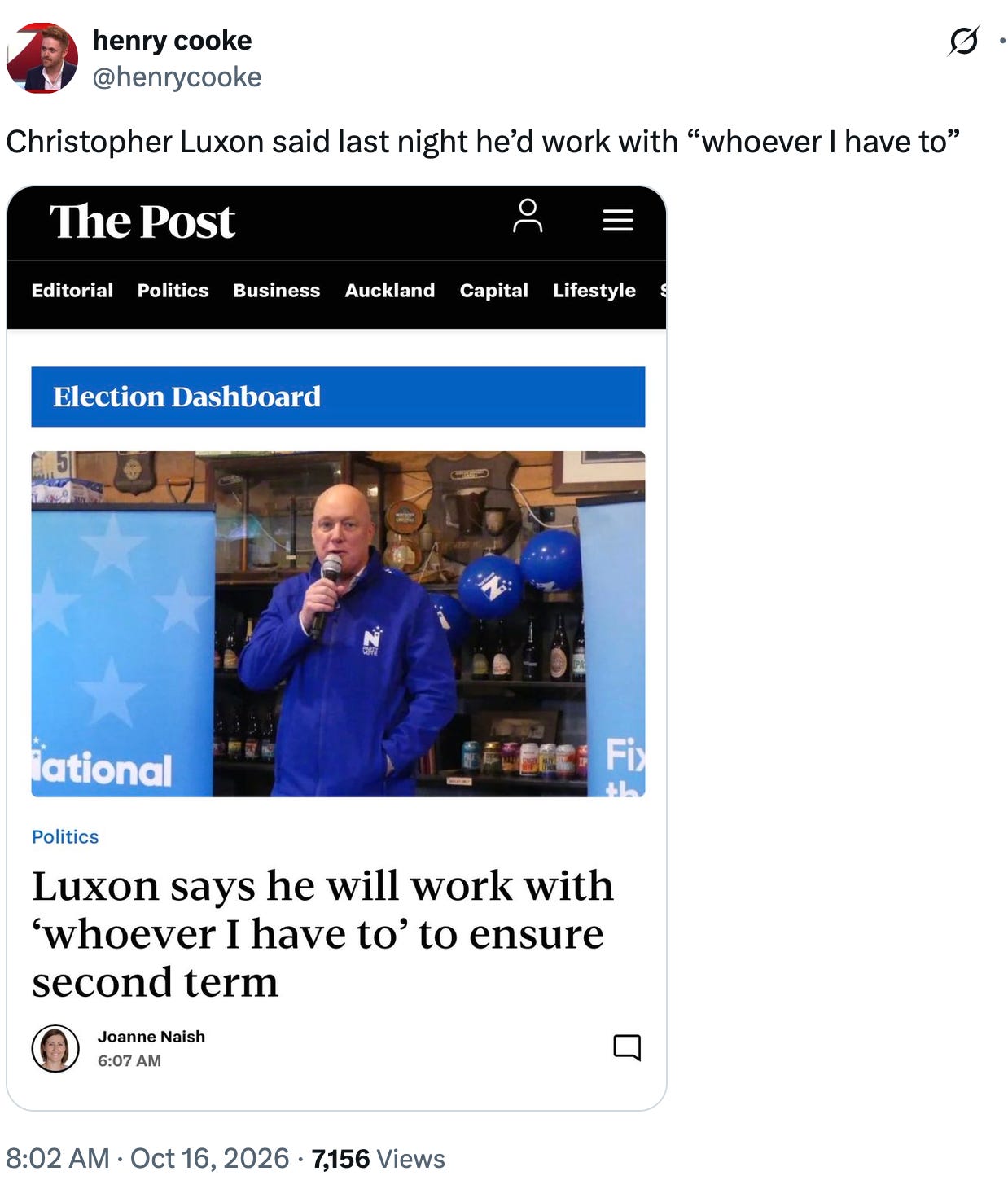
Headlines to that effect were released the next morning, before the PM’s Press Office walked it back.
They claimed Luxon meant NZ First, and ACT, but that doesn’t pass the sniff test – the three partners have worked with a cohesive electoral partnership approach, and they have publicly signaled their collective collaboration.
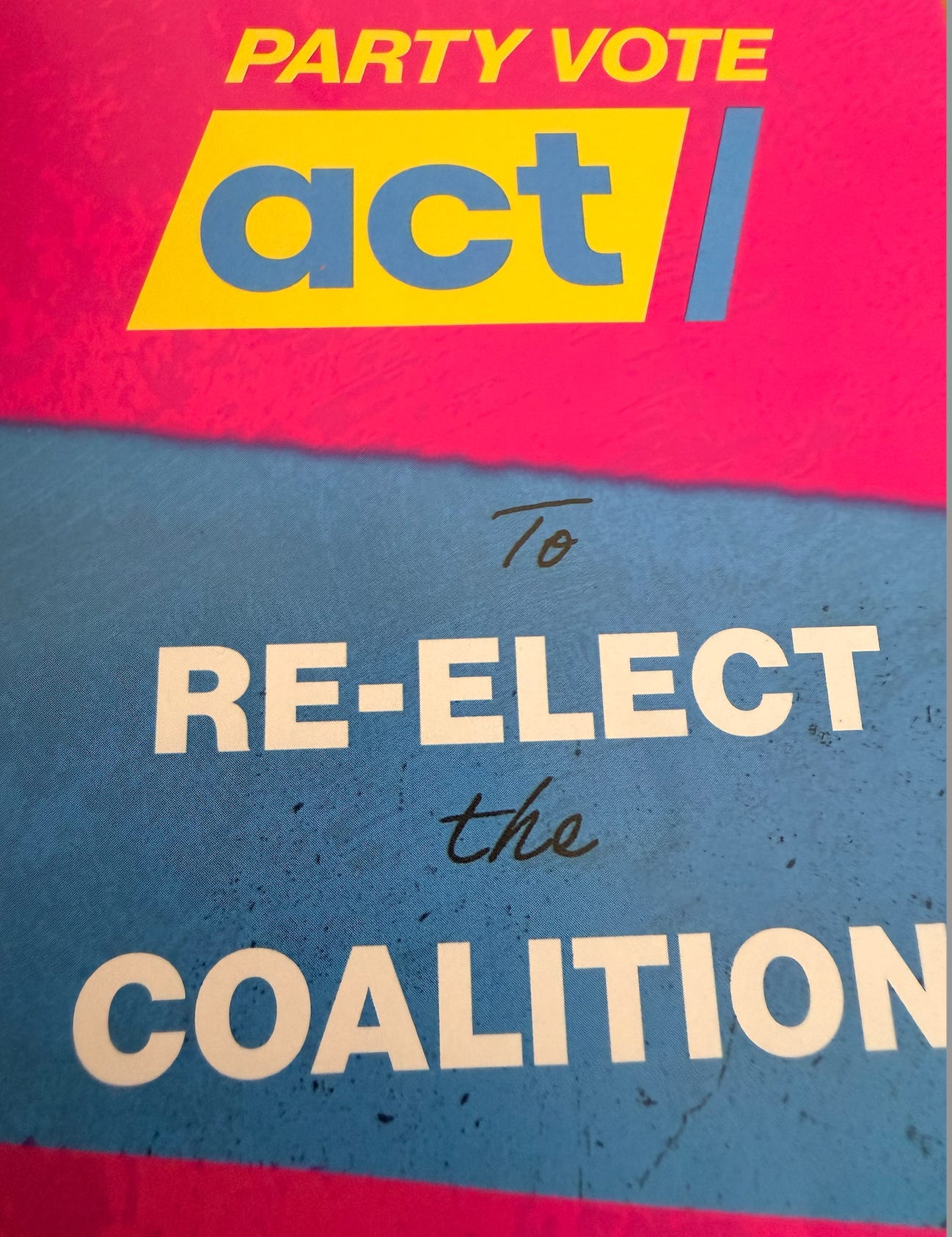
It’s a smart strategy by Luxon because it keeps National Party voters onside and as promoted by Luxon, to “two ticks National” to increase National’s party and electorate votes.
Opportunity’s strategy gives a leg up to National
And it is the topic of strategy that brings us to the fundamental weakness of the Opportunity Party for those not looking to reward Luxon, Peters and Seymour with another 3 years in power.
Qiulae Wong has confirmed she will do her best to work with whichever party has the largest number of electorate seats,.
And that can only mean National or Labour
And on current polls, it’s National.
Combine that with National’s voter suppression law, that is seeing 1 in 3 young people potentially ineligible to vote on election day, and, according to Bernard Hickey, could see 80,000 Kiwis stripped off the roll compared to 2023, the right’s chances are increasingly climbing.
As Chris Bishop admitted to Jack Tame on Q&A, this voter law should give National two extra electoral seats.
In such a tight race, 2 seats is everything.
What are the potential scenarios at play?
Qiulae Wong has been at pains this week to say that there is no forgone conclusion, despite OP’s approach to forming Government, should they pass the 5% threshold.
There are a number of potential scenarios that could occur:
- National secures the most electorate seats. If National needs Opportunity (OP) to achieve a majority, government, the parties successfully negotiate a Coalition agreement, along with ACT and NZ First – forming NACTO1. At this point, and if we take Wong’s words on face value that she will negotiate in good faith with whoever wins the most seats, and she is happy to go either left or right, this has an 80% chance of happening.
- National secures the most electorate seats, but Qiulae Wong walks away from Coalition talks after being unable to form agreement on key policies. This would hurt Opportunity’s standing among its right leaning voters, of which there are many. This has a 65% chance of happening
- National secures the most electorate seats but remains unwilling to work with OP in a Coalition agreement. Instead, Luxon chooses to work with Opportunity in a supply and confidence agreement basis, leaving OP out of government but with the right still firmly in the drivers’ seat. OP would have helped weaken the left’s votes and can now be trusted to want to drive policy as a partner. 75% chance
- Labour secures the most electorate seats. Labour, Greens and Opportunity work together to form and establish a Coalition government, allowing Qiulae Wong and her party to rise to increasing prominence in Kiwi politics. Given current polling stats, that probability is 15-30%. Should Labour party votes increase significantly, that probability rises to 85%
- Opportunity fails to meet the 5% threshold. Thousands of votes would be wasted and the 40% of left leaning voters supporting them would have wasted their vote.
So, is Opportunity a “Trojan Horse” Party?
There appear to be a number of passionate, and genuine supporters in the party who see the party as offering a “fresh, new” way of doing politics.
Many of those are disillusioned with the major parties and hope OP will offer an alternative model from which the country can reclaim its “better days” (the irony being of course that New Zealand came out of Covid-19 with some of best social, economic and health outcomes in the world, and yet Kiwis saw themselves with such negativity. And that on objective metrics, Ardern’s Government performed very well)
However, as Russell Brown recently wrote, the party is also “messy” and a “toxic culture and power struggles” aired in other recent reports come as no surprise.
I’ve recounted the stories of how many credible political commentators, including Brie Elliot, have come under attack from Opportunity Party members and Board members, for merely critiquing their policy.
Such inability to handle critique and/or question is a sign of a nascent party filled to the brim with defensiveness and which finds it hard to accept questions.
I’ve also seen first hand the type of supporters that the Party attracts and the ease with which they, including MP candidate and executives, have chosen to mislead.
And, using internal party communications boards, they actively “swarm” i.e. brigade internet channels and personalities critical or even simply skeptical of them, with a fervour and rabidity that speaks to a lesser level of maturity.
Perhaps maturity will build, perhaps it will not. Time will tell. Sean Plunket was once a member. Now he is not. Same as Gareth Morgan. The party is highly fluid and its choices dictated by the present leadership team, of which Qiulae Wong is but one.
Ultimately, for now though, it is the presentable and pleasant Qiulae Wong at the helm, and should the party cross the 5% threshold, she will be at the forefront of the party’s voices.
And I do believe Wong believes in what she says. The issue is her party and the layers underneath that, but that is an Opportunity Party issue ultimately, and so one we will have to accept in its current phase of maturity.
They are ultimately a Trojan Horse for having hinted to the left, at least online, for months now, that they prefer the left, while signalling the same to the right leaning voters.
Chameleons change spots – so as long as you know what you are buying, both above, and under the covers, so be it.
It’s a fair play by the Party in that regard. And the time is ripe for their emergence as Hipkins and Luxon both remain relatively unpopular
A note to the left
Ultimately we will have to accept whatever outcome ensures. And accept it with grace.
The electorate is a large field, and the power of populism, media coverage, money difference, power differential, misleading advertising, and appointed media executives by the Coalition, means that the left will always be at a disadvantage.
This election is predicated on swing voters, not left or right voters alone, and it is this group that is also least likely to have the details on hand, and rely primarily on impressions and headlines.
And in that regard, National are on top.
I think we walk tall regardless because ultimately life throws curveballs, and it’s up to us to play them with our best hand available.
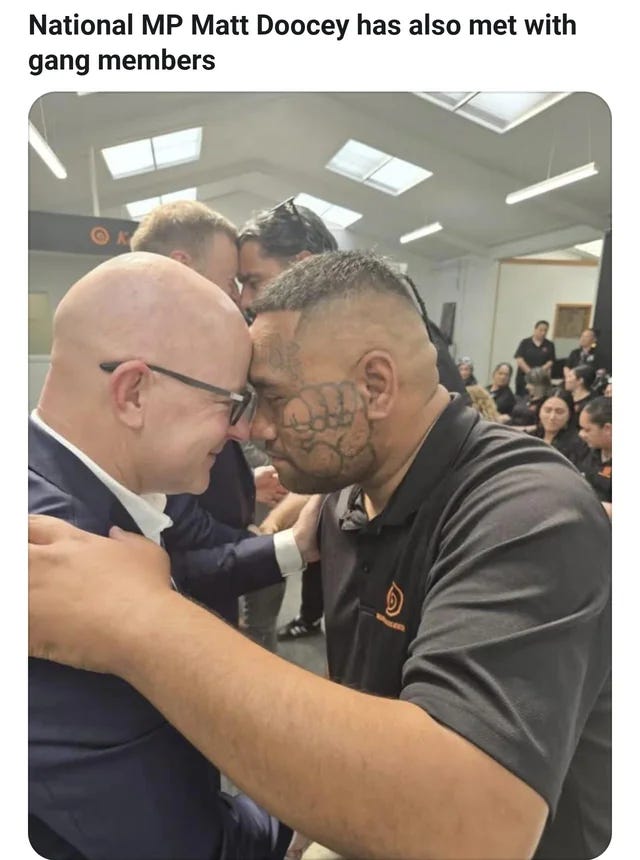
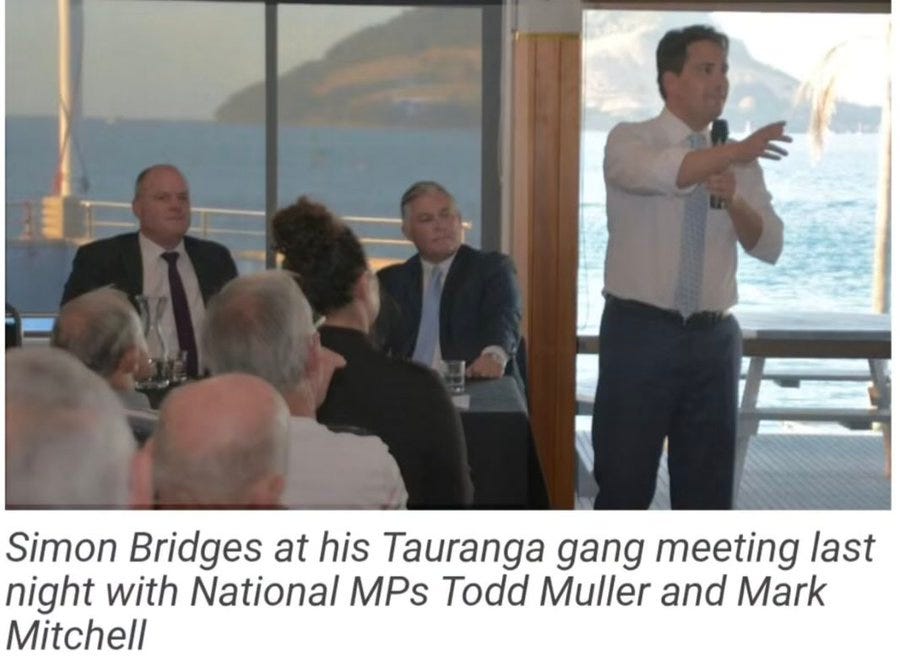
PS On the “Gang” furore
Is this what media really want to focus on in the last days leading up to the election? The answer could be “Yes”.