
We don’t, but we should, because if we don’t we will destroy the things that our existence depends upon.
The limits to growth here refers to biophysics not human society or endeavours, although the point is the latter are constrained by the former.
There are always limits to growth, because we have a finite land base and a mostly finite resource base. Sunlight being an obvious exception, but the ability to harness sunlight using high tech is limited. Using natural cycles eg plant photosynthesis is for all intents and purposes unlimited eg growing a forest for food and to sequester carbon.
The need is to shift from a perpetual growth paradigm, because sooner or later we will hit limits that kill us, to a circular paradigm based on renewable resources and integration of waste into natural cycles.
Doughnut economics is one model that places humanity within ecology, and finds a way that we can have wellbeing over the long term. Developed by renegade economist Kate Raworth, it places two key concepts in the model – the boundaries of ecological ceiling and foundations of human society – and suggests how they can co-exist regeneratively over the long term.

It also shows what happens when we transgress those boundaries.

So what’s the big deal? Can’t we just adapt to those big red flags? Or if all else fails, go to Mars?
Everything we do that relies on physical space and materials comes from nature. For example, if human-induced colony collapse disorder reduced the honey bee population too far, and we no longer had sufficient mass pollination of crops, we would have mass starvation and economic collapse. The artificial bee drones some people think will work instead are manufactured via a long chain of resources that is utterly dependent on the physical world. Think cradle to grave materials and engineering, including energy (at this point mostly from fossil fuels), human resources (which need another whole set of resources to support them), and what to do with the waste and pollution generated.
Even if that worked materially and economically, we also have to factor in time. Can we produce enough in time? What happens to that timeline if there is another pandemic, major war, or global financial crisis? What is involved in transporting and repairing and replacing the drones? I’m pointing here to the inherent precarity in silver bullet solutions rather than ones based in sustainable systems.
I used the bee example for three reasons:
- colony collapse disorder is already a significant problem
- we have a tendency to think the best solutions are more complex tech rather than ecological and systems based
- there are indeed viable ecological solutions (that’s the good news: we already have on the ground regenerative agriculture and ecological restoration systems. The kind of land use leading to CCD is not our only option for food growing)
We are all socialised to believe that humans are special and will endure if we just find the right tools. The Limits of Growth report in 1972 outlined that the economic tools we were using were going to cause problems, and fifty years later it’s been proven right. Doughnut Economics gives us a different set of tools for managing human societies, ones that won’t in the end destroy us.
Here’s how New Zealand was doing during the last Labour government,
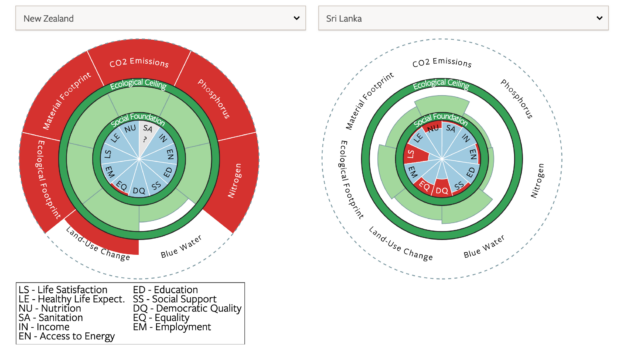
I’ve written more in depth about Doughnut Economics in Budget Day: there are real alternatives and other posts.
here's the graph generator for comparing the social and planetary boundaries of different countries
https://goodlife.leeds.ac.uk/national-snapshots/countries/#New%20Zealand
The short answer to the question is yes, but only if sensible risk management is prioritised by everyone, and since being sensible is merely a sporadic strand of human nature, many opt out instead. Since leftist and rightist neolibs are the primary blocks preventing progress, comprehension of Raworth's view by those people depends on how much (metaphorical) whipping they must be subjected to get them up to speed. Too bad Rod Oram died and we have no other economist leading the Green interface.
UK neolibs will be thrilled by such high ratings! Ranking is everything in the thinking of the establishment. As long as faith in the market persists, normalcy will prevail as the mass state of mind. To do a paradigm shift away from neoliberalism we need a succinct prescriptive list of principles to present as the new paradigm. We knew that in the Greens economic policy working group and discussed proposals extensively more than 30 years ago: you'll have to ask the Greens in parliament what happened next…
agree that the biggest challenge is getting the neolibs to think differently. Not just the politicians and economist's but the voters. Thing I notice is the lack of engagement with the evidence. It's a very strong ideology.
The short answer is yes (with no 'but') because there is no alternative for long-term human survival.
At the present, we (the technologically 'advanced' societies of the world) are consuming more and more energy from all sources (combustion, wind, solar, tidal, etc). And to do what in the long-term?Create weapons and fight wars by destroying the 'enemy's' civilisation and resources? Implement more technology and accelerate the consumption of resources? Research ways to create a 'home' for some humanity on Mars, even though we can't stop destroying our home here.
We're also destroying the natural infrastructure systems that maintain our air, food, water, climate, etc in ways that we don't yet fully appreciate. The result is an increasing need for technological solutions (fertiliser, water, and distribution systems) to feed everyone.
The ultimate idiocy is the use of energy (even solar) to remove CO2 from the atmosphere instead of using it to reduce the production of CO2. Prevention is always preferable to cure.
Note that the question of whether a system is sustainable depends on the defined criteria for the system. For example, a human population of 1 billion living in small enclaves of fertile land with minimal technology might be sustainable, where 200 million with a 'high' level of technology may not. The answer is either yes or no – 'more', 'less', improving' sustainable is still "not" sustainable.
TINA as framing only works for reasonable people who focus on reality. They are always out-numbered by the majority who get off on fantasy way more. Its why even the Greens in parliament don't use TINA as framing. Democracy constrains.
A timely question – for many decades now. While many individuals and groups respect spaceship Earth's limits to growth, evidence indicates that humans in toto have not and will not respect planetary boundaries voluntarily – the attention of movers and shakers being laser-focused on short-term windfalls afforded by on-going disrespect for limits.

This disrespect is exemplified by our CoC government's "Going for Growth" slogan, and why not – after all, we have a Minister for Economic Growth.
"Most indicators are for the year 2011", which is the most recent year for which most indicators were available. The NZ picture is unlikely to look any better now, or during the last Labour government.
Here's a link showing the trends for NZ from 1992 to 2015 – not a pretty sight.
https://goodlife.leeds.ac.uk/national-trends/country-trends/#NZL
The NZ trends in Phosphorus and Nitrogen indicators are "?" because values for these indicators are absent in the underlying spreadsheet data, and I don't understand why – NZ's known Phosphorus and Nitrogen levels being well over the per capita boundaries in 2011 (as shown in the last diagram in the post.) The Trend spreadsheets for most other countries show values for these indicators.
Humans are not! respecting limits to growth.
Current Goverments, such as our own Coalition of Cockups, are busily reversing the already inadequate attempts to do something about AGW.
Politics – Carbon News
With adaptation intended to protect the wealthy, such as insurance company and bank shareholders at the expense of those who cannot adapt.
A warning from the future: the risk if NZ gets climate adaptation policy wrong today
Another example of socialising losses, while those who caused it, such as oil companies and "kick the can down the road" Governments and their supporters, escape paying for it.
The euthemism, "Climate Change" is part of the tobacco company like attempts to downplay what is happening. It is AGW, Human caused Global Warming!
The Limits To Growth was great for showing so many different systems were interrelated, and showing that accelerated human development also meant changing the world faster. But that's it.
It is self evidently true that "humans are special and will endure if we just find the right tools" for about the last two million years. For the most part we really do find the right tools to fix everything, and we have:
– In 1820 about 75% of the world was in poverty, and it's down to just over 10% now.
– In 1840 when this country started there were no global institutions or rules of any use, and in the last century we have formed massive global systems that worked really well and for the most part still do.
– Global deals like the Antarctic Treaty System which includes bans on mining and heavy controls on fishing, global controls on CFCs that were damaging the Ozone layer but are mostly good now, the Kyoto Agreement and Paris Accord, and bunches of others like the CPTPP, are holding up
– Market forces like the switch away from combustion vehicles (in China for example they will get to 100% BEV by 2030 far faster than anyone thought and a full BEV national fleet in about 10 years after that), and decreased reliance on coal for electricity generation, are changing the world for good and permanently
– World populations outside of sub-Saharan Africa are either plateauing or in rapid decline, and I sure am looking forward to a robot pulling me up out of bed in the morning rather than a minimum-wage worker. WE're on track to peak at 10.2 billion and track down after that.
The one thing little old New Zealand could do to become more balanced is to get rid of intensive dairy farming, but since it's the only large industry we've ever had and the only one we are globally useful at to pay the taxes that keep us in biscuits, it's going to stay. Sure, keep the pressure up but don't dream.
So, in short, the pessimism is unhelpful and destructive, the graphs are just exercises in feeling bad, we really are destined to dominate the world, our technological improvements are working, the limits to growth are actually working, and try picking up a book on development economics that's written in the last five years it will do you good.
You think Doughnut Economics is pessimistic? Wow.
Yes, it was a report. In the 53 years since a large body of work has been developed on solutions. The report influenced so many things and people that led to the cutting edge regenerative models and practices that exist now.
It's not that we haven't done good things with industrial society. It's that overshoot is an actual thing that isn't being taken into account, including in your comments. People who take your position never address the argument being made, whether it's climate science, or population, or pollution. Again, it's not that we haven't made inroads into those, but no-one who is serious about climate thinks we are doing enough or the right things.
I think for people with little experience of the regenerative subcultures, it must be scary to think about, because the paradigm of controlling the earth is so strong and upheld by myths of nasty, brutish and short. But there really are alternatives.
Look, the world is scary; you resist and work or you just keep reading the same old stuff and do yet another doomscroll post.
Still, you'd have to be irrational and/or willfully blind not to feel a little anxious. We (should) each do what we can (safely do) – coping/resistance mechanisms vary.
https://www.earth.com/news/some-ecosystems-collapse-quietly-without-warning-signs/
https://www.livescience.com/planet-earth/climate-change/were-within-3-years-of-reaching-a-critical-climate-threshold-can-we-reverse-course
Same old same old.