
The US and Israel have for decades pursued the destruction of Iran as a sovereign state. We are now in the opening days of what may be the final, decisive war to determine either the survival of the Iranian state or the expulsion of the US from the Arab lands and the creation of an entirely new security architecture for West Asia. Sounds implausible?
We live in truly unprecedented times and many scenarios are possible. There are signals as to what may come next and to help identify them I spoke with US Ambassador (ret) Chas Freeman.
Whether intended or unintended, the US and Israel are in the process of severely damaging the economies of the Gulf States. By attacking Iran, they knew full well what the Iranians would do in response – after all, Iran had warned that any further attack on it would lead to a regional war. Are we witnessing a brazen plan to destroy both Iran and seriously weaken the Gulf States, using Iran as a weapon to do the latter?
Could this be a Machiavellian plan to throw a cluster bomb into The Great Muslim Reconciliation between the Sunni states and Shia Iran? Will the war halt or accelerate the project to create an Islamic NATO which is based around last year’s Saudi-Pakistani defence pact? The Saudis have the dollars; the Pakistanis have the nukes and the troops.
The permanent isolation of Iran was the centrepiece of the US-promoted Abraham Accords – designed to bring the Israeli regime into the circle of love and keep Iran out in the cold. Anything that runs counter to this is a threat. The war comes at a time when Iran and the Gulf States had taken major steps to mend fences after decades of hostility.
The murder of top Iranian General Qassem Soleimani on orders of Donald Trump in 2020 was supposed to kill off a diplomatic rapprochement between Saudi Arabia and Iran. Soleimani and other officials were killed in a US missile strike at Baghdad airport without the permission of or notification to the Iraqi government. He was, according to Iranian, Saudi and Iraqi sources, including Iraqi PM Adil Abdul-Mahdi, heading for a meeting with his Saudi counterpart to broker a peace deal. The assassination was successful but the US attempt to kill off the peace process failed.
US sabotages diplomacy
A week before the US and Israel launched their latest attack, Egypt and Iran announced that they had agreed to fully restore diplomatic relations and exchange ambassadors. It was the latest in a series of such moves to bring Iran in from the cold.
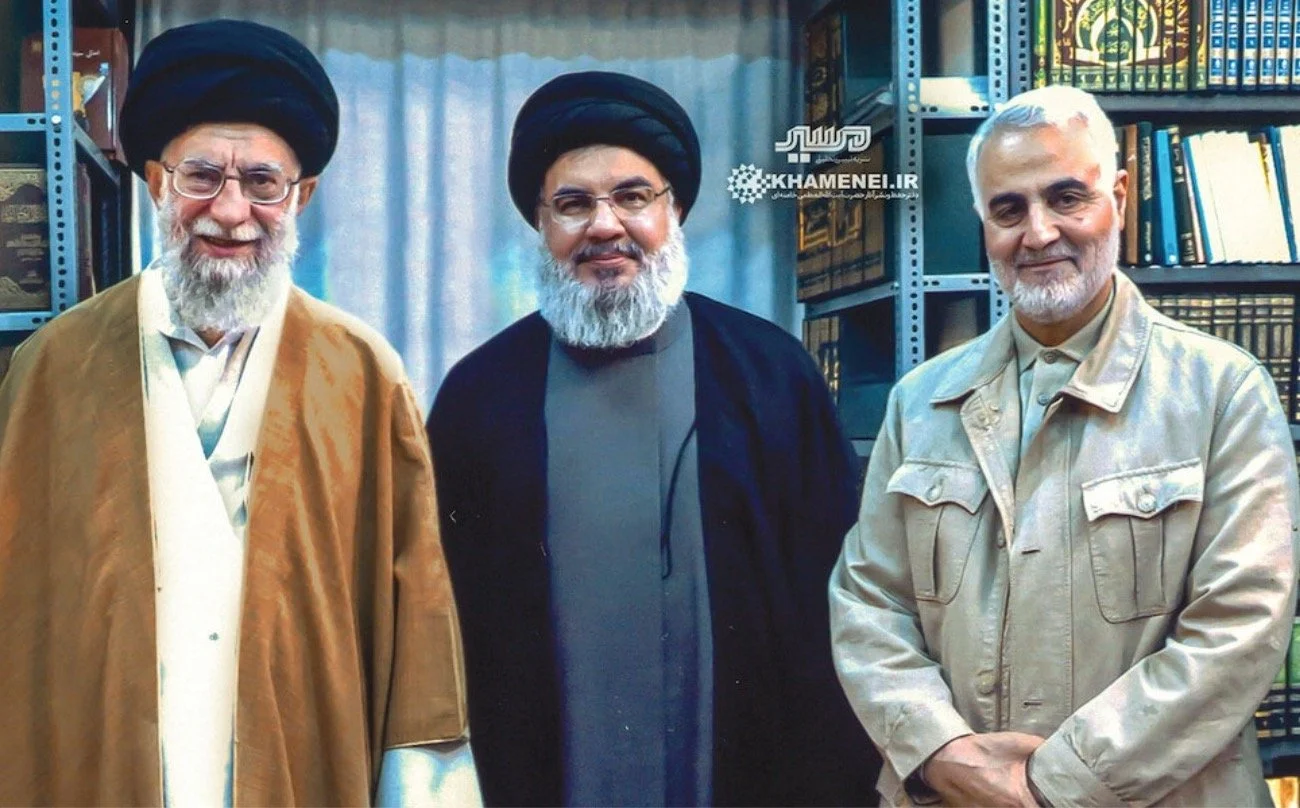
UAE opened an embassy in Tehran in 2022 which rattled the Pentagon. Under the aegis of China, a historic reopening of embassies occurred between Tehran and Riyadh (Saudi Arabia) in 2023, and was swiftly followed by Abu Dhabi and other Muslim states. The long cruel stranglehold the US had placed on Iran since the 1979 overthrow of US client and autocrat Shah Reza Pahlavi was starting to loosen. Iran’s economy could at last recover – which would improve life for millions of Iranians. This was the last thing the sanctions-crazed USA wanted.
The Israeli attack on Doha
The Israeli attack on Doha on 9 September 2025 will likely be seen as a watershed moment for the Arab states. The target was Hamas negotiators including Khaled Mashal, chairman of the Hamas Political Bureau, adding to a growing list of attacks on negotiators by (let’s be honest) the ever-perfidious Israelis and Americans. Among the victims were Qatari security personnel and civilians. Qatar correctly decried it as state terrorism. The Arabs took note: the US didn’t stop the attack from happening and deployed no interceptors despite being Qatar’s security guarantor.
As the Middle East Institute pointed out shortly after, “Within days of the Israeli strike, [Pakistan’s] Prime Minister Shehbaz Sharif visited Doha in a show of solidarity. Seizing the crisis as an opportunity to elevate Pakistan’s strategic presence in the Gulf and the wider Middle East, its government voiced support for the proposed formation of a joint Arab-Islamic security force.”
The quickly signed Strategic Mutual Defense Agreement (SMDA) got a lot of attention in West Asia and was soon dubbed an “Islamic NATO” – an alliance that could one day replace American boots on the ground. The Gulf States were also slowly coming to the realization that America was unreliable, Israel was a genuine threat and Iran might be useful as a counterbalance to the US and Israel. A Pakistani nuclear shield and conventional military backup was being discussed as far away as Ankara; there were even whispers Iran might be invited to join.
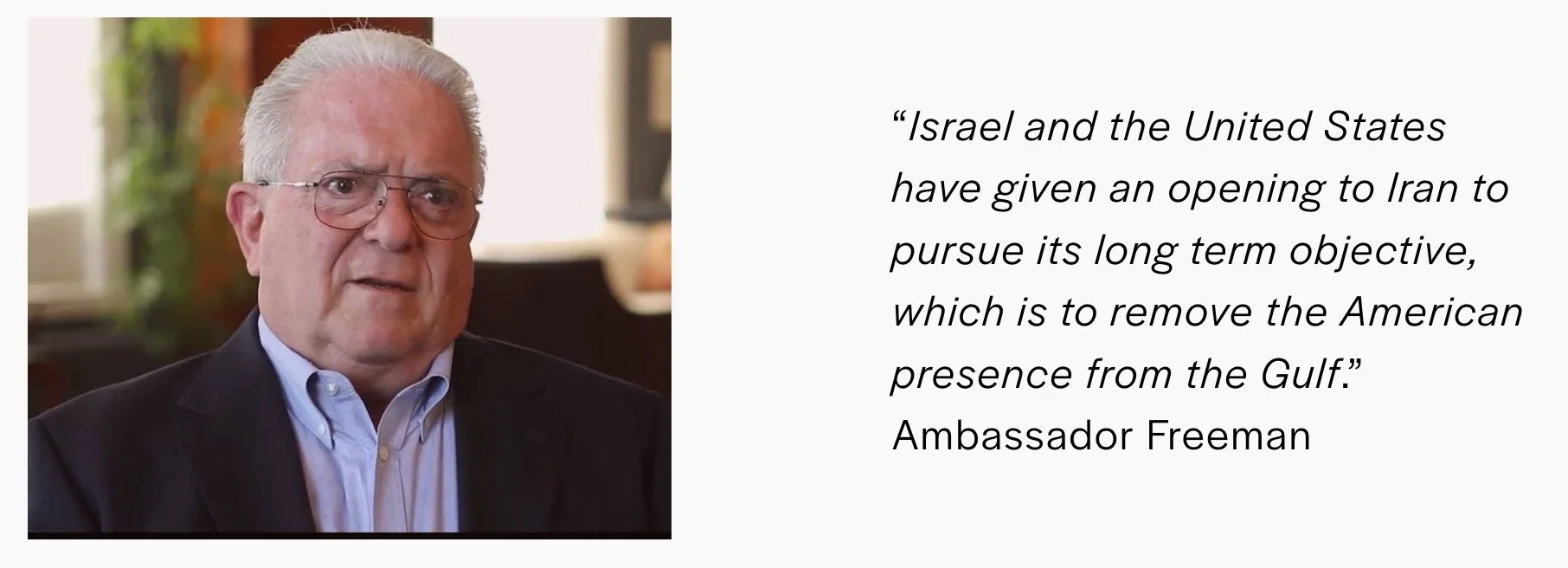
Now, back to that question of whether the US is, through its war on Iran, deliberately weakening the Gulf States as part of a strategy to keep the Muslim world divided. I asked US Ambassador (ret) Chas Freeman and he replied, “I think you give far too much credit to the United States, and more particularly, to Israel, in terms of devious planning to do these things in the Gulf,” Freeman said.
“We’re actually pretty stupid and clumsy at what we do. Look at what we’re doing with the Peshmerga and the Kurds. How stupid do you have to be to do that?”
Ambassador Freeman is highlighting what has been a recurring cycle in US foreign policy – strategic betrayal – in which it uses groups like the Kurdish Peshmerga or the freshly-minted Coalition of Political Forces of Iranian Kurdistan (CPFIK) to attack US enemies only to throw them under the bus the moment they have served their purpose. The CIA and the White House have tried to lure the Iranian Kurds into the current battle, Trump blurting out how “wonderful” it would be and how the map of Iran would be redrawn. This will only fuel Iranian nationalism.
Ambassador Freeman is numbered amongst those who believe that the US-Israeli defense shield is running low on interceptors and Iran could strike back hard in the coming weeks. He also surmises that the Iranians will have secretly signalled to the Gulf States that a condition of the war ending – if Iran gets to set the terms – will be the removal of all US military from the Gulf States. None of us can say with certainty what the respective breaking points for the belligerents are but I certainly believe Iran is very far from out of the fight that the US and Israel has forced on them.
“Prior to the US-Israeli attack, the Gulf Arabs were moving – in their usual incoherent and inchoate way – toward some kind of coalition with Iran to balance Israeli military hegemony in the region,” Ambassador Freeman told me.
“Now Israel and the United States have given an opening to Iran to pursue its long term objective, which is to remove the American presence from the Gulf. Iran has turned a vicious attack on it into a strategic opportunity to force the Gulf States to do a cost-benefit analysis.”
Chas Freeman is probably right: the US didn’t intend to shatter the Gulf States as one of its war aims. That leaves the more plausible explanation: the Americans and Israelis are simply demented and war-crazed. Either way, the US-Israeli war machine must be stopped for the sake of humanity.
Eugene Doyle
Eugene Doyle is a writer based in Wellington, New Zealand. He has written extensively on the Middle East, as well as peace and security issues in the Asia Pacific region.
A depressingly familiar pattern. The first ones to get rubbed out in any ideological conflict (whether or not escalated to an armed one) are the conciliators, the bridge-builders, the compromisers. Whether it's their own side seeing them as traitors, or the other side regarding them as not-with-us-therefore-agin-us is immaterial. The struggle becomes and remains polarised, and has to go on until eventually one side or the other blinks, then scuttles and runs.
The US would love to get out now, I believe. But I doubt if anything bar his own death or serious incapacity will stop Netanyahu on his disastrous course. Possible trial and imprisonment if he's deposed are major factors, naturally. But his relentless hostility to Palestinians and their sponsors could have personal origins too – long-simmering resentment at the circumstances and causes of his brother's death at Entebbe, fifty years ago this year.
I think it is hard to deny that this conflict carries serious first- and second-order risks for US foreign policy. To begin with, it is still not clear exactly why the US has chosen to go to war with Iran. History tends to show that wars launched without a clear political objective or plausible end state have a habit of drifting into disaster, escalation, and commitments far beyond what was originally envisaged.
Likewise, Iranian retaliation against other states in the region will almost certainly have triggered some reflection on what a post-conflict regional security structure might look like. It is entirely plausible that any future arrangement will be less dependent on the US than the current one.
That said, any analysis of American motives needs to remain grounded. It is tempting to attribute every consequence to grand strategy or deliberate design, as Eugene Doyle attempts to do. But incompetence, short-termism, and strategic drift are often more plausible explanations. Hanlon’s razor may be glib, but it remains a useful lens through which to analyse Trumpian foreign policy.
Moreover, it is important to remember that states are not monolithic actors executing some coherent master plan. The real world is not a game of Hearts of Iron. Domestic politics, personal ambitions, institutional rivalries, and contingent events shape foreign policy decisions far more than tidy geopolitical narratives.
For example, relations with Iran were slowly edging toward normalisation under Obama through the nuclear deal. That alone makes it difficult to maintain the idea that the United States has been engaged in some decades-long project to destroy Iran. In reality, American policy toward Iran has been inconsistent, frequently reversed by successive administrations, and shaped as much by domestic politics as by any coherent long-term strategy.
It is also worth noting that Israel and the United States are separate states with their own domestic politics, strategic interests, and decision-making processes. While they are close allies and often coordinate policy, treating them as a single actor obscures important differences in motives and objectives. The “US–Israeli” framing used throughout the piece implies a level of unified planning and shared intent that is not supported by the evidence.
At that point it becomes extremely difficult to treat the argument as serious analysis. It is better understood as an unusually internally consistent conspiracy theory.
Your comment attributed to the authour but that's not what the author said. He said:
Please stop the lazy islamophobic misinformation. The Trump administration and Kiwiblog does enough of that already.
After the Russian backed counter coup to the one of 1953, Iran ended recognition of Israel in 1979.
There has never been any declaration by a member nation of the UN to destroy the state of Iran, even by Iraq and they invaded.
Wait, what?
Nothing in my comment mentioned Islam or Muslims. I’ve discussed the Iranian state in other threads, but the comment you’ve replied to was about US foreign policy.
In any case, criticising the behaviour of a regime — whether it’s Israel, Iran, the US, or anyone else — isn’t the same thing as attacking the religion associated with that country.
And I’m not sure what the supposed misattribution is. I paraphrased Eugene’s claim that the US and Israel have pursued the destruction of Iran as a sovereign state. That is substantively what he said.
Unless you’re suggesting that any position on the conflict that isn’t simply “the US is always morally evil” counts as Islamophobic?
Israel and the USA wrecking the World Economy full stop !!!
I think that is precisely what has happened. And now the foolhardy idiots don't really know what to do.
Eugene Doyle is probably right. We are seeing the beginning of the end of US/Israeli dominance in the Middle East. But there is going to be many more lives lost and the rest of the world turned upside down before it happens.
Netanyahu has used the security threat posed by 1979 Iran (from 1993 – first using the Hamas proxy, then Hezbollah, now Iran itself) to legitimise permanent occupation (and oppose the Oslo Accords).
The intent is not dominance (regime change), but periodic security gardening.
Saudi Arabia has one Thaad system and has ordered 6 more, UAE has 2 (being subject to intense stress to diminish missiles).
There will be the move to develop a pipeline to an Oman port (and they will get Thaad systems then).
https://www.haaretz.com/israel-news/2026-03-13/ty-article/.premium/dont-fall-for-the-regime-change-talk-israel-is-mowing-the-lawn-in-iran/0000019c-e254-d989-a7dc-e35c611c0000?gift=09f69f31683a46bcbda94f440c77af77
However:
In Trump's delusional world it's US dominance. And he has a significant section of the US military behind him. I have no doubt he has dreams of becoming King Donald 1st., ruling over the entire Western world . No-one should give him credit for being capable of sound, strategic thinking. That's why he keeps ringing Putin to ask him "what should I do next?"
The current stoush.
https://www.thepost.co.nz/world-news/360967254/four-options-open-trump-so-he-can-finish-job-iran
https://archive.li/TucwO
The Gulf Arab governments were pretty upset about Israel trying to kill Khaled Mashal in a Gulf state, sure. But no-one in those governments would have been delusional enough to imagine the US might take any kind of action to protect any leader of a Muslim terrorist group, let alone one currently at war against America's closest ally in the region. The Qataris have been sailing pretty close to the wind with their support for terrorism and all the region's governments know it.
The idea that Iran will be the country setting conditions for the war's end has wild optimism going for it, if nothing else. A counterfactual: it looks like Iran adopted a strategy of attacking all the Gulf Arab states to get them to put pressure on the Americans to stop the war. That strategy grossly and insultingly underestimated the Gulf Arab governments and has instead has led to them standing fast. All of them will now be thinking about how much worse this could have been if Iran had been left to build up its drone and missile stocks further, and how it might be a good thing for the Gulf Arabs if they just let the Israelis and Americans go to the trouble and expense of destroying Iran's ability to threaten them.
That's true to some extent: Iran is forcing the Gulf states to do a cost-benefit analysis. It's fired more missiles and drones at the UAE than at Israel – RNZ, Why Iran is targeting UAE more than other Gulf states in war with US and Israel.
Which would be pretty bad for the UAE, except:
How is it doing that? With US technology that was developed in cooperation with Israel.
Just about every war Israel's fought since the early 1980s has been against Iranian proxies or Iran itself. Iron Dome, David's sling etc only exist because of Iran's proxies. US systems like Patriot and THAAD exist because the Israelis shared the benefit of their experience with the Americans. You could say that the Islamic Republic of Iran's most notable achievement has been to turn Israel into the most powerful military in the ME, through a kind of natural selection process: Israel evolves its military to deal with the threats or it goes extinct.
Iran's now also achieved a second counter-productive feat, conclusively demonstrating to the Gulf states how they're better off working with the US and Israel than with batshit-crazy jihad-and-martyrdom enthusiasts in Iran.
Iran is trying to diminish the UAE missile stocks & take out the Jordan Thaad system (thus talk of the SK one moving to the ME) to place pressure on them and Israel to call this off.
But yeah having a Thaad system is ME security these days.
Surely, those tasked with the war gaming scenarios must have run this one past the US high command, I.e the possibility that Iran would alienate all of the US allies and proxies in the ME and the greater damage would eventually be done to the US. Admittedly there is not much IQ capacity evident in the Trump / hegseth /Vance orbit, but surely someone must have said “ Hey , hang on a minute. “.