
If you want to understand what’s going on in Iran, abandon what the Persians invented centuries ago: Manichaeism. We use the term today to denote political framing which is simplistic, black-and-white, two-dimensional – a world of Angels (us) and Demons (them). This article recognizes multiple perspectives, including those of an activist associated with the anti-government Woman Life Freedom movement whom I interviewed this week. First, however, let us look at the geopolitical manoeuvers at work and ‘The Invisible Hand of Israel’.
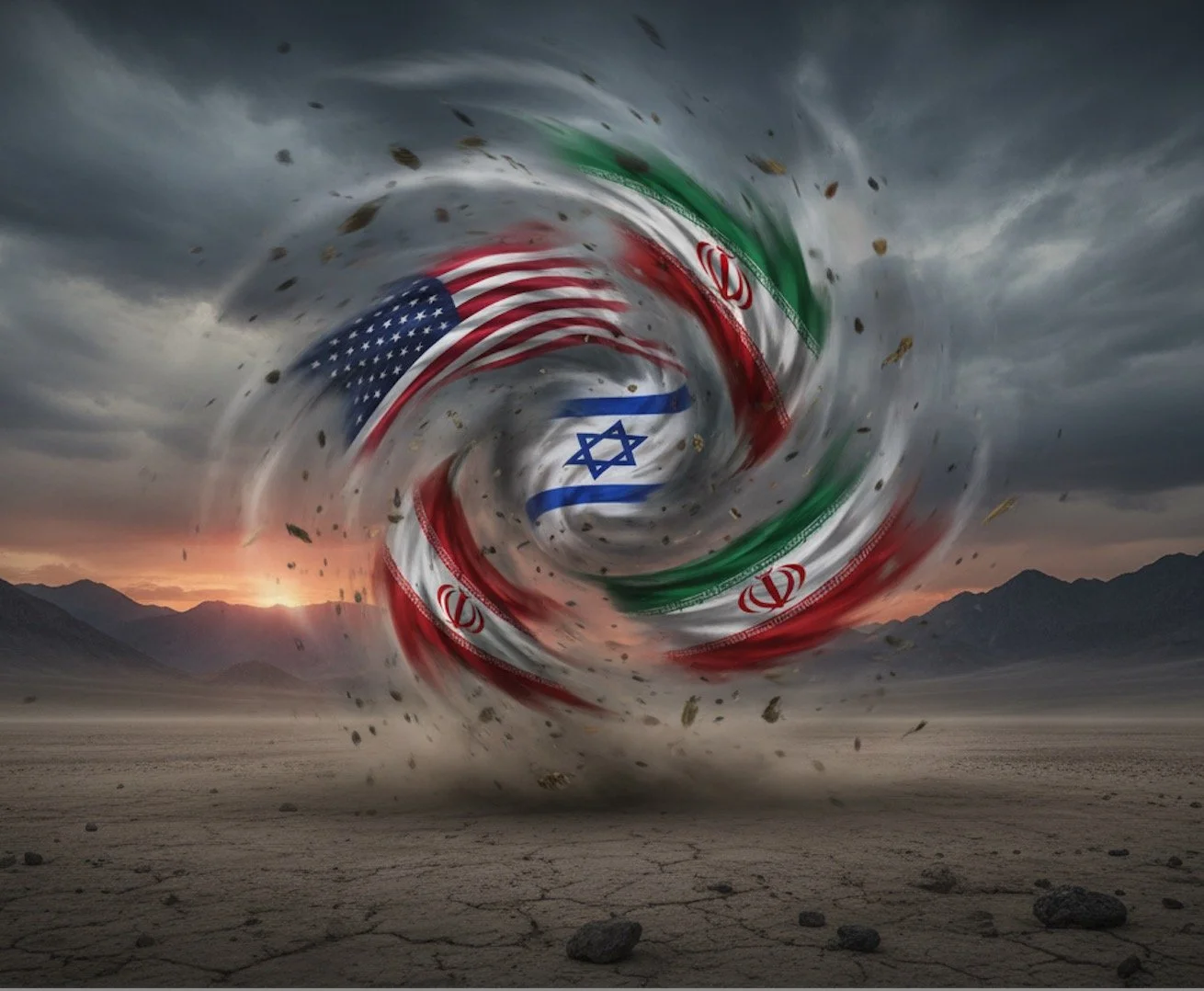
The Invisible Hand of Israel
Former Israeli Defence Minister Yoav Gallant told Israeli army radio this week that Israel must be ready to act when the Iranian ‘regime’ is ready to fall.
“At this moment, when what matters most is the mass action on the ground, we need to stay in the background and steer things with an invisible hand,” said Gallant, who is the subject of an ICC arrest warrant.
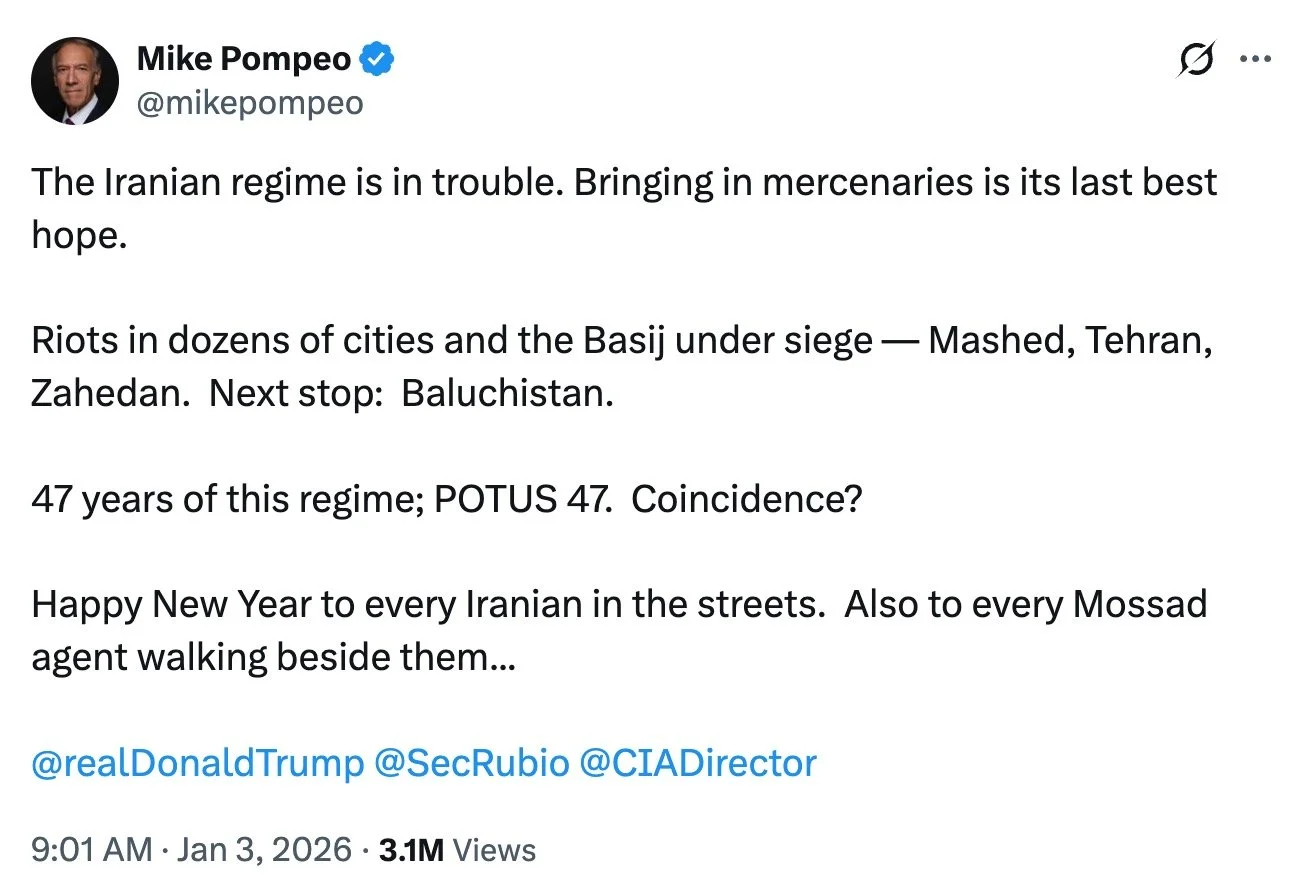
Former CIA director and US Secretary of State Mike Pompeo tweeted this week: “Happy New Year to every Iranian in the streets. Also to every Mossad agent walking beside them.”
I don’t believe this was a case of letting the cat out of the bag; I think this is both true and a form of psy-ops (psychological warfare), trying to unnerve the Iranian government and encourage the kind of harsh crackdown that regimes resort to when they feel cornered. MI6, CIA and Mossad are active in Iran, much to the frustration of many of the large numbers of anti-government protesters determined to end the rule of the clerics.
According to Israeli and Western sources, tens of thousands of Starlink terminals were smuggled into Iran to by-pass any internet shutdown. Yet the government – apparently using sophisticated Chinese ‘kill switches’ – were able to disable most of them, thus decoupling people within Iran from external coordinators.
Trump: “Help is on the way”
“Help is on the way,” Trump said menacingly on 12 January. How did that kind of ‘help’ go for Iraq, Libya, Afghanistan or so many other countries going back to the Guatemalan Silent Genocide or the Vietnam War? American ‘help’ resulted in the overthrow of the democratically-elected Mossadegh government and the installation of authoritarian rule under Shah Pahlavi in 1953. The West got their hands on the oil.
This time if they can’t get regime change they will be happy with regime destruction, civil war and the end of the multi-century project for a unified and sovereign Iranian state. So far, things have not gone to plan.
Long-standing Israeli security analyst Ehud Ya’ari told Israeli Channel 12 this week that the Iranian government remained firmly in control and that there was no evidence of momentum in the protests.
“I want to say things that disappoint not only the viewers, but also me,” he said. “At the moment, we do not see a continued expansion of the uprising. It is not taking on new and larger dimensions, as it did in 1978–1979 before Khomeini returned to Tehran.”
This is inconvenient if the West indeed plans to launch a war. The first Gulf War was partially sold on the killing of imaginary Incubator Babies, the Second Iraq War was sold on imaginary Weapons of Mass Destruction, the genocide in Gaza was launched amid lurid tales of imaginary Beheaded Babies. War propaganda peddled by our mainstream media demands worthy victims.
Western contempt for international law could get a lot of people killed
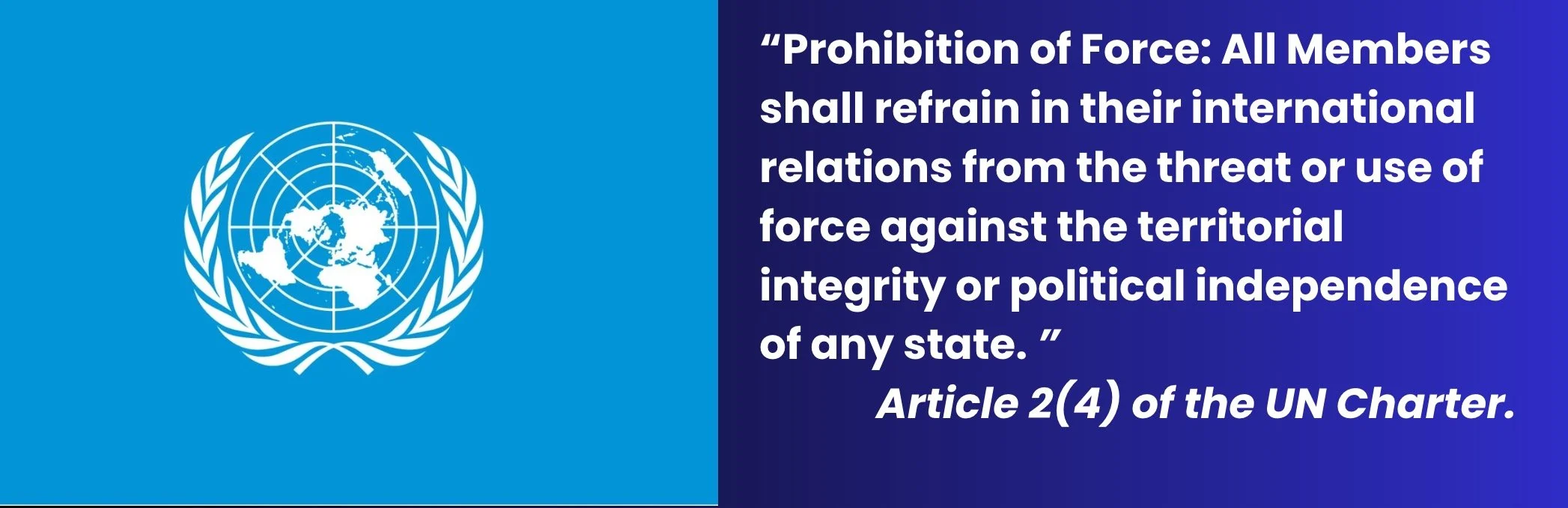
As shown in Palestine and in Iran, the West tends to have a spitting contempt for international law if it is their team that tramples on it. Two cornerstones we should never forget are:
Article 2(4) of the UN Charter – Prohibition of Force: All Members shall refrain in their international relations from the threat or use of force against the territorial integrity or political independence of any state.
And, yes, that does include powerful white countries. And yes, that does include Russia.
Secondly, we should never forget the 1965 UN Declaration on the Inadmissibility of Intervention in Domestic Affairs. Back in the 1980s the Reagan Administration secretly sold weapons to its enemy Iran to secretly fund Nicaraguan Contra death squads. In the 1984 Nicaragua Case at the International Court of Justice, international law was clarified by reaffirming that the principle of non-intervention “involves the right of every sovereign State to conduct its affairs without outside interference”.
Alastair Crooke, a former high-ranking member of Britain’s MI6, an expert on Islamist revolution, says Mujahedeen-e-Khalq fighters trained by the CIA in Albania, along with Kurdish fighters trained by the US in Syria, infiltrated Iran recently and played an important role in the violence. “We’ve had demonstrations periodically in Iran but these were much more violent.” He suggests the ploy was to provoke retaliatory regime violence which could act as an accelerant to further popular escalation.
Some important truths about what is happening in Iran this month
There is a large anti-government portion of the population which has long-standing and genuine grievances. I know and admire a few of them. There have also been equally large pro-government protests, largely unreported in the Western media.
Foremost amongst the anti-government protesters are women and, for that reason, I interviewed Aida Tavassoli, an Iranian women’s rights activist with the Woman Life Freedom movement.
“I think the people of Iran are just so fed up right now,” she told me. “I’ve always said Iran is like a pressure cooker. Each uprising is like you put more steam in the pressure cooker. Eventually it will explode.”
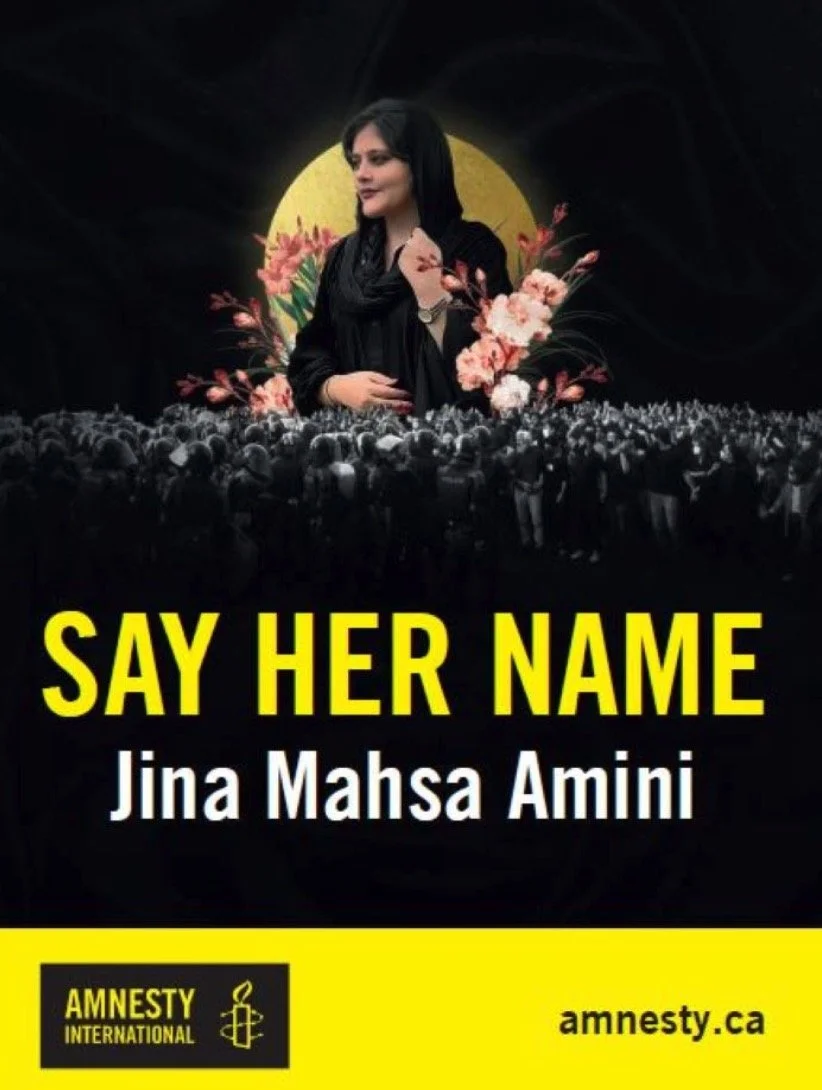
Aida became active in advocacy for women’s rights in Iran in 2022 when Jina Mahsa Amini, a 22-year-old Kurdish-Iranian woman, died in a Tehran hospital after being arrested by Iran’s morality police for allegedly improper hijab wearing. Her death sparked major protests inside Iran and around the world. The circumstances of her death are, typically, contested. “The whole world basically erupted into protests over the lack of women’s rights in Iran,” Tavassoli says. “The entire legislation of Iranian law is against women; they treat us as second-class citizens. We have basically no right to divorce, to the custody of children, to say no to child marriage. There’s a lot of honour killings in Iran, which we think are perpetuated by these discriminatory laws.”
This time around the most prominent anti-government groups rally around Reza Pahlavi, the son of the deposed Shah, who lives in the US, is endorsed by Israel, the US and powerful parts of the Iranian diaspora. According to Iran watchers I follow, his popularity within Iran is limited.
Pahlavi is in direct contact with Trump. He publicly supported the American bombing of his own country last year. He has expressed a desire to be in Tehran sooner rather than later. “We will Soon Be By Your Side.” he tweeted to protesters, urging them to stay on the streets.
Images of rallies around the Western world in support of the anti-government action inside Iran typically show three flags prominent in the protests – the Lion and Sun flag of the Pahlavi regime, the Israeli flag, and the US flag. This alliance between the monarchists, the Israelis and the Americans is concerning for many Iranians, including anti-government people like Aida Tavassoli.
“It almost feels like Reza Pahlavi and his dear friends – the Israelis and Americans – are stealing our revolution,” Tavassoli says. She emphasises any change should come from civil society inside Iran not external actors.
London-based Middle East Eye (MEE), with reporters on the ground, say “Iranian protesters reject US and Israeli interference”.
MEE quotes one of the protesters, Sara: “We want regime change, but we do not want our country to be destroyed. And given Israel’s record, it would not be surprising if they tried to exploit this situation.”
Not in any way discounting the validity and determination of many anti-government protesters, the events of the past month show all the tell-tale signs of a US colour revolution.
The Islamic Republic is under the kind of pressure that the West has become adept at applying. The US reneged on the JCPOA nuclear agreement in 2018. Subsequent sanctions and further isolation are powerful. US-Israeli assassinations and missile attacks triggered the 12-day War last year. Some believe the sharp decline in the Iranian currency this month was part of an orchestrated destabilization campaign. Combine this with corruption and what is widely assessed as incompetent economic management and you have all the ingredients for serious discontent. Ordinary Iranians are suffering and frustrated; many are turning against the government.
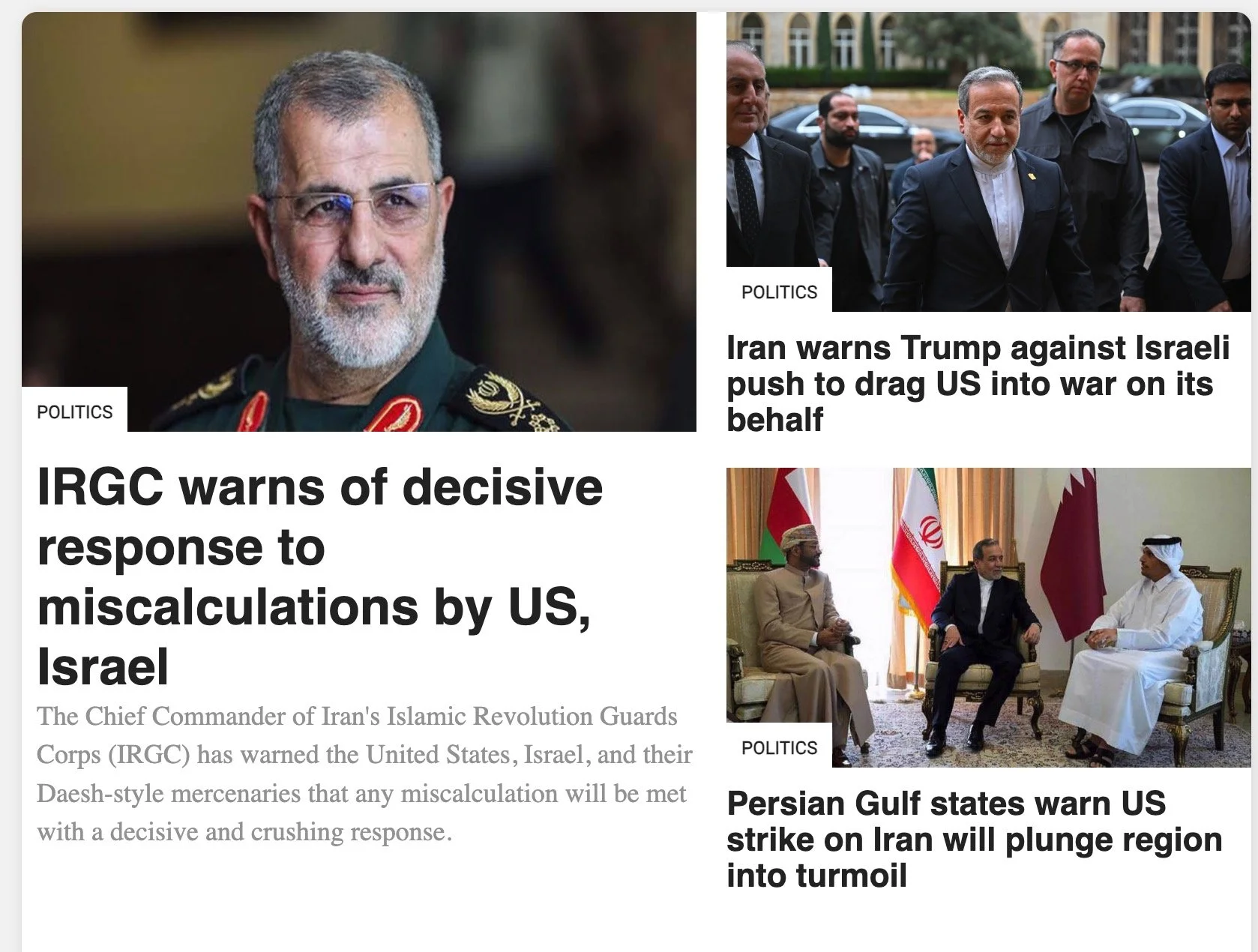
The US is moving more attack assets into the region; Israel apparently wants to try its luck again. Here we go, yet again. Professor Glenn Diesen: “The result is always the same – from the Arab Spring onward. The country which was to be liberated is instead destroyed. So we’ve all seen this movie before.”
Government incapable of reform?
Protesters make the valid point that the Iranian government has shown itself incapable of the kind of reform that would recognize the pluralistic nature of Iranian society. Whether it is capable of reform is a moot point but all regimes crack-down on dissent in the face of serious external threats and that is why I believe the US-Israel-EU approach is disastrous and counterproductive. Change must come from within and not be imposed by powerful hostile countries – not least by ones actively pursuing genocide in Palestine.
Eugene Doyle
The article opens by warning against Manichaean thinking, then immediately builds one. The only difference is that the moral colouring has been flipped. Where Western media sometimes flatten Iran into a cartoon villain, this piece flattens everything into an omnipotent US–Israel conspiracy, with Iranians reduced to bit players in their own country.
Yes, Western interference in Iran, particularly the Mossadegh coup, was real, damaging, and still shapes Iranian politics. But treating that history as a standing excuse for everything that follows is intellectually lazy.
Iran is not a passive actor. It is a major regional power with its own intelligence services, proxy networks, and long record of interference across the Middle East. Hizballah and Hamas do not exist in some geopolitical vacuum. Iranian officers and IRGC "advisers" are not rare sightings. Iran has spent decades projecting power beyond its borders and has done so deliberately.
You cannot claim to care about sovereignty, international law, or non-intervention while pretending this record does not exist. Iran is guilty of the very practices it attributes to the “West”: covert action, proxy warfare, political subversion, and routine violations of other states’ sovereignty.
The difference is not moral posture but method. Tehran is simply less delicate and less constrained in how it does it.
Iranian intervention has not been bloodless or abstract. It has been borne by minorities, border populations, and proxy battlefields: Azeris, Kurds, Arabs, and others whose lives are treated as expendable in service of a larger ideological struggle. Appeals to anti-imperial virtue ring hollow when sovereignty is defended selectively and human cost is dismissed as collateral in the fight against the “Great Satan.”
The protests don’t need a shadow war to make sense either.
The idea that the current unrest must be explained through Starlink smuggling, Mossad psy-ops, or CIA orchestration is ludicrous.
There are obvious, sufficient reasons why people are protesting:
None of this requires foreign puppeteers. It requires a government that has lost legitimacy.
Yes, foreign intelligence services are watching. Of course they are. They always do. But watching events and causing them are not the same thing, and pretending they are is a way of denying Iranians agency while sounding anti-imperialist.
For all its talk of caring about the Iranian people, the article ends up treating the continued rule of the Islamic Republic as the least-bad option, with any alternative framed as foreign-imposed chaos.
If you genuinely cared about Iranians, particularly women, young people, and dissidents, you would at least be able to say this plainly: the regime is a core part of the problem.
Getting rid of it would be hard, dangerous, and uncertain. But pretending its permanence is humane, progressive, or somehow anti-imperialist is morally indefensible.
Eugene points out several times that the ruling regime in Iran has multiple faults, not once does he suggest that it is purely foreign interference inciting the protests.His point is that foreign meddling(and did you honestly think that stopped after Mossadegh…I mean really??)exacerbates the situation and makes it even harder to effect change.
Your last sentence is a straw man
And your entire reply is a non-sequitur in defence of a thoroughly dumb analysis. As if cramming the word "Mossadegh" enough times into the coversation magically trumps any argument that contradicts you.
And if we want to talk about foreign interference, theres more than a few dead Lebanese, Syrian, Iraqi, and Israeli civilians with some very strong opinions on Iran's links to terrorism.
You know, what you are saying is very similar to the "But do you condemn Hamas!" as the starting point to any discussion about Gaza and Israel's war of genocide
It's a form of whataboutism, deflecting from the main thrust of Doyles post
You could have condensed your response to "But do you condemn Iran?"
Well…. do you? Or are war crimes and political meddling only objectionable when the US commits them?
Eugene’s central claim is that US/Israeli interference is the primary explanatory driver of events in Iran. Pointing out that the Iranian regime itself is a deeply interventionist regional power isn’t whataboutism. It’s directly relevant to any serious discussion of sovereignty, legitimacy, and agency.
The problem isn’t acknowledging foreign interference. It’s framing it as an “invisible hand” that turns Iranians into puppets and drains the protests of any meaning beyond serving as further “evidence” of the grand CIA/Zionist conspiracy the piece claims to analyse.
That is so far from the content of Doyles post , and totally ignores the pressure economic and otherwise that Iran has been under since the Shah was thrown out.Economic pressure, Mossad assassinations, threats to decapitate leadership, withdrawals from Agreements (JCPOA) before they had a chance to lead to normalising of relations between Iran , the US and Europe, plus the reimposition of far reaching sanctions do not make for the kind of scrabble playing cardigan wearing model democrat state you think Iran should be.
At this point I’d settle for a reasonably competent, non-theocratic government: cardigan-wearing or otherwise.
Yes, Iran has faced sanctions and sustained diplomatic and economic pressure. But not because of the Shah.That revolution was over forty years ago. The pressure exists because the regime continues, as a matter of policy, to support armed proxy groups, carry out regional interventions, and, as recently as last year, launch ballistic missiles at civilian targets.
I agree that Trump’s abandonment of the very real (if fragile) progress made under the JCPOA was probably the diplomatic blunder of the century. But that doesn’t remove agency from Tehran. Khamenei could choose to halt nuclear escalation, rein in or dismantle the IRGC’s external operations, and stop killing his own citizens en masse.
If he did, Iran could quickly be welcomed back into the international fold.
Sanctions and pressure shape the context, but they do not compel every choice the regime makes. Those choices have been made: nuclear escalation, ballistic missiles, and supplying drones for Russia’s war in Ukraine.
There’s a bigger inconsistency here: if the US-led capitalist/imperialist order is the root of all evil, why is exclusion from it treated as the decisive harm and the master explanation for everything? Either access to that system is valuable (so admit it), or it isn’t (so stop using sanctions as an all-purpose excuse).
You can’t have it both ways.
Re "non-theocratic", I was surprised by Iran's "secularism score 2024": ~75 (on a 0 – 100 scale), placing it in ~80th place – not too different from India and South Africa, well ahead of Brazil (66), Turkey and Iraq (64), and streets ahead of Saudi Arabia (51), Egypt (45) and Indonesia (43).
Perhaps Iranians would settle for a reasonably competent, less authoritarian (less repressive) government, substantially free from international sanctions and other foreign 'influences'.
https://en.wikipedia.org/wiki/International_sanctions_against_Iran
And then there's Iran's still sizable oil reserves – "Drill, baby, drill!"
I'm really sketchy on the (non-disclosed) methodology used by Secular Countries 2026.
If a country literally called the Islamic Republic of Iran, with a constitutionally entrenched official religion that vests ultimate legal and political power in a cleric, and an actual religious morality police enforcing doctrine, isn’t a theocracy, then the term has lost all meaning.
Who's suggesting that the Islamic Republic of Iran isn't a theocracy?
There's what you would settle for, and there's what Iranians might settle for – I'm suggesting that these could differ.
Perhaps historical foreign interference in Iranian politics is cause to question the motivations of those who currently seek to do the same.
Well said francesca. Its difficult to come to any agreement when all the ones you do make are pulled out from under you.
Unilateral sanctions are illegal for the reason of the harm they cause the most vulnerable in society. they are essentially a blockade on a sovereign state, especially when the US controls access to the world financial system.
The effect is similar to the illegal blockade of Gaza where US/Israeli control of what enters means that they can just watch as premature babies released back to their communities die in the freezing cold winter where everything in the makeshift tents is saturated by relentless driving rain. So far the count for these babies is 8 dead and its not just babies dying.
This is sadly, the evil face of US/Israeli hierarchy of life value. Eight dead premature babies. It beggars belief. More than 500 dead Palestinians since the start of the famous 'cease fire'.
This is Nora Barrows-Friedman from electronic intifada on the dead babies
Whilst it's amusing to see leftists pretending Trump is bad when he applies pressure to the Islamic monocultural regime, the situation is so nuanced that only multidimensional analysis will achieve a balanced overview.
Obviously the cleric wants the imprisoned protestors to be executed because a pluralistic society just ain't the will of Allah. Just as obviously, T & Netanyahoo will interfere because they can. I agree with Eugene's closer, which takes the form of moral imperative, but realpolitik rarely accommodates such stances.
Trump's being careful due to the pressure of economy: spend too much time and effort on one bunch of nutters and you give the Dems mid-term advantage…
Thanks for a bit of sanity Eugene.
Its not possible to look at Iran without US/Israel. There is no doubt that Iran stands with the Palestinians, Lebanese, Iraqis and Syrians. These credentials inevitably put them in US/Israeli crosshairs and given the boasting of Israel in their media we know that Mossad was involved in the killing of more than 100 of Iranian Police deaths. Not to mention riots and burning of mosques. Mike Pompeo gives confirmation of US approval.
For those that still remain neutral on the ongoing genocide being carried out by US/Israel, it might seem natural to give US/Israel some benefit of doubt. For those that have made some attempt not to turn away from this horror, it is not possible. Iran, standing beside Palestinians, against genocide, does what it can and in so doing is in accord with the ICJ ruling. They have limited resources but so far have defied all efforts by US/Israel to constrain their actions.
You are aware Israel and the US are different countries with different foreign policy goals, right?
You are kidding. The US/Israeli ongoing genocide is a caricature of the good cop/bad cop routine. A super majority of US politicians are bought and paid for by AIPAC. Netanyahu, a war criminal wanted by the ICC is back and forward to Washington to discuss tactics with impunity while the US supplies the planes and bombs and weaponises diplomacy in order to aid Israeli sneak attacks and refuses to enforce the one sided cease fire in Gaza for which they are the guarantors.
Methods and timing may differ but they are in lockstep with regard to the destruction of resistence to local Israeli hegemony in the Middle East. Any posing of the US/Israel as concerned about the welfare of ordinary Iranians is completely obliterated by the continuing US/Israeli genocide in Palestine. Each needs the other to perpetrate this evil and each needs the other to spread this evil to Iran.
Are you denying that Israel has huge influence on US foreign policy?
I'm not denying Israel has an outsized important in US foreign and domestic policymaking.
But I am denying the US is some kind of Zionist puppet state bought and paid for by AIPAC.
You can condemn Israeli war crimes, oppose US policy, and recognise Western interference without turning geopolitics into a single all-powerful cabal.
And yet that is how they act in the middle East. First Yemen and then Iran demonstrated that although singular certainly not all powerful. Those days are now well in the past.
You mean Yemen: the country in the middle of a civil war where one side is openly backed by Iran as part of its proxy conflict with Saudi Arabia?
That sounds like far less to do with the CIA and far more to do with the Quds Force massively overplaying its hand.
The Houthi control most of North Yemen, the STC want self-government of South Yemen – they are backed by the UAE.
Riyadh backs an internationally recognised government of Yemen that holds small parts of North Yemen near the SA border. It has begun bombing the STC and has told them to come to talks in Riyadh.
The CP in Riyadh is too dumb to accept even tacit STC rule of South Yemen, because his priority is SA vs the Houthi.
The venn diagram overlap is very large when it comes to US/Israel foreign policy goals.
I would venture to suggest superimposed circles, one upon the other.
The planning now is over their future, post the regime. Hopefully this allows a sovereign Lebanon and Iraq.
https://paxconsulting.blog/2026/01/12/monarchy-or-republic-in-iran/
Hmm; I’m not so sure about Lebanon. Hizballah will almost certainly continue to exist (albeit with ~99% fewer pagers), and there’s a genuine question about whether the only thing holding the country together was hating the Syrians slightly more than they hated each other.
Besides, Michel Aoun is still floating around and has yet to be held accountable for his role in the crimes of the first civil war. And sectarian conflict, like denim, never really goes out of style.
Lebanese sovereignty is dependent on its military being able to dominate Hezbollah and their nation not being used as a base for another nations war against Israel.
They were hardly united, if a military force their army was weaker than was fighting for the Syrian regime.
https://en.wikipedia.org/wiki/Sanctions_during_the_Venezuelan_crisis
https://en.wikipedia.org/wiki/International_sanctions_against_Iran
I'd prefer that Iranian governance becomes much less authoritarian – less repressive.
Iran has sizable oil reserves, but nothing lasts forever – "Drill, baby, drill!"