
OPINION:
Yesterday, I came across an article by former ASMS Executive Director, Ian Powell, and this caught my attention:
Quote:
“The response to my … Newsroom opinion piece [on corporate health apps displacing traditional GP visits’] was immediate…
Within a few hours there was a legal threat claiming defamation and demanding that my piece be immediately withdrawn.
Eventually, after further discussion between Newsroom and Tend Health, the opinion piece was slightly tweaked and a response from the Chair of the corporate’s board of directors, Dr Lee Mathias, published five days later…
It’s disappointing, but not surprising. I’ve personally heard of similar situations, but had no way of knowing if it was true, or the extent, if any.
But Powell’s statement reminded me of the environment in which health professionals and industry experts might operate today.
And National’s laws continue to impinge on our freedoms of speech and health professionals’ freedoms.
Powell continued:
Overall I found [Tend’s Newsroom] response to be cleverly written by downplaying the profit motive and asserting that the corporate’s activities are for the public good.
Private health business are often adept at this.
I also found it to be self-promotional for Tend Health and erroneous in part, including over some things I had said in my opinion piece.
Two matters relevant to this post deserve specific mention. First, [Tend’s] Mathias argued that another corporate, Tāmaki Health Ltd, already operated a PHO (Total Healthcare) so there was precedent for what Tend Health is doing.
This is misleading. Tamaki Health didn’t become a corporate until 2017. For many years it was GP and family owned. Total Healthcare was set up as a PHO around 2009…..”
Source – Ian Powell: Corporate Ownership Of General Practices Extends Power Into Primary Care Organisations
Mountain Tūī has covered Tend Health’s compelling rise in government support under National’s government over the last months, including: My Food Bag’s Cecilia Robinson Courts Money For Health and My Food Bag Founders’ Tend Health Win and What the hell is happening with Health NZ & Tend Health?
In the last article, I reflected on how Tend was “reluctant” to become a taxpayer subsidised PHO (primary health organisation – which are the primary contractors when Kiwis have health needs) & by my back of the envelope calculations, gives Tend access to a starting point of millions of taxpayer funds.
And even as Robinson admitted Health NZ was actively helping Tend to become a PHO as far back as December 2024, it blows my mind that Health NZ was not even accepting PHO applications over that period.
But meetings in February 2025 with Health Minister Simeon Brown reveal Tend lobbied Brown about directly contracting to Health NZ over this period and pushed for PHO reform, while Simeon’s talking points focused on how he could “better support” Tend’s business model.
(How generous of Simeon!)
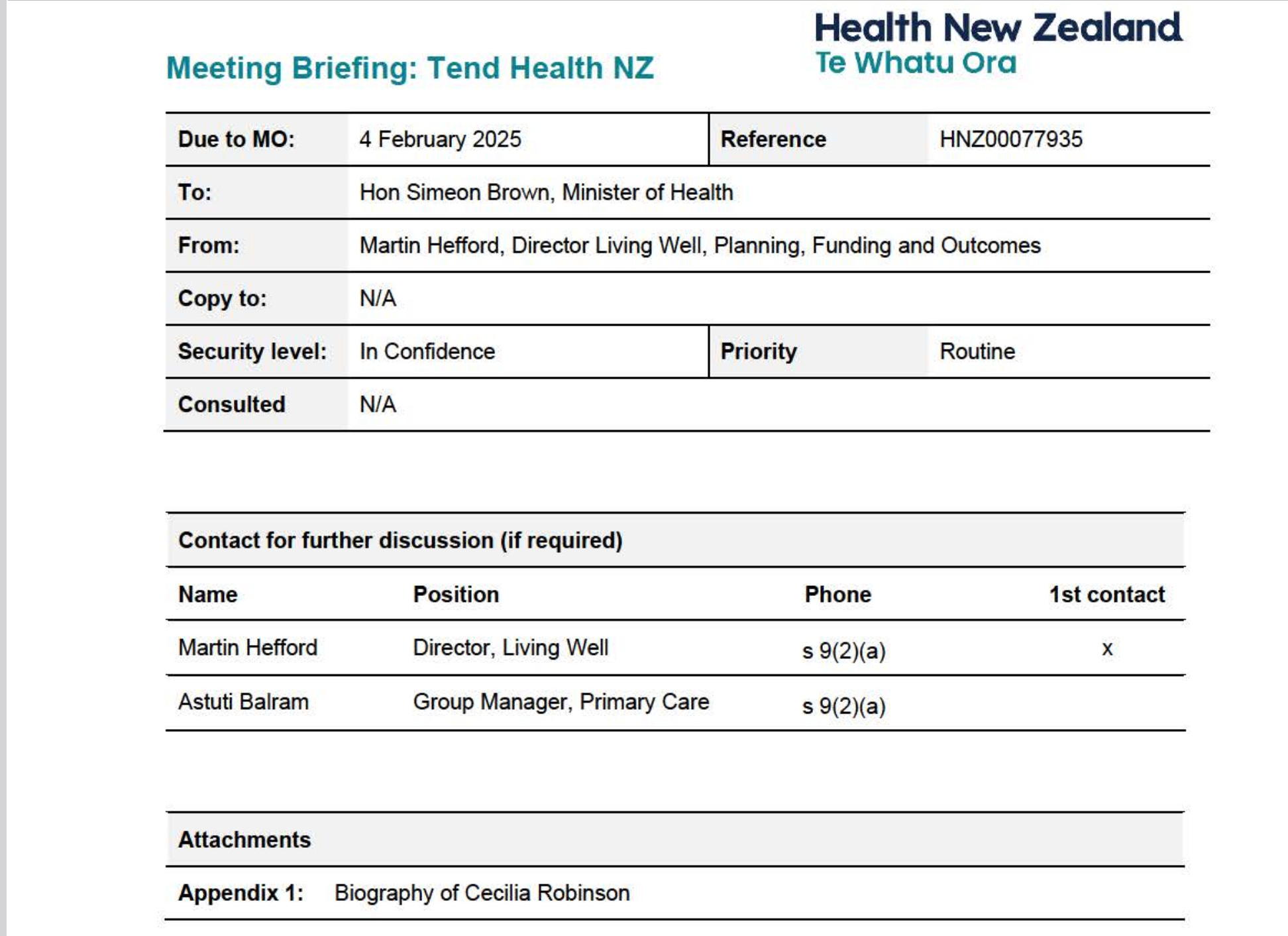
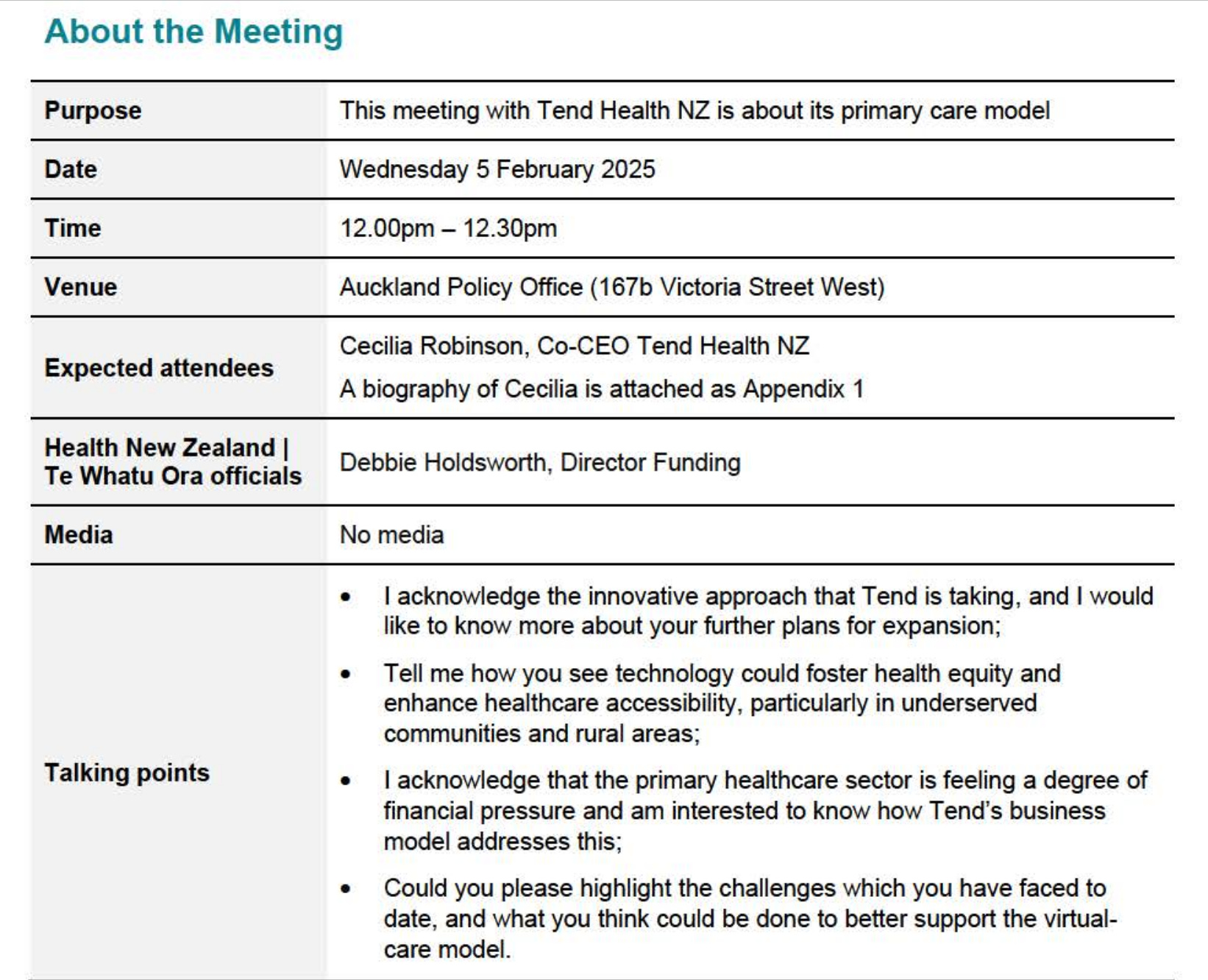
And yet, when asked by 1News’s Benedict Collins on why and how Tend was granted a PHO a few days after Health NZ lifted its moratorium in May 2025, Simeon Brown claimed he had no knowledge.
On a personality level, I’ve also admired the friendship Robinson has exhibited to the Prime Minister Chris Luxon. But personal matters are ultimately inconsequential when it comes to healthcare, in my view.
Tend Health’s PHO entity is now Arataki PHO – a fully registered charity.
One of the Directors on Arataki is Cecilia Robinson’s Tend Health co-founder, partner and COO, Josh Robb. And Cecilia and James Robinson have taken themselves off of the Board but the connections are clear –
Associates have voiced concerns to me about mega entities’ impact on early child education (ECE) and the ongoing acquisition of smaller providers.It’s similar to anecdotes I’ve heard around the Tend Health acquiring smaller community based GP practices, effectively curtailing doctors’ private ownership and contributions, and replacing it with corporate/private equity models (these can include foreign investors of course).
Based on Powell’s opinions above, it seems Tend as a sole corporate becoming a PHO was also fairly unprecedented – thanks to the National Government.
As far as I understand, Tend Health is nearly 25% owned by Pencarrow Private Equity and is on the prowl to acquire more Kiwi GP practices (Robinson also brought in private equity partnership – Waterman Capital – prior to its My Food Bag IPO, I believe)
I have no issues with success, at all – but all of this does lead me to reflect on how the system is fundamentally imbalanced, wealth and media and lobbying is too interconnected, and questions of fairness accrue in my mind.In addition, when doctors’ practices are owned by community doctors, profits are kept local, there is more incentive for local doctors to train as primary GPs, and the service and care of patients over the long term – including preventative care – is more likely to be retained
It’s important to address these points.
NZME’s Ryan Bridge interview (HERE) is an example of how I believe this influence is corrosive and dangerous. Instead of asking why we as Kiwis would want to pay ~$70 – $99 – $120 to a telehealth provider who is more likely to be unable to diagnose complex cases, and/or send me to a secondary provider on in house for a physical consult, and not necessarily be incentivised on prevention , why shouldn’t we be taking better care of our community GPs?
Instead, corporate media’s Bridges fawns over Robinson, claiming that being sick is a good reason to stay away from doctors’ offices.
Labour has started signalling its clear intent to work on primary care (a topic Shane Reti last year told Jack Tame was too complex and likely too expensive for his government), but when and if Labour or Green or TPM or whoever forms government again, everyone should remember:
Don’t kill the golden goose of any government with the right intent.
The topic is not easy, but nor should we ruin what we are, and what we have in New Zealand right now, for Luxon’s short term KPIs and National Party’s aspirations to be that party for the wealthy and connected.
That’s my take anyway.
One of the great things about smaller owner operated GP practices is the whole idea of the family doctor- the doctor we see for years on end , who knows us, understands us and has a real personal connection with us based on face to face contact and touch, and sees our health needs in a holistic context.
The telehealth corporate model does not have this. It is profit based.
I find it interesting, in all the talk of cutting red tape, for a health professional trying to develop their own practice, red tape is used as a weapon to the big corporates advantage. By this I mean accreditation of a practice, all the technology requirements now and compliance with all sorts of things – just even dealing with this measles issue is a test for a practice's systems. Corporates can do all this easily- multiple practices can be accredited by just copying and pasting, whereas doing something like that from scratch is onerous and in reality squeezes out the small players.
But bigger is not necessarily better.
Big corporates are invading all sorts of health in NZ. Opticians, pharmacies, physiotherapists, dentists etc. It makes public ownership and public operation of our hospitals even more important.
We are heading for complete corporatisation of all health services in NZ
They got vet practices and pet shops stitched up some time ago (Animates are everywhere). It was only a matter of time before human health care was swept into the corporate maw as well.
Tend Health is actively buying up GP practices and then saving money by giving the GPs such awful conditions that they leave. Then to be replaced in a "doctor-light" or "noctor" ("not-a-doctor") way with nurse practitioners who pretend they know as much as a GP. They don't.
It's the end of traditional general practice in NZ.
How do I know this? Inside knowledge.
that's a nightmare. People will go along with it as choice lessens and then acclimatise to it.
I’ll remove the mod note and subsequent comments.
The great dream of the Nats (now NACT1's) was always privatisation, and one of the last bastions of Public, is NZ Health of course. In recent memory (well, for me anyway ) was Ol' dr Jonathon..Coleman. Who after his attempt at fucking over our NZ Health…headed off to where the
grassmoney was greener….The latest cohort of cnts have learned from all that of course, and with much Atlas, et al backing..are well on the way to the American system ? Hell no. Fight Back. Kick them out !
Great dreamer, great listener, etc. etc. Luxon would regret it if “we didn’t go fast enough and we weren’t bold enough“.
https://www.rnz.co.nz/news/top/532729/pm-christopher-luxon-admits-he-needs-to-work-harder-on-corporate-speak-after-customers-reference
Everything that can be privatised, will be privatised.
NACT1 summed. An ethos to be ashamed of? You'd think? NACT1 however seem have a smug achieving glow about them. IMO that glow is malevolent, as toxic, as a toxic thing.
I have to admit that I found this story more than a little interesting as my family and I moved across to Tend Health earlier this year (March). As a result, I thought I might offer your readers a bit more information about Tend.
In fact, based on their app, I can see that the next appointment I can book right now (03/11/2025@1024) is at 0850 tomorrow or in 1330 today if I want an online one.
All in all, they have been the best GP I have experienced in the last 20 years and due to moving around the country a bit, we've had a few (5), and I wouldn't hesitate to recommend them to anybody unhappy with the service their current GP is providing to them.
as one of the mods noted in the back end, this looks like an advetorial. But let's see how it stands up.
this is in fact useful, because the PHO system means that if you need to attend a clinic you are not registered with, you have to pay a lot more. The solution to this is to fix the PHO system, so that people who are mobile have the same equity of access to others.
What happens if the after hours GP you telehealth with says you need to see a doctor within a few hours? You go to A&E right? Unless you are in one of the many areas where there is no A&E service. Then what do you do? This is why we have public health systems which need upgrading and better funding, rather than privatisation by stealth which would mean the core services continue to degrade.
but not a GP who knows you right? So you have to spend a chunk of the 15 minutes explaining stuff to them that a GP who knows you would already know. But hey, if you are comfortable with being treated as a machine that can swap around different mechanics, have at it. Many people have medical and healthcare needs where that just doesn't work.
And if you are in a rural area, you can't see that GP but have to telehealth. What if you need to be seen?
Funny. I just looked at their website and you can't see what appts they have without giving them your phone number and having a phone that can download their app. That's stupid and a barrier to care. I have better options via my GP clinic's online system.
what follow up care?
what pricing?
It's not about you. It's about public health for the whole population. That's a diverse range of needs that can't be met by the system you are describing.
Telehealth is great, and can be done well or badly. But GP clinic services that replace doctor/patient relationships with a conveyor belt are designed to make money, not prioritise the patient and their wellbeing.
First off, other than being a patient or customer of Tend, I am not an owner, staff member or in any other way associated or involved with the organisation (and neither are any friends or family to my knowledge), so my comments are completely my own.
Your suggestions for possible improvements to the public/GP system are completely valid; however, as no government in the last 20 years has made any such change, I don't expect there will be any significant change in the next 10 years around the existing model.
Not at all. We have been able to develop a relationship with a particular doctor who we can see as per normal during clinic hours, and when we have chosen to use the remote service, we have found that their after-hours teams have full access to our medical files, have been clearly able to see what recent medical involvement there has been, etc.
It reminds me of the "old days" of when a GP would actually make house calls, visually inspect how a wound is healing, etc, and generally be able to receive the same level of care in my own surroundings.
Of course, if it is a medical emergency, then yes, you go to the hospital A&E or call an ambulance, the same as any other GP.
Their App is simply one of the methods I mentioned. They also have online portals or staff who actually answer their reception phones and can assist with things like making appointments, getting test results. The main difference I have found is that their staff actually answer the phone and are knowledgeable, whereas my previous GP would frequently take 4-5 minutes to answer, place you on hold multiple times and then end up taking a message to get somebody who can provide the information.
Earlier this year, I required surgery, for which they contacted me several times during the recovery process, 3 or 4 times to check via phone how things were going, in addition to the checks that occurred during dressing changes.
Furthermore, one of my daughters has ongoing health conditions which require weekly visits with a nurse practitioner. Depending on test results, there has been a required follow-up with her GP at Tend, who has consistently made contact within 24 hours.
Their pricing is available on their website at:
Tend Online and Medical Centre Fees – What You Need to Know | Tend
Completely agree however, this is not the experience my family and I have found with Tend, but rather a team of caring professionals who are providing what I have found to be the best medical experience I have encountered in this country over the past 20 years.
Thanks Jaques. Would you mind sharing the shortcomings?
At my Auckland GP practice I can get a same day appointment with a dr if necessary, but usually not with my GP. I can also book online with my GP about a week or 2 in advance. Online I can see what days and times are available for each GP at the practice.
Just pointing out that this is not limited to corporate GP practices – my suburban independently owned local GP practice has a team of 3-4 GPs – any of whom might be the one that you are seeing. Apart from the practice owner, these tend to be relatively short term (a year to 18 months).
I don't think this is in any way deliberate – it's the staff that the practice owner can get – many are on their way either into (newly accredited migrants) or out of (NZ GPs on their way to OE, or further training).
Which means that, unless you are like my elderly mother, and able to be both flexible in your timetable, and prepared to wait for the appointment with the practice owner – you are likely to be seeing someone new every time you go – especially if you want/need an urgent appointment.
yep, that's the GP shortage. I don't really get it, but assume it's a global shortage since the pandemic. Training new GPs and bonding them should have been a priority of the previous Labour government. Maybe everyone thought once the pandemic was over there would be plenty of GPs again. But I also wonder if telehealth is sucking up a fair number of GP availabilities.
Tis mainly an aging out thing combined with a non-training up thing to adjust to both an increasing immigration and an aging population.
Entirely forecastable.
NZ has almost doubled in population over the last 50 years without commensurate investment in anything to keep up with the needs. Except roads.
No way to know. But telehealth was put in place precisely to address the shortage of GPs – so is the consequence, rather than the cause.
Once again, NZ needs to be training at least 3x the number of doctors we currently are, and making it much easier to access the post-grad GP training.
That's thoroughly decent and charitable of you, and I welcome open, rational debate informed by real-world experience and conducted with all the honesty we can achieve as flawed mortals with inherent biases. However, it is my personal opinion that you may have posted your testimonial on the wrong site.
I'm also enrolled as a patient at a practice which was acquired by Tend last year.
I haven't had to use the remote option but the offering in the Tend app looks good to me although as others have said, if I actually need urgent treatment, a remote appointment will still have to be supplemented by going somewhere. Something I've noticed about availability is that if it's a regular appointment with a named GP/nurse but remote, it has the same availability hours as going to my practice, so availability obviously depends on which option the patient actually needs.
I also appreciate that they have an app which is fine, the interface is usable, my test results and notes are viewable, and I get emailed receipts after a visit (handy for medical insurance). I can also request prescription repeats and medical certificates easily.
However, if I want a standard appointment (with regular prescriptions, at least every 6 months), my personal GP is rarely available, so I have had to see whichever GP has appointments available, or a Nurse Prescriber (better than nothing but not the same as my regular GP), and still rarely am able to get an appointment in the same week. For a few months, I had to book a month or more in advance. I would change to a different GP at the practice, but turnover is quite high, so the available appointments seem to be for recently-employed GPs who then don't stay that long.
Edit: Forgot cost – more expensive than it was but hard to say if that’s because of Tend or just general cost increases.
Mine has 6-7 GPs (used to have more) and 10-11 nurses so is a bit larger. My own GP has been there for some years, but the others are more recent hires (none of the others predate the acquisition by Tend). The practice had some turnover before, being a large practice, so it's probably not entirely because of Tend, but the acquisition hasn't improved matters.
The prescription service is good, but electronic prescriptions being sent to the chosen pharmacy and SMS notifications being sent by the pharmacy once ready to collect was already in place at my practice and selected pharmacy before Tend took over. Obviously useful for those where that's a new service courtesy of Tend but there was an existing system being rolled out anyway (nice to modernise things though).
Also at my Auckland GP, I can request repeat prescriptions online, and can view my test results, and reports from specialists online.
Interestingly, a doctor friend of mine told me that they believe Tend hires a lot of PR folks as well as lawyers to defend them.
Powell's article reminded me of it.
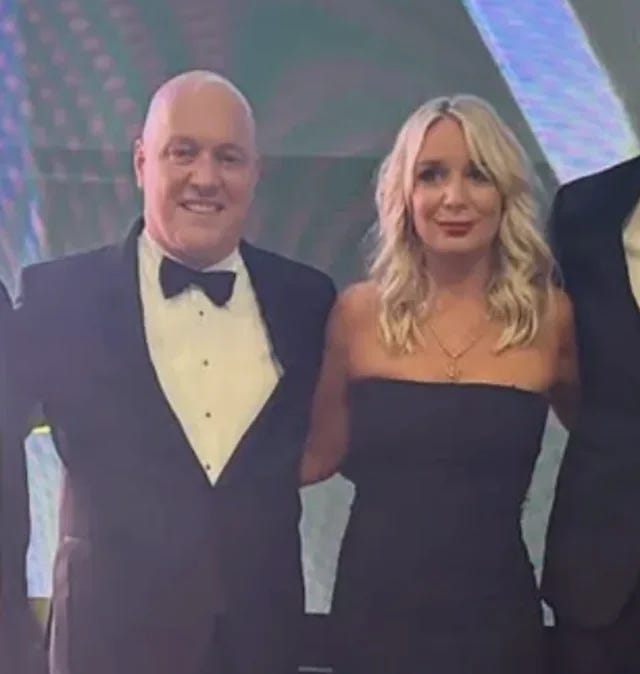
I don't really care to defend or discuss the business model Tend, but it's perhaps noteworthy that Cecilia Robinson is a reported neighbour of Luxon, and although I haven't seen any details on this, I have seen Robinson post a photo with Luxon, calling it the "Waiheke Island" crew.
Also Luxon was boasting about similar activities last year – saying healthcare is now available anytime anywhere – for a small price of $99 or so!
What I can say for myself though is that Tend have been the fortunate recipients of a National Government that appears on privatising & corporatising healthcare & moving NZ to a US style healthcare system rapidly, as our top doctors make clear –
Why? We have (in my opinion) a reasonable article highlighting the perceived negative aspects of an organisation's business practices. I've simply presented my own first-hand experiences of those practices.
If we are going to examine the perceived negative aspects of a subject, shouldn't we also examine the positive aspects?
The Standard is a political blog. Personally I appreciate positives as well, but we're here for the politics. It was the lack of political context in your comment that raised eyebrows and made it seem like a personal testimonial.
The continuing consolidation and corporatisation of primary health isn’t the disease; it’s a symptom.
The way we publicly fund privately owned general practices is fundamentally flawed. Capitation was designed for a time when most patients came in around three times a year and where keeping your population healthier meant fewer visits and a small financial surplus.
But that assumption hasn’t held for years, if it ever did.
Demand is higher, conditions are more complex, and funding hasn’t kept pace. Many practices are now left with an impossible choice: push complex patients into the public system, absorb the cost of care, or cherry-pick healthier, wealthier patients just to survive.
At the margins, that’s created “ghetto” practices: those left carrying the most vulnerable populations with the least resources.
In sum, it’s another failure of neoliberal logic around the principal–agent problem. Far from rewarding better health outcomes, the current model incentivises cost-cutting and selectivity.
If we want to understand what’s happening with Tend and others like it, we have to be honest about the system that made them possible. Corporate ownership isn’t the cause of our problems in primary care. It’s the predictable result of decades of underfunding, distorted incentives, and policy neglect.
Until we fix that, we’ll keep getting more Tends.
One question that nobody (anywhere I believe) has ever answered is "how much taxpayer funding is enough? As of the 2025 budget, Health was forecasted to account for $32,700,000,000 of Crown Expenses or 22% of the total amount, while Education represented only 14%.
Now it would be easy to say that the budget represents about $6104 per year per person, which seems a lot however for context, I'm due to have shoulder surgery this month and have been quoted:
$ 2600 Anaesthetist Fee.
$ 5300 Surgeon Fee
$ 2500 Implants
$10249 Hospital Charges
$20649 Total
It has been declined via the Public Health System, so thankfully, I have private medical insurance; otherwise, this one surgery would be costing around three times my "allocated Public Health Care" allowance.
when we run the health system down at the same time as pushing more people into poverty (which engenders more illness and accidents and those compound), it costs the state more. Everyone knows this, what's not explained is why people resist sorting it out at the top of the cliff instead of putting more ambulances at the bottom.
Even accounting for the increased cost of high tech medicine, much would be reduced by health protection and prevention of illness and accidents. It's not rocket science.
I agree, but how much do you think should be allocated to healthcare? If you look at the forecasted Crown Expenses for 2025/2026 what do you think it should be?
22% Health ($32.7b)
17% Social Security ($25.5b)
16% NZ Superannuation $24.7b)
14% Education ($21.5b)
06% Finance ($9.5b)
05% Law and Order ($7.3b)
05% Transport and Communication ($7.2b)
15% Other ($21.9b)
What?
Roads of National Significance $ 40-50 Billion.
Fiscal outlook – Budget 2025 – 22 May 2025
This is the source I used. Happy to be corrected.
are you suggesting the NZ government should reduce the health budget? What would you like to cut?
The principle behind private medical insurance and public health is the same.
One you pay tax to have the cost spread amongst everyone. The other you pay premiums to have the cost spread amongst all those paying premiums.
You are using the wrong comparison. What is the cost of the operation compared to the premiums you have paid? I'm betting your annual premiums do not come to $20,649 per annum. I also bet you can get much fewer types of operations done.
Except the public health system refuses to cover the surgery I need and therefore the only options available to me is to either
a) Accept ongoing constant daily pain and limited movement in my shoulder or
b) Paying to have it done privately.
Fortunately, I have private medical insurance that allows me to proceed with option b, as without it, there is no way I could come up with the $20K directly; however my issues are a) I have still been taxed, so that I should be able to access the care I need through the public health system which I can't and b) what about those in the same situation as me but without insurance or $20K they could use to directly fund the surgery?
Everybody should have the same access and level of Healthcare.
Yes but we used to be taxed higher to pay for such services. I remember when hospitals had their own OT's – and in fact their own builders and groundsmen, etc. You can't expect to get both tax cuts and same services (and on top of that an aging population). You can't sell of your revenue producing assets for a short-term capital gain and still expect to have the same disparate revenue. You can't add dividends to shareholders and profit and provide the same service without charging more. You can't shift the cost of wages to state supplementary payments and still provide the same services.
We want to afford more but don't want to pay for it – especially employers and the well off.
Taxes gone:
sales tax on luxury items such as caravans, boats and cosmetics 1986
stamp duty 1988
high tax rates on high income i.e. from 66% to 33% in 1989
land tax in 1990
higher tax rates on business income
estate tax in 1992
gift duty in 2011
land tax 1992
All these tax removals benefitted mainly those who had capital and high incomes and who in the words of our Prime Minister "were sorted."
In fact these changes allowed this group to accumulate more capital, to have the revenues that once flowed into government coffers now flow into theirs, enabled them to buy their rental properties and extract working class wages to their own pockets.
Have shifted so much wealth upwards the working class got nothing out of it ultimately – including the run down of public services. They certainly never got the higher wages employers said they needed tax cuts for.
The working class don't mind paying tax for public services only the well off do and the tax system has been rigged to work in their favour.
So nah you haven't been taxed for the services you want from the health system – you've been taxed for the bare minimum and the health system to run down. The promulgation of user pays should be right up your alley – but nah entitlement remains – you want low tax but same service.
Look at the farcical limits for childcare $220,000 per annum. Most of us don't make half of that.
House prices have doubled and tripled since Rogernomics, with nary a CGT
John Key and other property juicers made half of the country quite wealthy, and locked the other half into rent for ever.
NZ has abandoned its old values of fairness and living wages. And those who made the most money are determined to make the "bottom feeders" suffer.
While I hold no brief for the National governments over the last 2 decades in the property area – you cannot except the Clark and Ardern governments (especially the latter – which presided over an unprecedented boom in house prices).
https://thespinoff.co.nz/money/26-01-2021/twenty-years-of-housing-costs-beating-wages-in-one-heinous-chart
Basically both National and Labour have dropped the ball over this one.
why?
Everybody should have the same access and level of Healthcare.
We would not have closed rural hospitals if we wanted that – further disadvantaging Maori when we closed those.
What people really aren’t asking is: what’s the return on investment for our health spending?
Spending on hospitals is popular: it’s visible, immediate, and politically safe — but it often delivers a lower return than funding primary care.
If we can avoid that $20,000 surgery by giving your GP another $2,000 to manage prevention and early intervention, that’s money well spent. It saves both the patient and the system in the long run.
I bet hospitals have 1000x the ROI/ BCR of Simian Browns mega roading scheme
To be fair, you'd have to literally be lighting money on fire to do worse.
But if you're going to have a limited amount of money to spend, it would make sense to spend it as efficiently as possible, so it does the maximum amount of good.
I would definitely agree that we need to be pushing more funding into the primary health care model.
But, does that also come with a social requirement to use it?
We are now seeing a measles outbreak in NZ – which is largely only an issue because of a failure to vaccinate children. Which is a failure, by parents, to engage with the existing (fully funded) childhood health services.
One of the things suggested (possibly by you) a few days ago, was a PHO which is funded/staffed to offer evening/night service. Which sounds much like what this corporate PHO is offering (I have no knowledge, apart from the article). Is this only bad because it's offered by a corporate entity, rather than the government?
Not sure what's happening with the current one, but in the past, low vax rates are associated with access issues. Fully funded is great, but doesn't help if you can't get an appointment, or can't get time off work, or can't travel, or are just so overloaded you can't make it work. There are cultural issues as well that function as barriers. These are all well known, including by MoH. It's not a simple as saying it's a failure of the parents (although I'm sure in some cases it is).
tbh, if I was in that situation, measles vax wouldn't be at the top of my list of priorities, but I'm of the generation where we all had measles and mumps. Yes, I know the arguments for vaccination, I'm just pointing out that for some people it's not a super urgent issue when they're juggling too many things.
You don't need a doctor's appointment for vaccinations – the practice nurse (from whichever health agency you're enrolled with) – can schedule and do these.
They also (or at least our GP does) send reminders via several channels (text, emails, voicemail, etc.).
Sorry, I don't have much time for cultural issues which people put ahead of their children's health.
Noting that there was a lot less sympathy on TS in relation to Covid vaccination uptake.
the cultural issues are with the providers/system. If we want a high vax rate, telling parents off isn't going to get it. Making systems accessible is. Doesn't matter if it's a GP or a nurse, access issues still exist.
Nope. There are multiple venues, including iwi and other community based public health initiatives – specifically put in place to address 'cultural issues'. Vaccines are accessible.
This one now needs to be sheeted back to the parents – who just can't be bothered looking after their kids health. Of course, many of these can't be bothered looking after their kids full stop, or are actively abusing them – as the long tail of assaults on children in NZ shows all too well.
A(t)las, some Kiwis choose to avoid seeing the reality of circumstance.
A consultant paediatrician in Auckland suggested that "it's possible – depending on where you live and work – to avoid seeing poor families.", just as many poor families are likely unaware of "bottom feeder" and “drop kick” judgements.
https://www.rnz.co.nz/news/world/574178/out-of-pocket-costs-eroding-trust-contributing-to-decline-in-childhood-vaccination-rates-new-report-finds
Compounded by deliberately not building and selling off state housing when the wealthy move in.
Kāinga Ora housing village on affluent seafront street in Napier set to be sold
https://www.nzherald.co.nz/hawkes-bay-today/news/kainga-ora-housing-village-on-affluent-seafront-street-in-napier-set-to-be-sold/
I think it’s important to note that there are already a lot of resources being directed toward vaccinations. The public data suggests the issue isn’t really capacity or access: it’s trust. In the medical system, in the vaccines themselves, and in the government more broadly.
If you’re poorer, more isolated, less educated, and surrounded by social circles saturated with anti-vax propaganda, it’s not surprising that you’d be sceptical.
As for corporatised telehealth practices, they’re not inherently bad. But their rise is a symptom of a system that isn’t functioning as well as it should. There are real cost and equity concerns. For example, their business model depends on charging patients more while avoiding the overhead of maintaining a physical presence in communities.
So it’s less that they’re “evil,” and more that they shouldn’t have to exist in the first place. Especially given the level of lobbying and special treatment they seem to be getting.
I can't see a problem with private health insurance. We are all taxed to provide for the public system and if you choose to go private it simply reduces the load on the public system. A win win for everyone.
in reality, the private surgeons are taken out of the public system. We have a shortage of doctors, including surgeons.
Maybe they are able to top up their salaries by doing private work which keeps them in NZ.
I'm sure money is a motivating factor for many, but you'd think NZ would be an attractive place to live. Maybe we should make it more like that.
Not noticeably. Australia is a more attractive place, professionally, for many medical specialists – larger population base simply means more opportunities to practice and continue to grow in their professional practice.
The reality is that NZ will never be batting in this league.
This is part of the issue with the hyper-competitive entry requirements for medical school in NZ – only the best and the brightest make it. And they are precisely the ones who are looking to make a world-wide career in oncology, or pediatrics or opthamology – and are least likely to remain in NZ.
Increasing the 'take' into medical school would widen the talent pool to admit doctors who can still pass all of the courses, but are more mid-range in talent and ambition – and more content to be a rural GP (for example).
I was thinking about things like raising a family and lifestyle.
You might be conflating private health provision/care and private health insurance.
Not a win for people like Jacques (at 6.1.2.1) if they can't afford to go private to get a needed surgery.
My Dad is paying $30,000 at a private surgery for a knee replacement.
Spare a thought for those spending years in agony or incapacitated on a public waiting list
I do see a problem with it.
If our public health system were working as intended and delivering on its promises, private insurance wouldn’t need to exist in the first place.
And it’s not as though the two systems are completely separate: doctors and resources move between them all the time. In practice, the private system ends up cannibalising the public one.
Worse, the private sector’s very business model depends on the perception that the public system is less efficient. Which means these companies have no vested interest in seeing real, systemic improvements to public healthcare. So when they lobby ministers or weigh in on public debate, we can safely assume they’re not pushing to make hospital care cheaper or GP visits easier to access.
Again, we’re in a situation where the private sector exploits a weakness in the public sector, then uses it as a thin edge of the wedge to embed itself into service provision.
The cure is to kill the parasite, not the host.
Yep, that was me.
I used to work for a PHO so had a close up (and often sobering) view of how the system actually operates in real life. Equity and access issues are very real, no question about that.
But when it comes to vaccination rates, the main driver doesn’t seem to be access so much as information or trust. Or rather, the social bubbles people live in and the narratives that shape their choices.
Which, yes, can be seen as a question of parental responsibility. But could just as easily be put down to the government and health system failing to adapt to vaccine skepticism.
I refuse to live in a society that’s willing to wash its hands of the unwell or unfortunate on the vague moral grounds that they should simply do, or be, better.
That's all very well, in theory, but at what point do you sheet home the responsibility to parents to adequately care for their children?
If you never do – then the state should just take over the responsibility for EC vaccinations – and not allow parents to opt out.
It's hardly a vague moral ground. MMR vaccine is routinely safe and works to prevent infection in 99% or the cases. Parents who can't be bothered vaccinating their kids are putting them at a very significant health risk.
Bothered?
Or perhaps they just don’t trust the health system enough to take what they see as a risk. No parent wants to endanger their child; nobody sets out thinking, “I hope my kid gets measles.”
Many genuinely fear vaccines because of misinformation.
As Friar Laurence mused in Romeo and Juliet: “Virtue itself turns vice, being misapplied.” In this case, parents’ very real (to them) fears of the negative consequences of vaccination drive them to make exactly the wrong decision: for their kids, and for everyone else’s.
Don’t get me wrong. I don’t agree with anti-vaxxers at all. It’s a catastrophically stupid stance, and kids will keep suffering because of it.
But in a fair and democratic society, it’s still their choice to make.
We can point fingers and assign blame all day, but at the end of the day we either accept that people have the right to make their own medical decisions (even when those decisions are terminally dumb and carry consequences for others), or we don’t.
And if we go down the road of not doing so, how can we do it fairly? Because once we allow the state to mandate medical procedures rather than simply create consequences, we’re on a slippery slope.
That’s the key difference, I think.
During COVID, the government didn’t force anyone to get vaccinated. It said, essentially, “If you want to live normally during a pandemic, the science says this is what you need to do.” That’s not coercion: that’s simply creating incentives and consquences for those who chose not to do the right thing.
And the bar should be incredibly high even for that.
OK. But choices come with consequences.
How about:
And tell parents up front. If you choose not to vaccinate – then you may be up for significant medical costs, and periods where you are required to home-school your child.
Of course you still treat the child – it's not their fault their parents are drooling idiots. But you don't reward the parent's stupidity.
I’m perfectly happy with your second option, but not the first. You can choose to put your own kids at risk, but not other people’s.
But if we start pushing the medical costs of unvaccinated children onto parents, where do we stop?
Do we make drunk drivers pay for their crash injuries too?
We already tell people they’re responsible for their choices, but we still cover them through ACC. Because we’ve decided that publicly funded healthcare and no-fault compensation isn’t a reward; it’s a social right.
The moment we start deciding who does or does not deserve care on moral grounds, we step away from our national values and toward something far darker.
Already said that the kids get care – the parents just get the (subsequent) bill.
Another alternative (for the people thinking that they are making an ‘informed decision’) would be to require them to get health insurance to cover any subsequent hospitalization for their child, due to their failure to vaccinate.
There’s a lot talked about individualizing benefits, but socializing losses. This is another example: The individual ‘benefit’ is to the parent (support their worldview); but the loss (the costs of medical care, and the costs of spreading a disease to those who cannot be immunized) – is socialized.
However, if that's a step too far – then lets explore further the option of mandating vaccine status being recorded at school (it's already supposed to be recorded at ECE and primary – but often isn't) .
And then requiring unvaccinated kids to be home-schooled during relevant epidemics.
It seems highly likely, that when the cost of a working parent having to remain home to home-school children, bites – the parents will be highly motivated to get their kids vaccinated.
And if they can’t afford to pay? Do we boot the kids out, or just load their parents down with medical debt?
Is that really in a child’s best interest?
Perfectly happy with that.
I'd never advocate not treating the child – and have been clear about this all the way through.
They are not responsible for the fact that they have idiots for parents.
The appalling child abuse, neglect and murder statistics in NZ disprove this statement.
That’s the most disappointing, cruel, and cynical thing I’ve seen anyone post on this site in the couple of years I’ve been commenting. And that’s including some of my own!
No, human beings aren’t morally perfect.
But if our core value as leftists isn’t building better and fairer systems that recognise that fact, and still uphold the dignity of our fellow citizens despite it, then what the fuck are we even doing?
I'm more concerned about the murder, abuse and assault of children, than the 'dignity' of their fellow citizen parents.
We have ample evidence that there are a number of parents in NZ who are parents only by name – they evidence zero care for their children – and, indeed, actively abuse them. Talk about cruel.
Pretending this doesn't happen, and that "no parent wants to endanger their child" – is being willfully blind.
Including my own parents, actually.
I lived through years of verbal and physical abuse at the hands of my stepfather while my mother looked the other way. And, oddly, in a way, I know I was one of the lucky ones. As painful and cruel as it was, my abuse was rather quaint and middle class, hidden behind drawn curtains and polite conversation.
Some of the kids we fostered had it even worse. At least we could vacuum the house or boil the jug without one of us screaming in terror. At least I wasn’t born addicted to P. At least I wasn’t reduced to stealing money from my fifteen-year-old step-grandmother just to survive.
At least I didn’t lose a bunch of teeth like my brother did; for nothing more than smiling at the wrong time.
So no, I’m not blind to what happens. I just refuse to let the worst of humanity define the way I see everyone else. We can recognise cruelty without abandoning the belief that people, and systems, can be better.
Pretending this doesn't happen, and that "no parent wants to endanger their child" – is being willfully blind.
Any evidence that anyone here has done that?
Many of us here have lots of abuse in their families and understand it isn't as simple as "bad people". Much is learned behavour, some is mental health. Some can be unlearned, some can be treated, some can be reduced through life improvements where day to day living is not a struggle (which is why Labour's failure to implement WEAG is such a lost opportunity). Some there is little hope – especially if they had their emotional centers damaged earlier than age five through violence.
There's a degree of randomness (genetic most likely in my view) as to how people who have grown up in abusive or violent families come out of it – lots of variance between siblings. Most of the violence, but not all, is by males.
Actually this used to be a thing, measles parties, don't know if it still is. The idea is that getting the measles as a child gives protection from measles as an adult, and builds immunity. This was a concept from the pre-Wakefield, non-vaccinating, hippy subculture, who practiced health promotion in their families (as opposed to the people who just choose not to vaccinate and take their chances). They tend to be people with the resources to feed their children well and do other health promotion actions. Some of those practices turned out to be real eg avoiding antibiotic use because of the negative effects on digestive function in particular.
It's different now because post-Wakefield and in the age of the internet, there's a proliferation of fear based memery and low science literacy and probably a loss of those more grounded health practices.
A dentist I know left the branded/franchised firm that took over the once private practise due to the pressure to do x amouint of the more profitable treatments each month. The options to pay off youir dentist bill which had been long standing vanished to you can borrow from a finance company.
The local doctors now a franchise won't accept you building up a credit but at the same expects payment now on the day and you are only allowed to discuss a maximum of three things when you do see a doctor.
Doctors receive lower incomes as corporate cost and shareholder profit is now included in the price.
And the public system is forever fixing up botched private sector work, deals with the heart attacks on the private sector operating table and does all the non-profitable stuff – you don't go private when you're in a head on smash.
Private have their dibs on public health cause they have to deal with the gutting of the middle class and the fact that their patients are old and needing more stuff as well and can't afford their premiums. The number of retirees I know who paid their medical insurance for 20 years plus, barely claimed and now have to pay (or not pay in most cases) very high premiums has left some very bitter people.
Same reason private schools are eyeing public education – without government funding they'd collapse. They ain't so profitable at all are they really.
that's grim. But honestly, if you set up a system that expects complex problems to be solved in 15 minutes, you're asking for trouble.
What's the rationale for not building up credit?
I believe it was too much hassle if someone needed their credit to say buy food / pay rent. This could happen if you had an automatic payment set up and you didn't need to go for a while.
But honestly, if you set up a system that expects complex problems to be solved in 15 minutes, you're asking for trouble.
A system that was initially driven by profit as these franchises started up. Family GP's when we had young kids with disabilities longer than 15 minutes was normal – took as long as it took. Now of course there is the added pressure of doctor shortages.
horrible to imagine the pressure GPs are under now. Some still make the time, but then they're running behind so much over the day.
Most businesses don't want to have to manage credit for customers. It loads an extra accounting cost on the business, and there are always admin challenges.
If you want to build a credit for medical costs – set up your own account, and transfer the money there, regularly.
Has been normal business practise for years and years and years with family doctors and dentists as was allowing you to pay off your bill with regular payments. Most businesses allowed it for most of my life.
Is only recently as corporates/franchises have come into play we have seen these options disappear. The loss of layby is another fast vanishing practice.
All replaced by faceless predatory commercial systems that charge fees and interest and who have non-local owners.
Yep. I know a pensioner couple, pretty well off, who decided it's more cost effective to give up medical insurance, use the public system for basic needs, and if the waiting lists are too long for specialist things then just pay it themselves from their savings. The private insurance premiums have risen too much.
And it’s great that for some people, private health insurance is still an option.
The worry is that, on current trends, it’s starting to look less like an option, and more like a requirement.
People over 65 need high incomes to keep private health cover going. For 90% of retirees its nigh on impossible.
That "self-insuring" model is one which Obtrectatrix and I are likely to be moving to before much longer. One big matter to be resolved first, though ….
That has been the case for virtually everyone that I know in my Mum's age bracket (over 70). It's cheaper to just bank the premiums in case of surgical need which is not covered by the public system (which, in reality, is almost everything incapacitating, but not life threatening).
It was ever thus. My wife had carpal tunnel surgery done privately. The wound got infected, private surgeon didn't want to know. Told her to go to A&E.