
Stuff had a short video up last week about Queenstown’s multiple infrastructure problems and whether locals are going to end up hating tourism. It’s also a snapshot into Queenstown’s failure to work within the realities of the Limits to Growth.
As an easy visual starting point, here’s a map of the Wakatipu Basin, with around 100km2 of land. You can drive from one side to the other in 20 minutes, or you could if it weren’t for the traffic congestion.
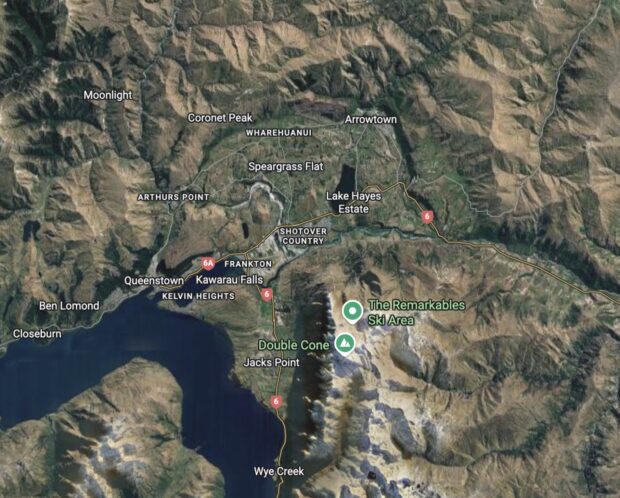
As we can see, the basin itself is surrounded by mountains and a lake, with just three narrow windy roads to the east and south leading to central Otago and Southland. This is the very epitome of physical limits. There are literally only so many houses and roads you can build there.
Build up you say? Arrowtown residents are gearing up for hearings next week to challenge the council’s proposal to build up to three stories. That’s the accusatorysound of NZ liberals crying NIMBYISM! but people choose to live in places for reasons, and often those are to do with environment and low population. But even if building three story apartments could be done well and with agreement of people who already live there, there’s still the issue of all the other infrastructure needed alongside that.
The Stuff video briefly names some of the most urgent problems associated with overgrowth, I’ll expand a bit,
- the housing crisis: very high property prices making affordable housing for families and the large number of service industry and tourism workers in short supply. Shortage of rental accommodation leading to overcrowding, and people living in cars and vans (ironically including tradies working on building sites). This spills over into the surrounding areas, the village of Kingston to the south and the town of Cromwell to the east now both have housing crises of their own, where some people end up living and commute to Queenstown for work.
- the poo crisis: with decades of poor planning, the sewerage treatment system cannot keep up and Queenstown Lakes District Council now discharges poorly treated sewerage into local rivers.
- the transport crisis: traffic jams are routine. Local resident and Otago Regional Councillor Alexa Forbes points out in the video that she biked to the interview in 8 minutes but it would have taken 20 minutes to drive because of the traffic. Queenstown Airport, with its geographically difficult flight and landing paths and proximity to residential suburbs, has been congested for so long there was a push to expand nearby Wanaka airport to international. Wanaka locals said no and won against the council in the High Court. QLDC transport policies in both towns have zero relationship to the urgency of the climate crisis and the need to reduce GHGs rapidly. Never mind heading in the right direction, QLDC is not even looking in the right direction.
So far so much so much like many places in New Zealand, right? I’m sure Aucklanders are laughing at the idea of having to drive 20 minutes instead of eight. Local independent media outlet Crux, who broke the news on the sewerage crisis that the council was trying to keep quiet, had this on their social media,
The rest of NZ is finally starting to realise that things have gone badly wrong in Queenstown. But is it too late and will anyone listen?
Many people see Queenstown as a place to poke the borax and will be getting out the world’s tiniest violin. When the Labour government introduced laws limiting offshore ownership of houses as part of their response to the nationwide housing crisis, QLDC lobbied (unsuccessfully) that it is special and should be exempt from the law because of the high number of uber rich people who own houses in the district but are resident overseas and like to fly in and out.
But, we are Queenstown. Like many other places with a certain image from the outside, the Wakatipu Basin is still home to ordinary New Zealanders and families that make up communities. The only real difference between Queenstown and the rest of the country is that Queenstown has such a geographically tight space to work in that the problems are much more obvious. It’s hard to get the population figures for the area, in large part because on any given day there are many more tourists than residents, and because of the numbers of summer and winter seasonal workers that support that. It may also surprise people to know that there is still a lot of rural land in the area, so like the rest of the country it’s easy for people to see the solution as expansion of the built landscape.
There are important lessons here. New Zealand is a finite land space too. It may be further away from running out of land, but like Queenstown, the question becomes if we are eventually going to run out of space, do we want to keep going until we have filled nature with as many houses and roads as possible? Or is there something here that is worth preserving and do we want to transition to sustainability while we still have it?
In New Zealand we mostly we see our infrastructure problem as one of poor planning and intent. It’s certainly true that successive local and central governments have failed us badly. It’s also true that, like Queenstown Lakes District, we have continued to vote in governance that supports a neoliberal, growth at all costs ideology, and in that sense we reap what we sow.
The Limits to Growth was a report in 1972 that took a serious look at economic and population growth in the context of finite resources. In the four decades since, a large body of diverse work has been done on solutions, from Permaculture to Transitions Towns to Regenerative culture and Doughnut Economics, but the main stream remains firmly weirded to the perpetual growth model. To such an extent that most people cannot even imagine anything different now and fear that anything else will be nasty, brutish and short.
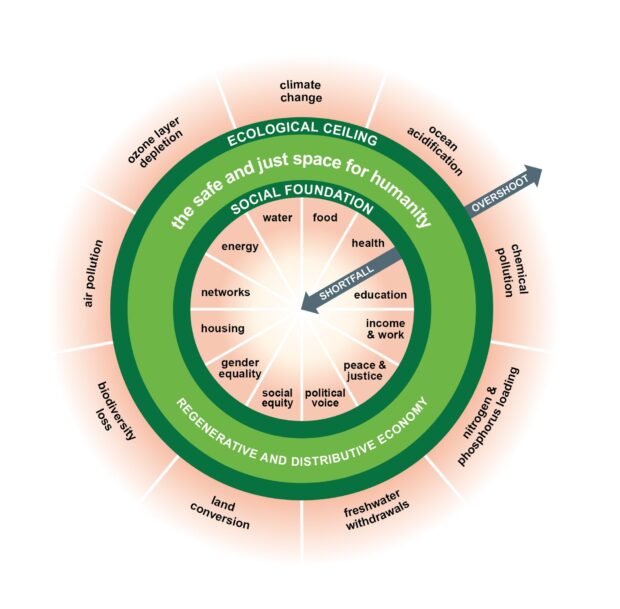
But humans have an amazing capacity for creativity and imagination if that’s where we put our will. At heart is a conversation about our values and the kind of country and lives we want to have. That heart sits in the broader context of nature, upon which we are all utterly dependent. In our faces are the complex multi crises of climate change, biodiversity and ecology, global conflict, and a myriad of peak resource issues.
During the recovery phase of the pandemic, there was a great opportunity for the tourism industry to shift to models and practices of sustainability. Many people in med/small and independent businesses were talking about creative solutions that supported local economies but in a better and more sustainable way than before the pandemic. In a profoundly depressing move, the government gave the funding to the people with the least imagination who then re-established business as usual.
I am reminded of the Queenstown developer, with large investments in Milford Sound, who once said that they should be allowed to develop Milford even more because it was already ruined. These are the people we have been empowering. With local body elections this year we all have the opportunity to seek out and support the people with the imagination to do things differently.
Queenstown and Selwyn District are the only places in New Zealand still growing at all.
Whakatipu, it's a place that makes people strong. The place where people want to visit, and live, if they can. So people will come, and keep coming.
Understanding that name helps to understand the place it describes, and the community that lives there. It is a vibrant and fast paced place and people, with many (most?) who go to fast, and think they are smarter or stronger than they really are. There's very few who have multiple generations living here, or in the graveyard. The vast majority of us are from somewhere else and family is there, not here, so churn is huge. You just get to know someone and they are gone to somewhere else.
So we grow in the blink of an eye, what were paddocks are suddenly filled with houses, quiet roads are suddenly choked with traffic, but it's still Whakatipu, that doesn't change.
There will be a limit, and that will be around sewerage disposal. The current situation of discharging 'treated' effluent to the Kawarau River isn't popular with people locally and downstream or Iwi. An alternative, land based disposal method will have to be found that has capacity for expected growth. Could be tricky, there's not much surplus land that's got the required permeability without potential to ooze publicly (airport), is affordable, and close. Piping it to Kingston or Gibbston will have mind boggling cost and / or completely unhinged opposition. There's a very sobering deliberation coming up for our community and I wouldn't like to be our next Mayor.
One outcome I can see is Government intervening and allowing continuing discharge to Shotover / Kawarau rivers. Air New Zealand jet services into ZQN were permitted by Order in Council the night before an Environment Court challenge to QLDC's approval as airport owner. The challenge was expected to prevail so the National Government of the day nixed it. Might have something to do with Joseph Mooney moving to Alexandra in the last month.
Regarding the QLDC election, Ngai Tahu have kind of entered the fray with local kamatua Darren Rewi standing for Mayor. Will be interesting to see how he gets on, leadership, or rather failure of, around the sewerage issue being his deciding issue. We've got a tradition of last minute nomination so won't get to know who's standing for council until it's closed but it's been slower / quieter than usual this time.
what do you think would have happened if Three Waters had gone ahead (and Labour had another term)?
Nothing. Doesn't share catchments with other areas.
Relating to the current debacle with the soakage field that never soaked, 3 Waters probably wouldn't have changed much. We'd probably be in the same position with 'treated' effluent going into the river. The discourse may have been more open, but could also have gone completely off the rails as local politicians and engineers scrambled to maintain their reputations. There's some commonality between those groups.
Had 3 Waters existed in 2016 when the soakage field idea was conceived, maybe there would have been a different outcome. When the MOW existed they had some spectacular outcomes with very well designed and executed infrastructure. They also had some comprehensive fuck-ups, especially at the smaller end of things.
Queenstown ended up where we are because the numbers for proper effluent disposal were so big, and capacities rater finite, that politicians became very motivated to come up with an almost magical solution, followed by a complete inability to understand that it didn't work, and then come up with a plan B. Real possum in the headlights stuff. Some people have a lot of explaining to do.
So 3 Waters wasn't going to help sort out historical issues? I thought that was the whole point.
I don’t know that three waters would have helped; what other council would have wanted to share this debacle. But had we managed to pull in with other councils, it might have worked. Today council decided (on a mayoral casting vote) to create a CCO to run its waters. Some will remember very expensive and problematic CCOs in our past so it’ll take a bit of highly transparent community relationship building to get that in place I would think.
bold move so close to the election. Which makes me suspicious. Is this about eventual privatisation of water?
Let's see who in the ring after nominations close.
What struck me in Crux's reporting of that was the Mayor's statement that if Council didn't set up a CCO, Government was likely to step in and do so.
https://crux.org.nz/crux-news/mayor-lewers-uses-casting-vote-to-push-through-new-water-cco/
I can see that QLDC is incompetent in this sphere and outside control is probably the best option, this is where 3 Waters stood out from a local perspective. Government intervention is probably inevitable, there's too much at stake for the economy and reputation if Queenstown had a hard stop to development.
We've got a kind of successful CCO with our airport, Council, through community pressure has managed to turn it into a slightly softer and bit more responsive beast. Maybe a similar model will work with water, >75% QLDC ownership with an appropriate outside cornerstone, say Govt. or iwi? Don't think there'd be much appetite for a private or other TA stake, after past debacles with water and current debacle with lines that's likely to precipitate an outbreak of lynching.
Hopefully QLDC councillors are understanding how serious this is, and that collectively they, and the organisation they oversee, aren't up to the job of managing Queenstown's water infrastructure, and that it's not a recent occurrence.
The current situation of discharging 'treated' effluent to the Kawarau River isn't popular with people locally and downstream or Iwi.
Does this mean the treatment plant isn't working properly? How old is it? Does a govt agency monitor it to ensure compliance? If so, are the regulations insufficient. Sorry, too many questions so early in the morning. Lack of popularity implies inadequacy, so I'm fishing for an explanation.
Google's AI has this: The population of Auckland was approximately 40,536 when the first sewage treatment plant was built. This occurred around the same time as the construction of Grafton Bridge and the Auckland Town Hall in 1910… The population of Queenstown, New Zealand in 2025 is estimated to be around 52,900 for the Queenstown-Lakes District. A recent report on Queenstown-Lakes District population growth notes that the district's total population was 52,900 in 2024. The urban area of Queenstown itself is smaller, with an estimated 28,600 residents in June 2024
So I guess it all hinges on how far the sewage system extends beyond city limits to connect to the hinterland…
it's not working properly, as far as I can tell, the town outgrew the system, the council knew for a long time and didn't act. Graeme can tell you the details, or go read the Crux reports, they were instrumental in finally exposing what was happening.
Newsroom has two very good summary articles that show the timeline, it goes back a very long time, long before the start of their timeline. There's a history of failure in water and sewerage engineering from the 50's, I don't think there's been a sewerage scheme that hasn't failed, in some cases spectacularly and from the day they were commissioned.
https://newsroom.co.nz/2025/04/29/how-queenstowns-wastewater-system-went-wrong-from-the-start/
https://newsroom.co.nz/2025/05/05/ex-mayors-square-off-over-treating-queenstowns-sewage/
Thanks Graeme, I get the picture now. Basically, it seems like nature defeated the best efforts of experts and regulators all the way through. When you have a fast-growing regional economy, infrastructure spending must keep up with that (a principle that National and Labour have failed to learn).
I sympathise with those negatively affected but market surges can also be seen as a force of nature and preventing population increase in the region isn't feasible. Infrastructure tweaking therefore fails if the money from growth isn't spent well. All those saying `we did the best we could at the time' are likely to be at least partly telling the truth, along with being economical with it.
Geo-engineering works on the basis of trial and error rather than theory I suspect, so the authorities just have to keep spending on different tweaks to get it right…
It’s worse than that. It’s a longstanding culture of determining the minimum required (maybe), then doing less than that, or magically coming up with a cheaper solution.
You don’t break that culture incrementally.
You don’t break that culture incrementally.
Such culture shifts as are produced by necessity are attitudinal and usually driven by some kind of darwinian effect. A pragmatist would point to adaption becoming contagious. A cultural analyst would go for paradigm shifting and a sociologist may go for zeitgeist.
My view from holism is that you get local culture, regional culture, and national culture all working in triadic synch. Scientists call it self-organising because nature does it, so it transcends humanity. So the Deep Green view then factors in local nature as operating context, where the triad takes effect.
That, as 4th element, makes a tetrad. Triads make process and tetrads make systems, so you get a nexus in which ecosystemic relations play out subliminally. Such relations constrain, influence, resonate, and inform all components of any natural/social system. Field effects ensue…
Looks like QT residents can have the experience of living in Auckland without leaving home.
I don't see that situation changing, given the government's fixation with growth at any cost.
The New Zealand Government has a job to house the population.
The New Zealand Government opened the gates to immigration and tourism.
Yes. There is double the population in Queenstown including the tourists.
The Government has sat back while Queenstown rate payers have funded the extra cost of tourists and Parliament has benefited from the extra tax revenues tourism is generating.
This process has left the Queenstown council under funded.
Queenstown tourism is profitable for the Government, so they need to invest in that area. Dollars invested = tax dollars returned to New Zealanders.
Government services are generally funded on a historic resident population basis, so little allowance for non residents and sudden spikes in population.
Hence Queenstown hospital is sized for a population of 4500.