

It would be tilting at windmills to criticise National’s election campaign in 2026 for the simple fact that it’s not in existence yet. Except it is, at least its bulletised framework, and that’s all we can and should expect from National. In typical National style, the newly anointed campaign manager of National, Simeon Brown, has presented the party’s campaign strategy and election manifesto in a post on social media, as has become the norm with important announcements by the Coalition Government. To curb the damage, it’s imperative to nip it in the bud.
For a proper analysis, we must look through the polarising rhetoric and propaganda and focus on the nuts & bolts of this important document:
Times are still challenging, but National has a credible plan to navigate them, providing timely, targeted, and temporary relief to those who need it, while ensuring we are respecting our economy.
The premise is clear, times are still challenging, and it implies preceding and/or ongoing challenges, most likely economic challenges. One could be forgiven thinking that this refers to the Covid-19 pandemic. However, the pandemic is over and was a health crisis, man-made or otherwise. Giving our innate recency bias free range, we should be thinking of Operation Epic Failure Fury, definitely man-made.
The challenge for National has been to convince people that they’re the best managers to sail through these challenges. So, to claw back some lost ground in the world of polls, National is focussing on business as usual and the economy as its number one priority. I’ll get to that below.
The means is clear, providing timely, targeted, and temporary relief to those who need it, which means that things change all the time, like traffic lights and bright centre lines that fade, dull, and eventually disappear together with road cones and potholes. Real need also is subjective, as landlords know all too well, but National has to start somewhere, don’t they?
So far in the cost-of-living crisis that’s rapidly worsening because of the fuel price shocks reverberating across the globe, the National-led Government has identified 143,000 working families with children and 23,000 care workers, but it doesn’t look like they could find any other groups of people who arguably could qualify as ‘needy’ thanks to the regressive nature of the rising fuel prices – note to David Seymour: adequate supply and availability doesn’t equal equal affordability for all consumers. To give the Government some slack, it can be quite tricky for the untrained eye to spot real need and economic pain in data such as dropping school attendance. Perhaps, AI could help them out, or the New Zealand Initiative?
Anyway, the Prime Minister [Chris Luxon] has said that their invisible hands are fiscally tied and that we should just “understand and appreciate” that there’s only so much Government can do. And who am I to argue with Fitch?

Since it might be less subjective to identify who or what is critical or essential in a crisis, I had a look at the National Fuel Plan. This plan accumulates & integrates years of collective wisdom and professional knowledge & experience. Section 3.4.2 lists alphabetically “sectors […] defined as critical customers, with the right to access priority supply at nominated sites for the purpose of continuing essential functions”. The list is comprehensive and appears to be void of ideology – note to David Seymour, who said education was “the last thing we would sacrifice”, schools did not make the list. The Government recently realised that they’ve been sitting on this Plan for all this time and decided that an update was timely. It’s very illuminating to read in the factsheets the proposed indicative priority bands for Phase 3, which is still under construction and which we’ll hopefully never have to experience. (NB hope is not a plan or strategy) It’s not hard to spot, even for the untrained eye, the strong focus on economic activities. Most strikingly, rural GPs and district nurses have been lumped in Band C: essential services. Even more strikingly, gobsmacking even, was the suggestion by BusinessNZ’s chief executive Katherine Rich to elevate the food and grocery sector to Band A: life-supporting services.

Apparently, this was met with a willing ear by Willis. Nobody was invited to that high-level meeting to make a case for elevating rural GPs and district nurses to Band A!? There’s already concern among GPs that patients may miss appointments because of affordability rather than accessibility and logic would suggest that this would be a lot worse under Phase 3 and therefore all primary care belongs in Band A. Is the problem that this would remind people too much of the health measures taken during the Covid-19 pandemic and has the Coalition Government boxed itself into a cul-de-sac with no fuel left to turn around?
The end [goal] of National’s election campaign is to respect the economy, since this is National existential motto. Frankly, I struggle with its meaning. Does it mean respect like for an elder, a boss/superior, or an authority, for example, or respect for a friend, neighbour, or spouse, for example? In any case, it appears to be respect for something that’s external to me without giving any justification. Rather, I strongly suspect that it simultaneously is a dog-whistle and virtue signalling that the Coalition will not spend a cent more than it has to for it to stay in power, and that the health of the economy comes before and above the health of the people.
So, there we have it, National’s plan is nothing more than a highly selective short-term reflexive reaction to rapidly changing circumstances in the same way as they’ve always treated the economy. It’s nothing more than a populistic plaster to win & secure votes that does nothing for NZ’s long-term fuel & energy resilience, the economy (!), and reforms & transitioning to withstand future headwinds & disasters. Thus, I’d relegate this lot to Band F: redundant and obsolete – for disposal.
We are incredulous at National's plans but the plans themselves aren't 🙂
How about cockamamie?
Little would surprise me on Katherine vindicated Rich and her lobbying/machinations.And of course she will have Nicola Willis' ear… However some might remember bit of previous from Dirty Politics.….And I certainly know who the Good Guys were,and are, they had/have NZ Health as foremost.
And re…
Luxon and cronies have the answer…TeleHealth !
And re your…
IMO a kneejerk reaction…by jerks.
Darn! I was meant to include telehealth in the Post but I forgot. Anyway, it was long enough as it is and thanks to you it got mentioned.
Great post – “respect the[/our] economy” reads very strange to me.
NAct MPs are laser-focussed on financial self-interest. Their wealth demands respect
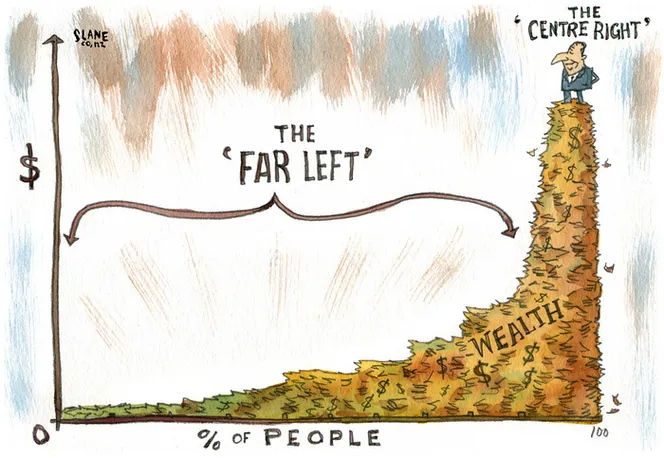
Outcomes of NAct actions remain much the same from one administration to the next.
“Cartoon shows a graph made of money, representing the distribution of wealth in New Zealand. The 'far left' has low levels of wealth, whereas the 'centre right', has a very high level of wealth. Prime Minister John Key is shown standing on a large pile of money as part of the graph.” https://natlib.govt.nz/records/32369771
Thanks for drawing attention to the fact that the economy isn’t fair & equitable, doesn’t deliver equally to all, and outcomes are unevenly and unsymmetrically distributed. Proponents argue that this is just, the natural order, for those with capital who take the greatest risks should reap the greatest rewards. In theory, this common sense may sound logical, persuasive, and acceptable, but in reality, it comes at the expense of the many who don’t have the same means to get ahead let alone catch up. This is the main a priori reason why ‘the economy’ should never come first and should not take centre-stage as it does at present and even less so during challenging times and crises.
I love the cartoon, BTW.
Agree +100%
Meanwhile the government of the people, for the people delivers. Sheesh anyone else wanna join the Australian Commonwealth at this point?
https://www.thepost.co.nz/politics/360975770/fuel-crisis-old-friendship-could-keep-new-zealands-fuel-flowing
https://www.mfat.govt.nz/en/trade/nz-trade-policy/agreement-on-trade-in-essential-supplies-with-singapore
Does put a question on the point at which actual lack of fuel is a national security issue, under the refreshed Australia-New Zealand alliance signed up b this government this year:
Operationalising the Australia-New Zealand Alliance: Anzac 2035 – Closer Defence Relations Statement | Beehive.govt.nz
By 2035, we will:
That would come under
*identifying essential users
*diminishing use by non essential users (EV public)(EV buses, trucks and hydrogen trucks)
*increasing storage by months for essential users (and or separating out reserves for military & various others)
If one wanted to 'respect' the economy, it would follow that you would help it grow. Unfortunately our Minister of Finance with a
Business DegreeEnglish major, has done the opposite.Aiding the shift of money out of the economy into landlords pockets. Meanwhile endorsing actions that would decrease $ flowing around eg Pay Equity denial to thousands of workers.
The mention of Katherine Rich sent shudders, no surprise hearing her shill for the supermarkets, I wonder if she has retained a casual contract from the Grocery Council.
"our Minister of Finance with a
Business DegreeEnglish major' at least will know these quotes- "And what rough beast, its hour come round at last, Slouches towards Bethlehem to be born?' from Yeats' sonnet 'The Second Coming" and "Th' whole worl's in a terrible state o' chassis" from Seán O'Casey's 1924 play Juno and the Paycock, set during the Irish Civil War.To see it happening and not be able to affect it meaningfully is a state of hopelessness. I grieved to read my daughter write of her fear of a Trump-inspired nuclear war.
Micky Savage in a new post today wrote "Who can remember the Cuban Missile Crisis of 1962?" I can, aged 12, and hearing the news on the school radio at playtime fearing the nuclear holocaust as an imminent reality.
As this post's title says 'Challenging times" but no-one in power with the wit or wisdom to effect the changes necessary let alone know what they are or even to suggest them.
The world seems to be ruled by malignant narcissists, psychopaths, predators, deviants, criminals, religious crazies, social misfits. There is money for bombs, war planes and rockets around the moon and the rest of us, faced with homeless hopelessness, are left with a pile of sand and a heap of sacks to sandbag ourselves against the future.
Time to get organised with an election coming, the nuclear and climate clocks ticking, and the future not yet fixed…..
Brilliant comment Mac1 and leads into something that happened in the past. I refer to Mickysavage’s youthful response to the Cuban Missile Crisis. It reminds me of my own experience.
As a teenager, I read Nevil Shute's "On the Beach" about the destruction of the planet after a nuclear war. My fear and trepidation was profound. In later years I was to be designated by a former prime minister and his lackeys as a closet Communist apropos of those views, and my life turned upside down.
I am sure you remember the Watergate Scandal of the 1970s:
What started out as a break-in of the Democratic National headquarters turned in to a story of political espionage, illegal surveillance, campaign sabotage, and the misuse of state power. Perceived [supposed] enemies of the state were also targeted and their lives turned upside down. Paranoia was running rife and it eventually brought down a former US President.
Well we had our own Watergate in NZ during the 1970s and into the 1980s. It took place under the Muldoon regime and included all of the above activities… illegal espionage, illegal surveillance, stalking behaviour, sabotage and the misuse of state power. Since I ended up a prime target I can identify individuals whom I knew, who were involved in the activity. Some were in high places.
There was the usual cover up just as there was in the US, but they had the likes of journalists, Woodburn and Bernstein who traced the activity directly to the White House under Richard Nixon. They were ably supported by a former senior FBI officer whom they termed “Deep Throat”. It brought down Nixon.
In NZ they let Muldoon get away with it.
Thanks for the reply, Anne. That's quite a story and a history.
I read On the Beach, too. Quite a few literary references under this post- Grapes of Wrath, your Nevil Shute, my Yeats and O'Casey.
They say the Left has the good songs and I'd say most of the literature. But the news, commentary and reporting is less so and social media attracts the crazies and the Right.
It requires more than a well turned phrase and a novel or two to change what is happening. The writers can make us aware, encourage and motivate us but what happens in Parliament and in the Government is down to what we make of it, what we allow, what we will not tolerate or condone.
It's a bugger. I'd hoped to be working on my literary efforts but as of a political meeting on Thursday and a street demonstration on Saturday, my retirement might be postponed. Donations, meetings, door knocking, pamphleting, advice, encouragement, phones, hoardings- the usual stuff of fifty years……
With your political back-ground I thought you might be interested.
Precisely, and I give TS authors in particular credit for saying it like it is without fear nor favour. It's what makes this site worth reading.
There was a tiny handful of journalists who stuck their heads above the parapet and alluded to what was going on. Tom Scott was one of them. But in general the press (as it was called back then) kept their heads down which is why they got away with it.
After years of research into my own experiences, I was to discover the breadth of the behaviour during the Muldoon years and it still astounds me. Most people would be shocked even by today's standards if they knew the truth. I was far from the only victim of course. There were many of them. To name just two instances:
1) Colin Moyle [probably the first victim] was the target of a scurrilous set-up. You will remember that affair.
2) the wives and families of the two Erebus pilots had home break-ins shortly before the Mahon Inquiry commenced. I was on duty at a Public Service entity closely related to the aviation industry when the accident occurred, and I also had a break-in. I was not aware of the connection until many years later.
Agree +100%
I heard the business correspondent on RNZ this week talking about how the "truckometer" had gone up 2% which showed there was growth in the economy. I wonder if she had taken into account the fact that there are now no rail capable ferries (and will be none until Christmas 2029, which means some time in 2030) and which adds significantly to truck movements.
This is all due to No-Boats English graduate Willis' dumb decision to cancel the original ferry deal. Talk about Grapes of Wrath.
Interesting point.
https://www.rnz.co.nz/news/business/591924/truck-data-shows-economy-steady-in-march-but-future-demand-softens
I think there might be a wee lag for things to show up on the Truckometer and, of course, it doesn’t tell the whole story of what’s happening in NZ. Personally, I find surveys of people’s views & confidence more telling and more important than how much rubber & diesel is being burnt on NZ roads. For example, today: https://www.rnz.co.nz/news/business/592139/state-of-business-poll-shows-business-owners-facing-rising-stress-levels.
if you support a growth economy in a neoliberal democracy, then inevitably some of the time the growth will be sectors of the economy you disagree with. I'm trying to think what the pivot is from National tanking the economy in conventional terms, to we need a different system that isn't based on ecologically and socially destructive growth economy (rather than National are tanking the economy, let's get back to growth).
I'm all down with a solid state or circular/doughnut economy. More ideally an economy based on sharing.
The reason for my comment is 'if you want to defeat your enemy, whistle their tune'. Taking Luxon/Willis/Seymour's reverence for the 'economy' and contrasting that with their policy decisions.
I understand. The problem is it focuses on solutions within neoliberalism, and they aren't really solutions. It also reinforces TINA economics. The hour is getting late for changing our minds on this.
Not a criticism of you, I make comments like that too at times, because it's the reality of the system we are in.
I'm sure the opposition parties would support a government initiative to freeze MP salaries during the crisis and target the money to a helpful budget.
During COVID, where I worked, higher earners opted to take a pay cut to set up a fund to help their colleagues.
That would be a simple start, not huge but doable at the stroke of a pen.
But the government won't entertain it.
Luxon and members of the COC are too Greedy !!!
National/ACT & NZF have been laser focused on destroying anything to do with the Maaori People here in NZ, like Winnie getting the names changed on Government Departments, it shows how vindictive and small minded these people are. Surely there are more important issues for the COC to focus on. This COC Government have achieved 5/8th's of FA since they have been in Government. A Labour/Greens/TPM Coalition couldn't possibly be any worse than the COC, at least they would have some empathy towards the NZ People, rather than worshipping Global Corporates, and Neoliberal Societies, like members of the COC do ???
"The end [goal] of National’s election campaign is to respect the economy, since this is National existential motto. Frankly, I struggle with its meaning."
It feels confusing because abstract ideas cannot be respected or disrespected. When we talk about 'the economy' we are usually referring to an aggregating/generalising model(s) of how a diverse mass of human activity we define as 'economic' supposedly functions. The models are debated, not respected.
But there is also a 'really existing' economy as we experience it – and that is the thing being 'respected' in this case. There is an element of TINA – that the really existing economy is an outward expression of natural inevitabilities. Therefore we respect it like we do nature itself (or even more so) and it must not be jeopardised. In practice it means that the titans of the economy (business, investors) who heroically drive it forward should have the greatest influence over policy-making. Public health and the environment are subservient to economic status quo protection.
I don't think this is totally daft. Rather than respecting the really existing economy, I think we should be scared of it. Scared of its fragility and tendency to moral insanity. We should be very careful about recklessly blowing it up. And fear is a type of respect.
Very nice comment, thank you.
The National Party and ACT are parties of ideologues. They exist to represent the economy, not the people. Or, if you want to stretch it a bit, they represent the [few] people who are convinced that the economy is the pinnacle of human endeavour, culture, and existence (if not evolution – think of the concept of the selfish gene). And it goes without saying that there’s only one (TINA) economy, the free-market neoliberal one.
However, it would be dangerous to think that this is where it starts & stops, i.e., more or less confined to strictly economic models/theories. What underpins and drives the thinking is a whole swag of ideas and habits & practices that have a long history – think of pagan influences on early Christianity. Anne Salmond has written extensively on this and she’s an anthropologist. It not only guides but dictates how the world should function, as efficiently as possible, and follow a ‘natural order’. Of course, this has direct implications for how people should engage and interact with each other, not just in the market place (figuratively), but everywhere else too (literally) – everything and every relationship is transactional in terms of ‘economic value’. All our preferences, goals & beliefs (and dreams & aspirations), and experiences are shaped in/by the confines of the ‘economic room’, so to speak, and forced to stay there – the closer we get to the walls/boundaries, the stronger the repulsive force, the push-back, not to stray any further, through fear & warnings & threats, legal constraints, penalties, sanctions, and any other means of pressure.
Without going too deep here, the point is that National (and ACT) puts their ideology first – ‘the economy’ is a smokescreen, an umbrella term for something much bigger and more pervasive – as followers (or disciples), and expects everybody else to fall in line with it too, voluntary or by coercion, which is where TINA comes into it again – people cannot escape the ideology unless they literally excommunicate themselves and leave society (which very few do, for obvious reasons, and one cannot truly completely leave unless taking drugs or ‘the ultimate trip’).
The above is why democracy is so important and hard-fought. It’s fragile because it’s constantly under siege from those ideologues & fanatics who shall not rest till their work is done [no pun] and their ultimate goal is achieved.
The CoC will swamp the airways and any televised debates with wall-to-wall blame for the Covid response; they've set the scene and will pump it home, encouraging the easily-manipulated and infuriating the rest of us. That's their strategy, in my view.
It’s a pity for the Coalition that the Royal Commission leading the Covid-19 Inquiry didn’t play ball, twice. However, not deterred by this, the Coalition resorts to cherry-picking and distorting stuff to re-write the narrative to serve their interest. Personally, I think this strategy could easily back-fire for them.
Not deterred, indeed! the Coalition must double-down, nay triple-down in order to capitalise on the ploys they've used thus far; they cannot play fair now or they will be drummed out of town come Election Day. They will sheet all blame to the Ardern Government. They will tie Hipkins to that Government and lay the blame at his feet. Peters will play Trump and confound the punters with unhinged attacks, on the media and on The Greens in particular. Seymour will hold fast to Atlasian dogma and deride anyone who points out its paucity of kindness.
There's a storm brewing, the likes of which we've not seen before. I reckon Hipkins, dressed in sea-captain's oil-skins and roll-down sea-boots, will, like the wee wee man in the teeny German weather-houses, stand staunch, remain dry despite the deluge and point the way to much-needed fine weather.
I'm certain of it 🙂
Tick tock…….tick tock……209 more sleeps to ejection day………
https://www.youtube.com/shorts/f76k6cF1heQ?feature=share
Coalition governments ejected on ejection day, I hope, and not bombs, not peoples, not tenants, immigrants, the homeless . Rejection is what I really hope for- of fear, hate, misogyny, racism, greed. Count the ticks for good party policies and ideals, and make those ticks count by registering and voting.
The Natz may want to respect the economy, but they also want to prop it up by consuming our environmental assets.
That attitude explains the Fast-track Approvals Act 2024.
Before that we got the stacking of Environment Canterbury with pro-farming individuals who ensured the region's water resources would be taken for short term profit by the favoured few.
Regional councils were designed to ensure decision-making power around resources (soil, water etc.) are held by farmers. It's a rock-solid system so it's something of a mystery why the National Government would be planning their extinction; perhaps they no longer align with farming but want their votes at election-time. So long as the coalition partners ACT and NZ First have the farming vote tied up, it doesn't really matter, I suppose.
I think this is getting at something real, even if the tone gets a bit carried away.
One of the biggest mistakes in politics is asking people to discount the evidence of their own lives. Right now, people can see a cost-of-living squeeze and fuel pressure building. Irrespective of whether the government’s response is technically sound, it doesn’t feel to the average voter like it cares.
That’s a serious problem for the coalition, especially heading into an election. National has historically been able to carry a perception of competence on economic management, even when it’s looked a bit out of touch. The risk here is that this moment cuts across that. Once voters start to question both, it becomes much harder to recover.
I wrote the Post for The Standard, not for The Conversation. It’s a tough gig in social media to get the attention and draw an audience; competition is fierce, even here on TS sometimes.
The core argument of the Post is that the Government’s response is not sound. Or, put differently, if the response is ‘technically’ sound, the ‘technology’ (aka ideology) is not. The fuel price hike crisis is an illustrative example, not the key argument, of why National hasn’t and won’t change its tune about the economy.
In the Post, I linked to The Ipsos New Zealand Issues Monitor – February 2026 and that shows that the economy is the third most-concerning issue for New Zealanders, that National’s perceived ability to manage the issue has been sliding downward since the General Election 2023, and that Labour and National are currently perceived as equally capable with regard to this issue – Labour by far is seen as the most capable party to manage the top two issues (inflation/cost of living and healthcare/hospitals, respectively).
I feel your pain
I'm definitely not arguing that the government's response is any way "correct." Or even vaguely helpful from an economic standpoint.
Only that even in the most cursed possible timeline, where National actually was as competent as they like to pretend they are, it wouldn't matter.
The electorate already believes they don't care about the current crisis.