
Tobacco and Atlas Network linked Taxpayers Union (not even a union, by the way) appears to be pressuring local councillors to sign a Taxpayers Union “pledge”.
Here is what it looks like:

The group has reportedly sent this to local Council candidates around the country over the last weeks.
By identifying who is willing to align with them, I can only assume they will run general attack ads against those who will not commit to such a “pledge”.
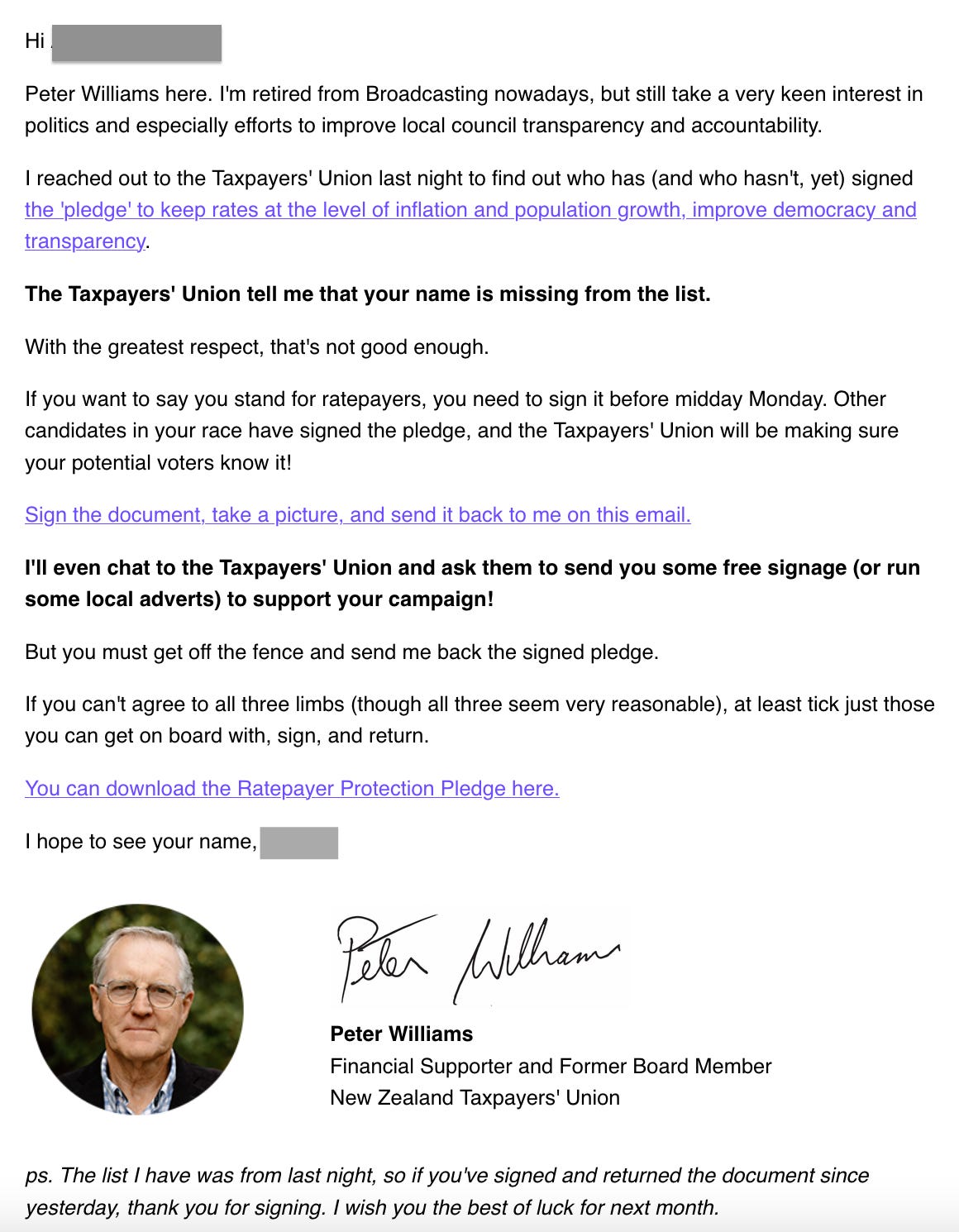
Indeed, in accompanying letters sent by the organisation 71 year former sports broadcaster Peter Williams sends this from a @taxpayers.org.nz address.
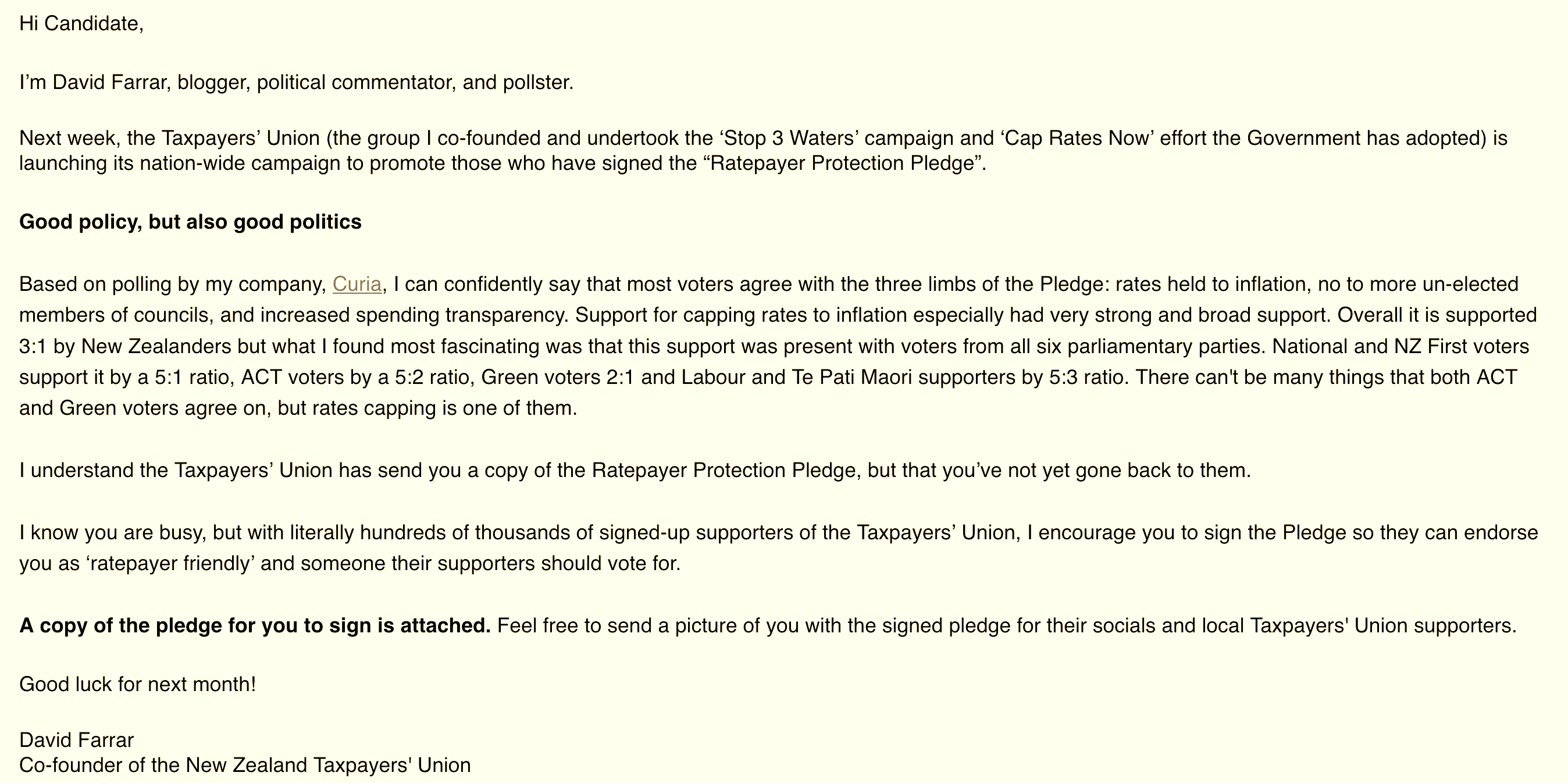
And in a more recent email from David Farrar, owner of Curia Market Research, we see Farrar claim Greens voters support their pledge ideas.
Is this acceptable politiking in our country now?
This is the same group which championed the attack on 3 Waters which is causing many councils to hike rates by at least a third across NZ and contributed many councils to get credit downgrades (hiking fees even more)
The fact is though, this is in National’s & ACT’s interests, in my opinion.
I think that their play is this:
- Identify and promote friendly candidates to take over local councils, irrespective of credentials and character (this is via support such as outlined above e.g. posters, advertisements etc).
- Simon Watts will propose the rates cap bill later in the year to suppress rates and investment across NZ, while claiming this is in Kiwis’ best interests.
- If they have sufficient support from within local councils, this will make it politically easier for the govt to get their way without appearing to subvert local democracy.
- “Their” friendly Councillors can also work for them organically from within Councils and antagonise local politics as needed
- Chris Bishop has brought in folks like Steve Joyce etc to progress his plans to “encourage” local councils to sell off local assets
- As Councils rely primarily on rates to run, once National ties their hands, and local councils are stacked with their people, it will be much easier to encourage sale of local council assets to friends, developers, donors, insiders etc.
- There are other things in play right now too e.g. LGNZ and other bodies are being systematically undermined by politicians like Nick Smith etc in partnership with Jordan Williams etc. to ensure they can’t work in the best interests of their members.
ODT ran an article on this too, which revealed high pressure techniques – 17 emails to some candidates, in what is being called “bullying and intimidation tactics”
Personally I’m not sure that this is the type of politics we want in the country but that’s just me.

Are you prepared for this, Aotearoa New Zealand?
Well it ain't hard for the alternative candidates to show the assets and services people get by paying their $$$$ rates.
Seriously local governments deliver so much, but even at LTP time most find it hard to say what people get for their money.
Simple example: does anyone know how much it costs to put in 1km of local road? Or the full 3 water cost of an average house per year?
Councils should be able to say what people are paying for, and make it worth their while.
Cost structures for things like roading and infrastructure are complex because they’re set on a project-by-project basis and depend on factors like material prices, timeframes, design constraints, and the scale of the work. So, it’s not as simple as saying your $X in rates equals Y kilometres of new roads. And remember; rates aren’t a direct “fee for services”. They’re a tax on property ownership used to fund a wide range of infrastructure and services.
The bigger challenge, though, is perception. There’s this persistent idea that councils are deliberately inefficient or “wasting” money on “nice to haves.” But when you drill down, the examples people get worked up about: staff morning teas, new offices, international travel (things I’ve seen some candidates get very loud about this election cycle), usually add up to fractions of a cent on someone’s rates bill.
At the end of the day, if we want efficient and effective public services, someone has to pay for them. Given the scale and complexity of modern infrastructure, and the regulatory environment councils operate in, we can’t just go back to the old “town clerk” model or arbitrarily slash staff salaries.
Imagine trying to run a council that refused to pay the going rate for wastewater engineers, IT specialists, or planners. You’d end up with worse services, not better ones.
Traditionally, the appeal of working in the public sector was the trade-off: lower salaries compared with the private sector, but in exchange for job security, professional development, and decent conditions. That model is breaking down. Increasingly, local government is becoming a place where you’re paid less and treated to as much contempt and bile as your fellow citizens can hurl at you.
Sometimes just for daring to have lunch in public.
The real drivers of rising costs aren’t morning teas or international travel. They’re the growing price of construction, the weight of regulatory obligations, ageing infrastructure, and the reality of delivering essential services in an increasingly complex environment.
As a major infrastructure project person, and as a person who's done it inside a large council, trust me it really is reasonable to do average costs per kilometre. Of course there are classes of road and classes of pipe. If it weren't possible you wouldn't be able to draft an LTP in the first place.
That's what to drill down on.
Telling people this is a tax and they should suck it up isn't just the cause of the crisis in legitimacy in rates, it pretty much sums up the entire crisis of the left. Drop the arrogance that rates are a tax on property.
The big challenge is no doubt perception.
You don't change perception by doing the same thing and expecting something different.
You tax people by showing that tax to be worthwhile, or you get your ass kicked out.
Okay, let’s say we put a figure on it: $12,000/km, $15,000/km, whatever.
Does that really make the legitimacy problem go away? Rates frustration usually isn’t about not knowing the cost; it’s about people not believing the spend is justified.
People don’t benchmark council costs against engineering standards; they benchmark them against what they think it should cost. That’s why this isn’t really about averages: it’s about trust, narrative, and pushing back against the idea that local government is somehow illegitimate.
What’s really arrogant is assuming that paying rates means you ‘own’ the council and its staff. You’re funding a collective system, not buying a private service. Everyone wants good roads, clean water, and libraries.
But pretending that your personal view of value should dictate every spend is exactly why we end up in gridlock.
The real ‘crisis of the left’ isn’t arrogance: it’s simple cowardice. We’ve stopped defending the value of government and fair taxation because we’re more afraid of upsetting property-owning boomers than protecting the poor and investing in the future.
If we can’t articulate why rates exist and what they achieve, we hand the legitimacy argument to those who want local government to fail.
Agree 100%. Res Publica
I guess you see a different side of things than what I have been involved with otherwise you'd be aghast just like many people are when you see the prices paid on council contracts and projects / services. There's a reason why so many contractors see getting into the council and / or government contracts mix is the holy grail of getting paid, no estimate needed just do the work and send through the invoice which as long as the work is done, will be paid with nobody questioning the cost.
As a simple example I was directly involved with recently. I needed to get a contractor to perform 'some work' (am being deliberately vague here for obvious reasons). The price (estimate, not quote so room for additional costs of course) i was given was let's say $20,000. My eyes literally nearly popped out of my head. This is a job that myself and a mate could do in 1 full day max for labor and we made a couple of phone calls and were able to source the 'building item' needed to replace the broken one at a staggering $2,200 dollars.
So even if we wanted to get really greedy and basically rip our client off we figured we'd be more than very happy charging $7,500 + gst from which we would clear over $2,000 each for an easy and fairly leisurely 1 day's work.
Obviously this is way too much and far more than what we would consider a fair price for the job, so consider the $20,000! When I suggested maybe we should ask for a breakdown of what they would provide for the money and maybe a high level line item breakdown such as Materials, Labor and other (such as travel etc). I was told the client doesn't care what it costs, they just need it done by this 'preferred supplier'
This is a tiny fraction of the amount of money being 'stolen' from ratepayer / taxpayers literally day in day out.
I firmly believe they don't care how much it costs because it's not their money being spent. Otherwise they would at least be asking questions about massively overpriced work being done by contractors.
I also have first hand knowledge of a lucrative and again overpriced contract in the facilities and maintenance areas awarded to someone was magically the only company tendering for this contract and who just happened to have a close relative who is a council representative/employee/elected person (could be any of these) involved in the tendering / contract process for facilities services. That could just be a coincidence of course……
Ratepayers have been getting ripped off for years and some real transparency would be enlightening IMO.
The plural of anecdote isn’t data.
I’ve been responsible for running procurement processes for major projects in my last couple of roles, and it’s a bit more complex than “council bad, contractors greedy.” When it’s done properly, there are strict frameworks, checks, and audits in place. I’ve personally had to push back, sometimes very hard, when prices looked inflated, and just as often when they were suspiciously low.
Honestly, the bigger challenge is often stopping selection panels from obsessing over price alone. The cheapest option isn’t always the best: quality, reliability, and long-term value matter too.
And if you think this stuff just gets rubber-stamped, you’ve clearly never tried getting even a rock-solid, best-practice procurement process through four layers of approval, procurement review, and legal sign-off.
Best summary of what’s going down by far!
A pledge extracted by force should not be binding. In this case presumably the force is the threat of not being elected if a candidate does not sign. If someone were to point this out then all candidates could sign, and the TU’s efforts would be rendered ineffectual.
So sign a pledge and then weasel out of it when you don't do what you signed up to do. Give the reason that "they forced you to sign it"… etc
Couldn't we just save all that drama and vote some adults onto council instead.
I will vote for the candidates who pledge to cap rates rises to inflation like Australia does. These constant 10% plus annual rises are really hurting.
The right wing unions now seem more influential than left wing unions in NZ. I first noticed their influence in 2021 when Jacinda abandoned the hate speech legislation after a big campaign by the Free Speech Union.
Then they went on to define and dominate the 3 waters debate. Now Council budgets.
The Taxpayers Union and the Free Speech Union are not unions in the conventional workers collective bargaining sense, they use the word to misdirect, confuse and mislead – they are mouthpieces for hidden capital that wishes to subvert the political process for its own ends.
100% See Mountain Tui on the subject.
Cool, so you’re happy with fewer and worse services then?
Because the reality is that the cost inflation councils face: things like construction, materials, compliance, and infrastructure maintenance; is well above the CPI. Councils don't buy a lot of butter or weetbix. But do need a lot of pipes and concrete and specialised engineering services.
Capping rates sounds nice, but it would mean cutting services, deferring maintenance, and letting infrastructure slowly crumble.
And the problem that occurred in Australia was that councils who had raised rates significantly before the legislation had the ongoing benefit of having done so locked in and those that hadn't were effectively locked out of ever doing so and are really struggling.
Point in time legislation like this is not useful by any means.
Same thing happened in the UK (councils capped & cutting services) & those small towns are really suffering (& coincidentally voting for Farage in larger numbers).
Signers of this pledge are cynics, who know the cost of everything and the value of nothing. I will not vote for cynics.
One example of the trouble with capping rates rises to inflation is that prices for the myriad of services council pays external providers for and project work, etc, all go up in price much faster than the 'official' rate of inflation. But Salaries for council employees yes definitely!
Yeah, good luck attracting the expertise needed to run a complex public sector organisation if you refuse to pay the going rate for qualified and experienced staff.
You do realise local government operates in the same job market as everyone else, right? If councils don’t offer competitive salaries, those people will just go and work somewhere else where they get paid more and don’t have to deal with everyone’s hot takes on how “easy” their jobs are.
Somehow, the same people complaining about “overpaid” council staff are usually the first to complain about “incompetence” when we can’t retain talent.
You can’t have it both ways.
As with all scams, be it from Nigeria or from the The Taxpayers’ Union (aka The Onion), ignore, don’t respond, don’t click on any links, and don’t download any documents. Don’t confirm your e-mail address, don’t give away your IP address, and don’t let on how gullible/paranoid you might be. The latter may be a weak point that others may exploit in future.
In general, I’ve got no issue with political campaigns pushing for their policies, even if I think those policies are stupid or wrong.
That’s democracy.
What really worries me, though, is the relentless pushing of an untrue narrative about local government: this idea that councils are incompetent, wasteful, or corrupt. It’s not just misleading: it actively delegitimises local democracy and turns public servants into targets in a manufactured culture war.
From inside the sector, it’s bleak. There are genuine break-room conversations about hiding our council IDs when we leave the office, just to avoid abuse. And the general consensus among a lot of staff is that it’s not a matter of if, but when, someone is seriously injured or killed because of this escalating hostility.
that's very bad.
Stochastic violence is a thing
I've just driven past about a hundred billboards of aspiring local body candidates. At least half lead with the promise of no or low rates rises. It is by far the most popular appeal for election. And there are many examples of incompetence and wasted money within Councils.
Wgton building the Takina Centre which loses a fortune each year before attending to the water. Some Councils get so bad that Commissioners have to be appointed.
it's not a surprise that people promise things to get elected. The reality is a bit different, which is why we're in the situation we're in with so many councils.
There's been strong expectation in the past that councils will do things like build events centres.
Wellington is a special case and should be studied for how not to do things for a long time into the future. WCC has one of the highest rate rises in NZ and has abysmal approval ratings. These two things need not be linked.
Over the years WCC has flown in the face of ratepayers wishes, and continues to do so. There was a reason that a Commissioner was placed within the WCC, ie inability to get agreement to the LTP but this hid a multitude of sins. There were concerns about overspending, predetermination in consultation decisions etc etc
In the meantime Wellington looks like a scuffed, kicked rundown city trying to live up to its former glory. There was a time when the slogan "absolutely positively Wellington' was proudly said and meant something.
Ratepayers, bless us, have been treated like an ATM with one of the highest rate increases NZ-wide in recent years.
Instead of budgetting for maintenance WCC prefers to slash and burn by proposing to demolish eg the Begonia House, City to Sea bridge, Michael Fowler Centre. We are now full speed ahead on the Golden Mile that many of us are over as it has taken so long, the world has moved on. City fathers and mothers still think the way to ensure the buses run to time is for them to make fewer stops, rather than looking at more bus lanes, buses only streets……then there are those who answer to budgets and general nirvana is to insist that everyone hops on a bike.
I've lived here in Wellington for 51 years and the last few, say two, years are the only times I have seriously looked at other cities, even countries, to move to. Our council seems wildly ungoverned with some seriously nasty people on some sides of the Council, and thankfully, some mild mannered stars too.
I have long been of the view that NZ politics has no place in local authorities, though I suspect the boat has left on that view. I had the view that the ideal person to be on a council was one who had demonstrated a track record of working for the city as a whole rather than a political party.
I can think of one Labour Councillor who I am proud he is a Councillor, Labour person and represents the ward I live in and even lives in my suburb. That is Cnclr Nureddin Abdurahman. But he is the exception to the rule being an exceptional person in a sea of unexceptional people who have shown their political colours. Of course there are others who espouse no membership of a NZ political party within council. Many of these are solid dependable Councillors.
Getting back to lower rate rise and limits to rate rises….. my view is that some sort of purity argument or even some sort of politics of envy around people owning property has no place in the current world. We should encourage people to own homes just as we should encourage the provision of longer term rental homes.
We need to ensure that our Councils are carefully managed, not subject to flights of fancy, focused on doing their jobs well. If this means a refocus on what the jobs should be then so be it.
If an acceptable aim is to keep rates rises to the rate of inflation then let's try this. Don't wave the aim away, untried, by saying it cannot be done.
Please also don't wave it away by saying it is somehow politically wrong. It is not wrong, especially to lower waged ratepayers for their Council to run carefully and efficiently. We want, or should want everyone to have a crack at home ownership if they want to.
Apart from having a roof over ones head, home ownership plays dividends in schooling with children educated with their known peers over years, stability in our suburbs also gives a springboard to homeowners who may be of a lefty persuasion to get voices heard in community organisations.
The local body candidates who are remaining 'schtum' about the rates questions are attempting to hide their heads in the sand. WCC has had a culture of excess for several years. It has a comms unit that is greater in number than even the current PM's. I would hate to find out the current churn but I somehow suspect it would be way higher than upper limit of expected churn of 14-16%.
So failing to heed and not dismiss people who want to limit rates rises may end up with us shooting ourselves in the foot/feet? We do not want anyone forced out by unaffordable rates rises. We especially don't want those of a left leaning persuasion to be forced out.
So please think really hard about what those who are in favour of limiting rates rises are saying. I'd rather focus on better roads, pavements, stormwater etc than free Neighbours Days celebrations or free cycle maintenance workshops (we have a myriad of these flights of fancy in WCC).
If we have to remove the frills to keep the budgets down, and this has the benefit of lowering rates and this then has the result of keeping home ownership wider than it has been then I'm all for it.
Limiting rates rise is NOT some capitalist plot. It is a fair and responsible attitude to the ones who pay the rates that enable home ownership and home occupation (WCC is one of the few councils to still maintain a system of rental properties)
I always mentally translate that into "Vote for me! I stand for deferred maintenance and deteriorating city infrastructure!" If they can't be honest themselves, I'm willing to do it for them.
Having worked in local government for over a decade across several councils, I can say with confidence that many of the candidates making these "no or low rates rise" promises have little understanding of how local government actually operates.
The reality is that a huge proportion of council costs are driven by two key factors:
Are there inefficiencies within councils? Absolutely. Are there things we could do to be more effective and efficient? Definitely.
And have some Councils made wildly terrible decisions? Sad, but also true.
But meaningful reform takes time, investment, and political courage: which means it’s often avoided when the focus is on short-term popularity rather than long-term sustainability.
And here’s the irony: the same people who complain the loudest about unsustainable rates rises are often the first to protest when councils invest in modern IT systems, better data, or process improvements, the very things that would actually deliver long-term efficiencies and cost savings, dismissing them as a “waste.”
There’s also a frustrating tendency among some of these candidates to begrudge staff even the basics: like tea and coffee in the break room. And God help us all if we want to work somewhere that isn’t a freezing, asbestos-ridden office built in the 1920s, or gasp have lunch in a public place during the day without it being turned into a scandal.
So, while the "no rates rise" slogan looks great on a billboard, the reality is far more complex than many candidates acknowledge. Too often, these simplistic promises lead to short-sighted decisions that create bigger problems, and bigger bills, for the councils and communities that come after them.
I couldn’t agree more with you. However, that’s not at the same level as “morning teas or international travel”. Not all coffee & coffee machines are the same either, so why should (senior) management give themselves those fancy perks over and above the many other worker bees in the same organisation? Do we give the cleaner crew ‘evening teas’ while the rest of us are having dinner or are at sleep at home? There’s a fine line between nice-to-have and need-to-have; the self-entitled and self-serving all too often move that line or ignore it. I wish I could argue that this is a spill-over from the private-corporate world but I can’t. That said, not all people working in/for the same organisation should be tainted with the same brush.
In our office, each floor has a pair of fancy machines that make barista-style coffee. They cost the Council next to nothing, but I’m sure there are plenty of voters out there who’d love to see them ripped out on principle.
Of course, that would just mean a substantial chunk of our 800-odd FTEs would be out wandering around at any given time buying coffee instead. And unless you happen to own a nearby café, it'd be a net loss to you as that would waste more time and hurt efficiency a whole lot more than keeping the machines where they are.
But hey. At least someone’s boomer uncle would get that warm, self-congratulatory glow you can only achieve by “saving” what amounts to less than a rounding error in one line in our annual plan. And, of course, they get the added satisfaction of feeling like they’ve really pwned those parasatic, lazy, overpaid public servants in the process.
I think you and I are talking somewhat past each other and I don’t want to dwell here on the hidden costs of fancy machines that make barista-quality coffee; hidden cost ≠ no or low cost. For my colleagues and me it’s a boiling appliance (used to be a plug-in jug) and bulk-buy instant coffee. If we want something decent to drink or eat then we have to head out and buy it ourselves. It doesn’t hurt our efficiency to have a walk away from the desk and get some fresh air but it does hurt in our pockets.
So a council employee working in an office job by the sounds of it rather than in the field, states with certainty that council isn't full of wasteful spending, isn't in general incompetent and there's no corruption of course.
Are you involved in paying service providers for various jobs in any way? Do you see the invoices? If so have you ever questioned (or tried to question) the amounts being invoiced to and paid by council?
I’m not sure if I like what you’re implying here. It sounds uncomfortably close to a personal attack rather than a discussion about process.
For the record, yes, I’ve been directly responsible for running procurement processes for major IT projects. That includes evaluating bids, reviewing invoices, and challenging pricing when needed; and I’ve done so many times.
There are strict frameworks, checks, and audits in place to make sure ratepayers get the best value possible, and I take those responsibilities very seriously.
If you want to accuse me, or anyone else, of incompetence or corruption, then do it directly and back it up with facts. Otherwise, you’re going to need more than vague anecdotes and pub-talk conspiracy theories if you want to be taken seriously.
The same people who bitched about 3 waters are now bitching about the rising rates bill as long neglected water infrastructure has to be addressed.
I still think expensive consultants should be replaced by inhouse qualified specialists
Consultants are the epitome of knowing the price of everything but the value of nothing. They almost always know nothing about what really gets done and what it takes to get it done.
Nut jobs say:
Rate caps = good
Rent caps = bad
The only 1 I disagree with is the first one, unfortunately we have decades of poor governance to catch up on.
And no I'm not anti Maori wards I just think those on them need to be elected.
Yes that's how exactly any ward works except when only one person runs. This isn't a feature of Māori wards or anything.
What the TPU is proposing is that no council member, who was elected unopposed, should allowed be on a spending committee. This would, for example, exclude the Mayors of Hurunui and Manawatu.
And a surprising number of mayors and councillors around the country over the years, my local Arrowtown ward, when it just covers the old borough, probably went 20 years without an election up until it expanded and got multiple councillors. No one seemed to mind and the people (s)elected were pretty solid so it worked. Unopposed generally means the incumbent is doing a pretty good job and no one is motivated to stand and say they could do it better
please fix your username on next comment. The system thinks you are a new commenter and is holding your comments back for manual release.
Sorted this time, I hope
Is that how you read the third pledge?
Yes. It is a pledge to 'oppose unelected appointments onto council committees', this means that they think that 'unelected appointments' shouldn't be on said committees.
Happy to hear other interpretations of 'unelected appointments' in this context.
I don’t think that’s what the pledge says or implies. Anyway, a person standing for office has to go through the whole admin & registration process to become a bona fide candidate. Only when that process closes will we know if they’re unopposed. If they receive >1 vote in the election they will be elected and appointed into the role they stood for.
If elected folks appoint unelected people, i.e., do a ‘Musk’ in some kind of backdoor way, then I’d have a problem with that unless pre-existing regulations allow for that and there’s a proper process for it that’s fair, open, and transparent.
If that is your interpretation of 'unelected appointment' in this pledge, fair enough, the language is ambiguous enough that both can be accurate. The eventual pledgees understanding of it and their intentions when pledging are likely to be broad enough, and also open to interpretation, that the TPU's promotion of it could appear 'non-denominational' as it were.
As I mentioned earlier, appointing external members to certain council committees is actually quite common: especially in smaller councils.
In many cases, this is about bringing in independent expertise for things like audit and risk committees, where specialist financial or governance knowledge is valuable and not always available among elected members or council staff. These appointments are usually made through a proper, transparent process and are intended to strengthen oversight, not weaken it.
What I think the TPU is specifically referring to here, though, is the appointment of representatives from iwi consultation groups onto committees.
That’s also relatively common, particularly where councils have obligations under the Local Government Act or other legislation to engage with mana whenua.
In both cases, these aren’t “backdoor” appointments. They’re made openly, follow proper governance frameworks, and are generally designed to improve decision-making and accountability.
The 'unelected' comment is, I believe, directed at the Wellington City Council, again. (We could do a series of lectures on how badly this Council has been run/governed over the last few years….)
Wellington has one Maori ward:
We have had Cnclr Nikau Wi Neera representing the Te Whanganui-a-Tara Māori Ward. I understand he is to study overseas and will not be standing this year. He has participated as well as many of the other Councillors and has not been overtly ‘whipped’ by the Green Party hierarchy on WCC. (Gossip says much to that party’s annoyance.)
This council also has non elected people appointed to its committees.
https://wellington.govt.nz/your-council/about-the-council/mayor-and-councillors/mana-whenua-representatives
Mana whenua appointees have voting rights on the all the committees they are members of. They do not have voting rights at full council meetings.
So no problem you think? The Committees are where the 'grunt' work happens. Then the minutes of Committees are usually just hand waved through and rarely is an item that was decided at a Committee looked at in depth at the full Council.
My observations are that
1 Mana whenua reps mostly vote in line with the Mayor's stance
2 They seem not to speak at the same rate as other members of Committees
2 Some contentious decisions, some involving particular communities, have had votes for unwanted WCC flights of fancy carried by a majority of two.
Had the Mana whenua votes not been counted in then votes would be tied. This then would enable a casting vote or delay to really work hard to find a consensus ie give/take.
I'd prefer more Maori wards or possibly to elect 2 people per Maori ward to a continuation of WCC's Mana whenua non -elected appointments.
That would certainly make things interesting. In practice, quite a few councils already bring in independent members to sit on, and sometimes even chair, their Finance, Audit, and Risk committees.
It’s one way to strengthen oversight and ensure there’s a broader range of expertise at the table. So obviously, denying those members a vote would definitely strengthen oversight rather than weaken it.
Unless, of course, “unelected members” is actually meant to refer to a totally different kind of committee participant. But surely surely an organisation as consistently transparent, principled, and completely untainted by any accusations of racism as the TPU wouldn’t dream of engaging in dog-whistling.
Quite.
I actually have no problem with co-opting expertise to get said expertise or broaden the outlook.
My view is that co-opted people should not have voting rights on any committees.
We could double up on the number elected in a Maori ward to get specific Maori representation.
So, if the principle is no unelected members having votes, then surely that also applies to Hobson’s Pledge’s push for self-appointed ratepayer activists to have a seat at the table, right?
Because right now, it sounds like co-opting unelected members is acceptable when it’s for governance, finance, or ratepayer perspectives. But when it’s mana whenua expertise, suddenly it’s a problem.
That’s not consistency; that’s a double standard.
I've got no problem with co-option for expertise.
I do have a problem with unelected or co-opted people, no matter who they are then having a right to vote to make decisions, as if they were fully elected councillors.
I have not heard of another council co-opting plus voting in the way that WCC has.
I've also not actually heard of a council formally co-opting people onto a council committee. I've not heard that WCC, for all its sins, has done this. Usually expertise is provided from within the council staff, by contracted staff or by consultants (shudder)
I stress it is the co-option PLUS giving an ability for a co-opted member to vote during committee work that I am concerned about.
If a Council did this to get any form of expertise I would have a concern.
In which case they aren’t genuine committee members as such, are they?
In the WCC model co-opted people have a right to participate including voting. These are people who have not been elected.
If expertise is required on a statutory board or local Authority then it can be bought in as an advisory role to the Council. In the PS of old there were many many boards that had co-opted members who particpated by passing on expertise & being involved in discussions but voting was restricted to elected or ministerially appointed people. No matter how they came to get to a board the all important discussion was wide ranging and the voting was left to those elected.
If we are lacking in Maori participation in local authorities, and we are in some places, then we could double up on numbers coming from the Maori ward votes so say 2 or 3 were elected per ward instead of the one we have now.
The way WCC has it now is a mixture of tokenism (ie Maori can't get there under their own steam so they have to be appointed in), and a disregard of the elected representative principles.
I don't have any issue with items two and three on their pledge, but quite frankly an endorsement by the Taxpayers' Union would be enough for me to reject a local-body candidate out-of-hand. My city has preferential voting, so for once I'm kind of grateful to the TU for helping me identify who to rank lowest.
I don't disagree at all with the second and third statements on the pledge and having knowledge of various contractors and amounts of rate payers money being what I consider "ripped off" from rate payers paying well over fair market prices for all sorts of services and projects. That aside, am not a fan of pledges or pledge cards in politics anyway. Outlinne your policy positions and people will hold you to account if you represent their interests well or not. (as long as rate payers have the information / data to be informed as to council 'goings on'.
But I would hope that all council candidates would agree with those second and third statements at least and explain why they either don't completely agree with the first or even come up with something better.
This is just a group playing the politics game. Yes Williams and his taxpayers union are tossers (to be generous) who care not a jot for your average joe (as is often the case with people that get involved in politics having come from a wealthy family background) But it's hardly bullying and intimidating IMO. I would maybe think twice about a potential candidate who isn't able to deal with this sort of thing. I would want my vote (If i wasn't voting for a candidate aligned with the taxpayers union, which I'm not) to go to someone who wasn't so easily fazed maybe?
For example I like to think I would never get 17 emails because I would have blocked them probably after about 3. Depending on how much spare time I had I might even annoy them back via the email platform. there's lots of ways to do that if you are that way inclined. But yes I know it's best to just block them and leave it at that…
Seriously, if someone considers the things being talked about here as bullying and intimidation then all I can say is they must have led a sheltered life thus far and maybe aren't quite cut out for politics just yet?
The ratepayers / voters they are trying to bring to their 'side' will see what appear to be entirely reasonable statements for a potential councilor to agree to, then they'll see or hear said councilor moaning about bullying and intimidation and then they'll conclude that said councilor just disagrees with the pledge statements because they want to go on a spending spree on nonsense, waste of money, virtue signaling projects and new departments, high salaries, etc. In other words you're doing exactly what the taxpayers union want you to do.
Heh yip if you arnt string enough to at the very least straight to spam that shit you're in the wrong job, I'd probably reply with a go fuck your self to be honest.
Whatever next? Horse heads in the bed?
Or, because it’s Taxpayers Union, the other end might be more appropriate
..
What many people don't understand is that Councils not only have to fund the building of an asset like a road or a playground, they also have to maintain them in perpetuity. They account for some of that by loading a certain number of years maintenance into the initial costings.