
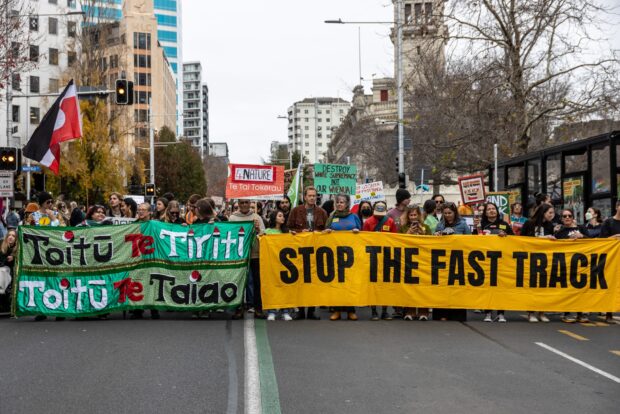
Just over a year ago the Government passed a constitutional abomination of a law and is now trying to make it worse and do this quickly.
What is going on?
The change is according to the Government about improving supermarket competition. When it was introduced Chris Bishop said that the bill was to “promote supermarket competition and to improve the application process so it’s more efficient for all fast-track projects”.
The supermarket competition bit is achieved by including the words “will promote competition in the grocery industry” into the list of matters the relevant Minister has to consider when deciding whether or not to consider a referral application for a proposed project.
This is one clause in a 62 clause bill.
The rest of the bill is said to be to make the system more “efficient”. This is achieved mainly by reducing the time taken to complete an application.
And the bill will make it cheaper for applicants. Those poor resource strapped applicants whicn in some cases include donors to the Government Parties clearly need the help.
It is clear from the briefing papers that the changes were drafted after the Government had a quiet chat to the applicants themselves and talked to the lawyers who must be making lots of money shepherding these applications through the process. And then followed their wishes.
The bill shows a further complete disdain for the Treaty of Waitangi.
The briefing to the Ministers says this:
Consultation with Te Puni Kōkiri indicated that reducing timeframes for comments and restricting either the time a panel convener may take to appoint panels or the information they may receive may run counter to the Crown’s obligations to its Treaty partners by reducing their opportunities to be involved in the process.
Efficiencies are being achieved in part by reducing time frames. For instance after some push back the original Act had a timeframe for Local Authorities to reply to applications of 20 working days. The original bill proposed a period of only ten working days which was a ridiculously short period for assessment of what can be incredibly complex applications. Although it compromised on this the Government is now attempting to push this time period back to 15 working days.
There is an extraordinary new power in the Act that is not referred to in the Ministerial Briefing Papers and which is way beyond a mere tidy up of the law.
The Government is taking the opportunity to give the Minister of Infrastructure the ability to issue Government Policy Statements which set out the Government’s policies about regional and national benefits of certain types of infrastructure or development projects. The Minister does not have to consult with the public. The guardrails that apply to the preparation of National Policy Statements or Regional Policy Statements in the RMA which require extensive consultation do not apply.
This is an extraordinary power.
And to add to the list of extraordinary powers is a power for the Crown to amend schedule 2 of the Act, the schedule listing all of the Government approved projects, by order in Council.
This is because the Government lost in Court when the Tauranga Port Extension was challenged on Judicial Review. The Judge in that case rightfully said that the description in the schedule which was “extend the Sulphur Point wharf” should be not be read, as the Environmental Protection Agency had attempted to do, to mean “extend the Sulphur Point and Mount Maunganui wharves”. If this Bill is passed there will be no need for the Government to worry about pesky lawyers and iwi wanting the clear terms of the statutory description being followed. They will be able to change it.
It is hard to understand why costs for applicants should be reduced. After all these are multi million if not billion dollar projects.
Just think about Trans Tasman Resources Ltd’s application to destroy a large part of Taranaki’s seabed in the pursuit of profits. There are estimates that it could earn the company more than a billion dollars a year.
And their shareholders do not appear to be short of money. For instance shareholder Phil Brown gave National MP David Macleod $10,000 before the last election which, along with other donations totalling $168,394 Macleod then forgot to declare.
National’s largesse to its donors is extraordinary.
The Trans Tasman Resource’s bid has been rejected repeatedly. It involves a really controversial proposal to rip up large parts of the Taranaki sea bed so that it can mine minerals. As Advantage points out this has destroyed an alternative proposal for windmills which would have provided the North Island with cheap power, as opposed to providing an Australian corporation with cheap rare earth minerals.
Its application went all the way to the Supreme Court where the Court decided that section 10 of the Exclusive Economic Zone and Continental Shelf (Environmental Effects) Act 2012 meant exactly what it seemed to say. Subsection one states that the purpose of the Act is “to protect the environment from pollution by regulating or prohibiting the discharge of harmful substances and the dumping or incineration of waste or other matter”. Subsection two states that sustainable management means managing the use, development, and protection of natural resources in a way, or at a rate, that enables people to provide for their economic well-being while sustaining the potential of natural resources (excluding minerals) to meet the reasonably foreseeable needs of future generations; and safeguarding the life-supporting capacity of the environment, and avoiding, remedying, or mitigating any adverse effects of activities on the environment.
And there is the not minor issue with the country’s obligations under the United Nations Convention on the Law of the Sea. This contains strong language obliging states to prevent, reduce and control pollution of the marine environment from any source. I wonder if the Government thought about this when it passed the fast track law.
This provides that when a panel is considering an application that affects the continental shelf section 10 has to be considered but that the more permissive provisions of the Fast Track Approvals Act must be given the greatest weight. Take that UNCLOS.
This whole regime stinks. Put aside the question of donations, the reducing and then further reducing the ability of third parties to have a say in really big and potentially environmentally devastating projects, the speeding up of the process even more, the giving Ministers huge power to pick and choose the projects they want to proceed and the giving to very wealthy corporations a fees cut, sucks a great deal.
And the Government is trying to smash this change through as. quickly as possible. Submissions close tomorrow at 2 pm and the Government wants the bill passed by the end of the year. They know there is a major risk that they will be thrown out at next year’s election and it looks like they are trying to get as many projects beyond the point of no return as they can.
This is banana republic stuff. I never thought that National would descend this low into environmental vandalism and petty corruption.
When it is set up someone should complain to the Regulatory Standards Board. This is the crassist example of law making I have ever witnessed.
Feels worse than Muldoon and Birch.
Disgusting to see our judicial system rolled like this.
One of the biggest weaknesses in the current regime is the 20-working-day timeframe for councils to process applications under the RMA. It’s also one of the few metrics TAs are required to report back to central government.
In practice, all this does is incentivise councils to game the system: endless RFIs, procedural resets, and technical pauses to stay “within” the 20-day window. Even though the real process often takes 7–8 months.
Everyone knows the number is fiction.
Arbitrarily reducing that timeframe won’t create efficiency. It will just make the problem worse.
At some point, someone needs to decide who actually manages natural resources in New Zealand.
If it’s councils, then Bishop should get out of the way and let them make decisions.
If it’s central government, then the government should take responsibility, resource the system properly, and run a nationally consistent process.
What we have now: pushing the cost and complexity of running consent processes onto local government while simultaneously doing end-runs around their decisions whenever they clash with ministers’ political interests, is constitutionally incoherent, legally risky, and exactly the kind of arbitrary decision-making the RSA is supposedly designed to prevent.
The irony is that Chris Bishop is also the Minister of Transport. You’d think someone in that role would understand the importance of picking a lane.
Great post Micky. Complete madness. More and more this feels like a doomed government ramming things through for its rich and/or donor mates before they are thrown out.
Hipkins needs to clearly say that all fast-tracking will be scrapped in the first 100 days after the election of a Labour-led coalition. [Possible exceptions-thermal energy projects, solar and wind farms that include battery storage]
Planning should revert to the RMA as it was when the COC was elected, and then soon after superceded by David Parker's two-pronged replacement for the RMA.
Corporates are also reducing the opportunities for ordinary NZers to fish, hunt and hike in the outdoors: https://www.scoop.co.nz/stories/BU2511/S00211/traditional-kiwi-outdoor-access-under-threat-from-corporates.htm
Every time I think of the Fast–track legislation it reminds me of Chris Rea’s song “The Road to Hell.”
https://www.stuff.co.nz/politics/360888343/greens-vow-kill-seven-mining-projects-currently-underway
It seems national arnt the only party that'll use the repeal hammer
It's NACT vs the (sovereign) nation state.
Their position on seabed mining as per UNCLOS has implications for our foreign policy in the Pacific Ocean.
The South Pacific Islands are debt financed by China. This to access their fisheries and sea bed zones for now – but they are also obliged to consult China about their foreign policy.
The Americans are responding – but do not have sea bed mining tech.
We had the chance for a sea bed mining free zone but this government is ruining our credibility.
Why?
How can we stand up to China in the South China Sea if we lose our own UNCLOS standing?
Who is in charge of NACT policy settings?
Surely it cannot be the Foreign Minister.
I read an RNZ article in relation….Of course Chris Bishop and Nicola Willis talk up the Fast Track Approval law like its going to be such a fantastic opportunity. Well, yes…making it so much easier for the rich..to get richer. I like that Labour MP's Arena Williams and Priyanca Radhakrishnan get to the crux of this Trojan horse arse…
Further in to the article….a fine speech by new Green MP Mike Davidson.
Cmon Labour/Green. Kick NACT1 out 2026 !