
Where we are now
The electoral position is clear pre-special votes: National, ACT and NZ First are up on the opposition parties by 3 seats.
Labour won the popular vote, but the Mowbrays, Reality Check Radio (anti-vaccination grou0) and NZ First/ACT alliance’s split voting strategy has resulted in an 11 seat overhang*1
And a tight, but very possible, victory for the Coalition.
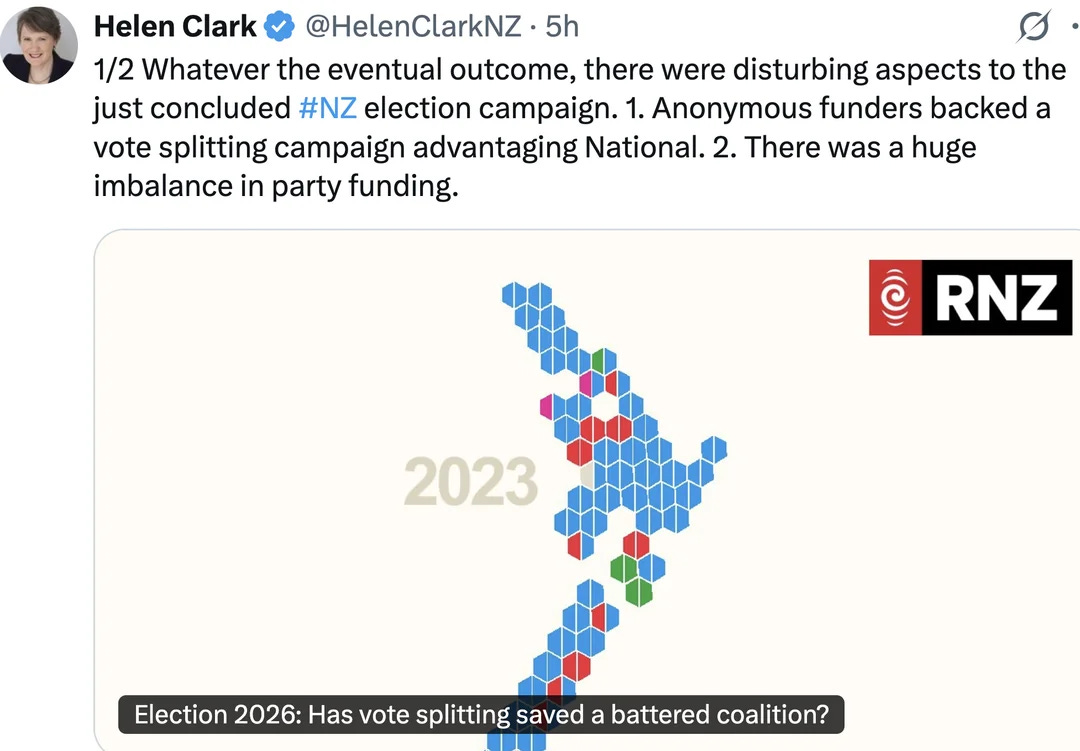
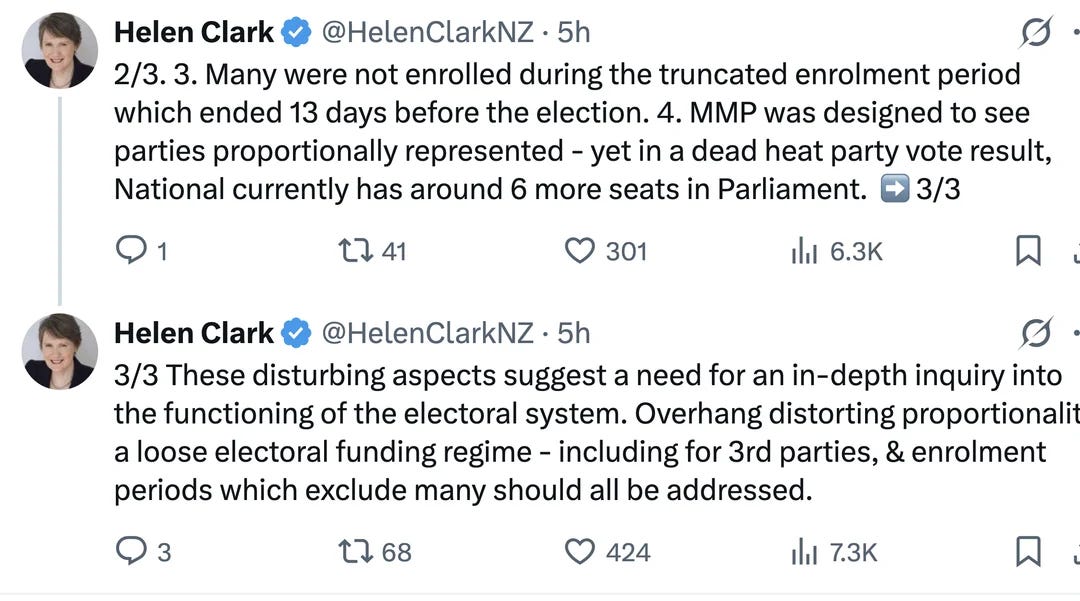
That 11 seat overhang in the words of former New Zealand Prime Minister Helen Clark, is ‘unprecedented’.
Specifically, Clark noted:
“Minor parties have had an overhang before, but a deliberate strategy with large funding behind it to distort proportionality to the extent witnessed yesterday does not have a precedent in NZ to the best of my knowledge.”
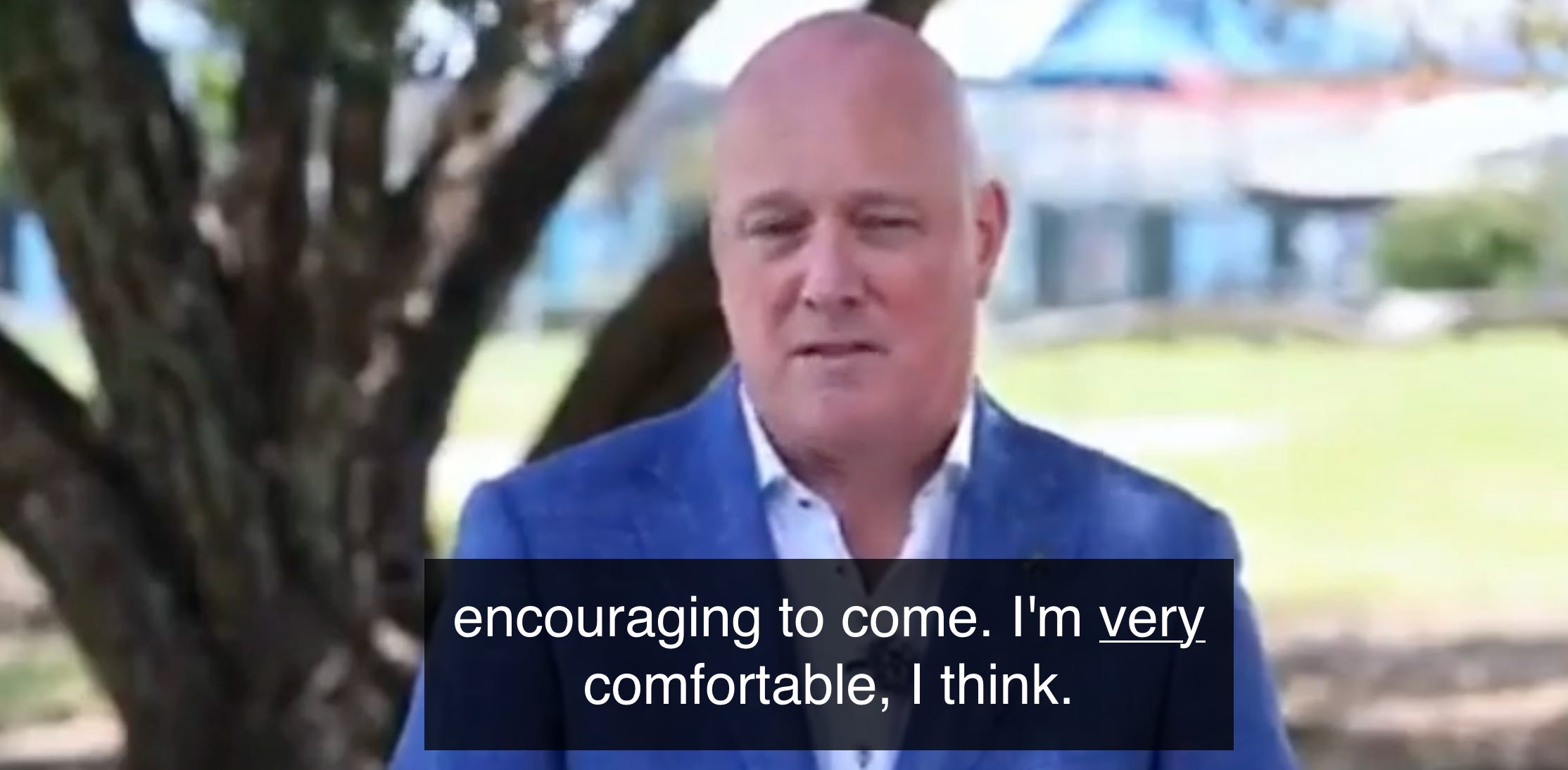
Still, specials, expected to be finalised by 27 November, 2026 will adjust the position
(Yes, nothing sped up from the voter suppression law apart from disenfranchising 300,000 Kiwis and potentially taking away the left’s usual +2 seat advantage. at the cost of millions of taxpayers’ dollars)
A Kiwi generation disenfranchised
What we do know is voter turnout was low – less than 75%.
From a youth perspective, in 2023, 75% of youths voted.
This year, by the 13 day cut off and during peak University exam and assessment period, only 67% of youths had enrolled. Voting would have been less and at least, 8% less than 2023.
I’m not going to do all the specials scenario math as there are far better people for that, but what I do know is that there will be a lot of recrimination to go around.
Recriminations
There will be those who are angry with Labour., and those angry with the Green Party.
Others like me, see lost opportunities and warnings that weren’t ultimately heeded.
Opportunity Party also was a distraction that consumed inordinate oxygen, and their narratives were frequently subtly misleading as well as inadequately analysed. (Jack Tame did a good job scrutiniising how unrealistic their flagship policy actually is)
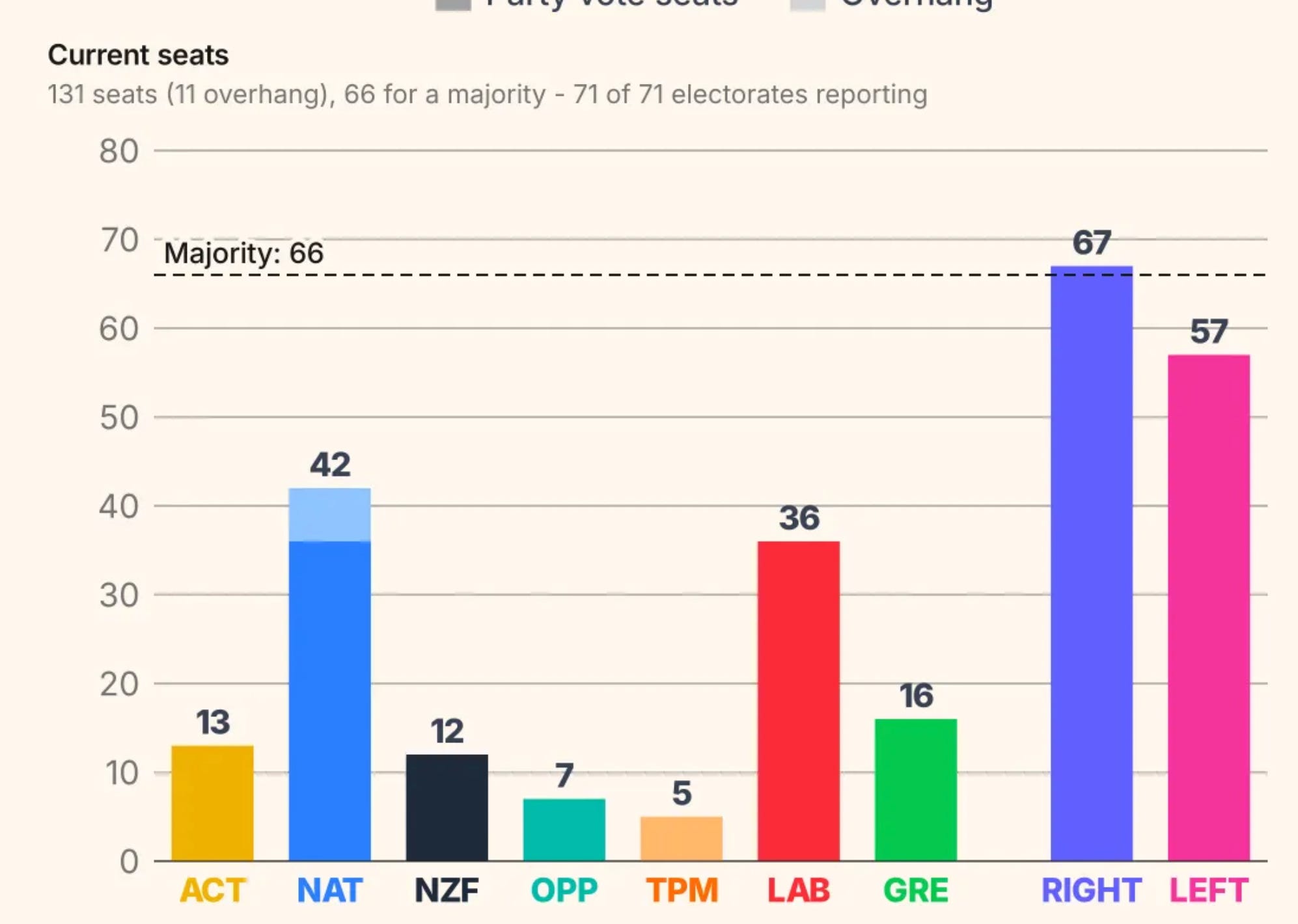
Yesterday in Nelson, Labour MP Racbel Boyak lost by 1200 votes. The Greens ran a high profile and excellent candidate there – O’Neill won 3000 votes.
i.e. The left, in theory, won the popular vote, but lost the critical seat to National.
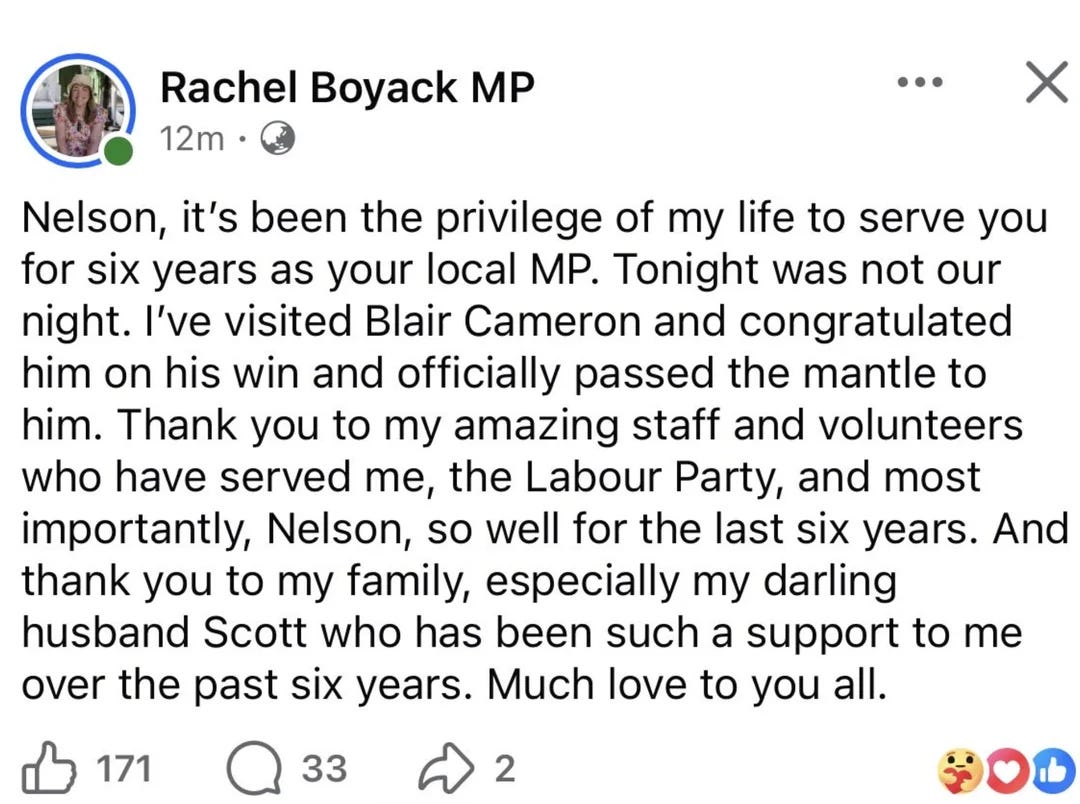
There are other seats where the criticism has arisen around the lack of strategic alignment, and which has cost the left its seats.
But the fact is that the Green Party and Labour are two parties, and if anything, what I have seen over the last three years, is a level of competition. and very different cultures.
Members of the Green Party often feel strong disdain for Labour, and I suspect Labour felt that a majority party had the job of governing for a majority, which inevitably included conservative voters, different electorates, and a broader reach – and they tried to straddle the reality and difficulty of delivery over ambition.
i.e. They hitched their tent to practical solar energy policies cost of living ideas, healthcare funding, but lacked the punch of penetrating through to the voter psyche – especially amidst the noise of the election period. And that is despite Hipkins and Labour being more trusted than National on almost every measure, according to consecutive polls.
In some ways, I felt that Labour campaigned with the knowledge and possible baggage/trauma of the past years, when Jacinda Ardern was overwhelmed and taken down by misleading, negative attack ads and messaging – much of that driven by foreign interference.
My article, I Hate Labour, but Wait, Why? examined how much Ardern’s government did achieve while in power – extraordinary results that demonstrate their ultimate competence despite their lack of PR agility and slick communication skills. And while some will say “Not enough!” I for one reflect on how hard it is to cook a three course dinner, or build a new shed from scratch, versus throwing out sumptuous ideas i.e Delivery is hard, changing generations of issues and National Party demolition of state housing and energy sector and healthcare, is not easy.
It’s not easy if you want to do things.
It just isn’t.
And then to be heavily handicapped by a media landscape that is captured and beholden to neoliberal ideas, such as government debt is bad but private debt is somehow fine, or government ownership is a poor idea, but privatisation doesn’t deserve scrutiny. That the poor are undeserving and lazy, but the wealthiest, which accepts hundreds of millions of taxpayer handouts is “success”.
Perhaps too, it is hard to understand the weight of the tsunami of attacks, disinformation and pure toxicity that could descend on politicians on the left.
Labour, and certainly this class of its leadership, had experienced it first hand.
So Labour aimed to deliver an agenda that they knew they could – and with every cent accounted for, in order to bring the books back to surplus by 2028.
For Green Party supporters, that was unacceptable. The Green Party had bold plans, including a 2.5% wealth tax on individuals with more than $10 million, and which excluded the family home.
It’s not an unpopular idea, and I think Labour just played in a different space because it set out to capture a majority – not a 15% or 13% slice of the electorate.
I often wish that Green Party members would respect where Labour was by virtue of its configuration, and therefore work more harmoniously to become a stronger left bloc – not just a competitor ( a very capitalistic concept in many ways )
I have no blame to give Labour even though I did have a lot of ideas which I kept quiet on – it’s far easier to type on a keyboard or analyse pre-and-post-fact than to be in the field doing the hard yards and making calls.
I give credit to the amazing mahi, and sweat and tears of the Labour MPs and volunteers.
The Green Party have experienced its best result yet, and the discipline, passion, messaging and positivity of the campaign and its leadership is praiseworthy. A huge congratulations to the Party and their new Chief of Staff for an excellent job.
Yet the need for competition, and the vying to be the “leading voice of the left” has impacts – especially in an election as close as this.
Te Pati Māori, which saw a crumbling of its of general political support after the acrimonious and public break up with Takuta Ferris and the Kapa-Kingis, stuck to their strategy of appealing only for electorate votes. They did well and secured 5 electoral seats. Debbie Ngarewa-Packer as usual, was refined, humble, and wise in her post election communications.
Labour will receive a bulk of criticism, and Hipkins will be a target. They campaigned far too late, and the charismatic point was a factor unfortunately – but the tsunami of billionaire / dirty politics, / dark money, corporate media, allies like Taxpayers Union and Free Speech Union, media figures such as Jason Walls etc cannot be underestimated.
Nor the skill, courage, and brilliance of Labour’s candidates like Dr Gary Payinda and Max Harris. Payinda was behind 22 points in Whangarei and yet closed the gap with Bayleys boss Lloyd Budd to a margin of 1000. An extraordinary result by Payinda.
Post election courtship
And this morning, Luxon is again appealing to Opportunity – the official courting dance begins.
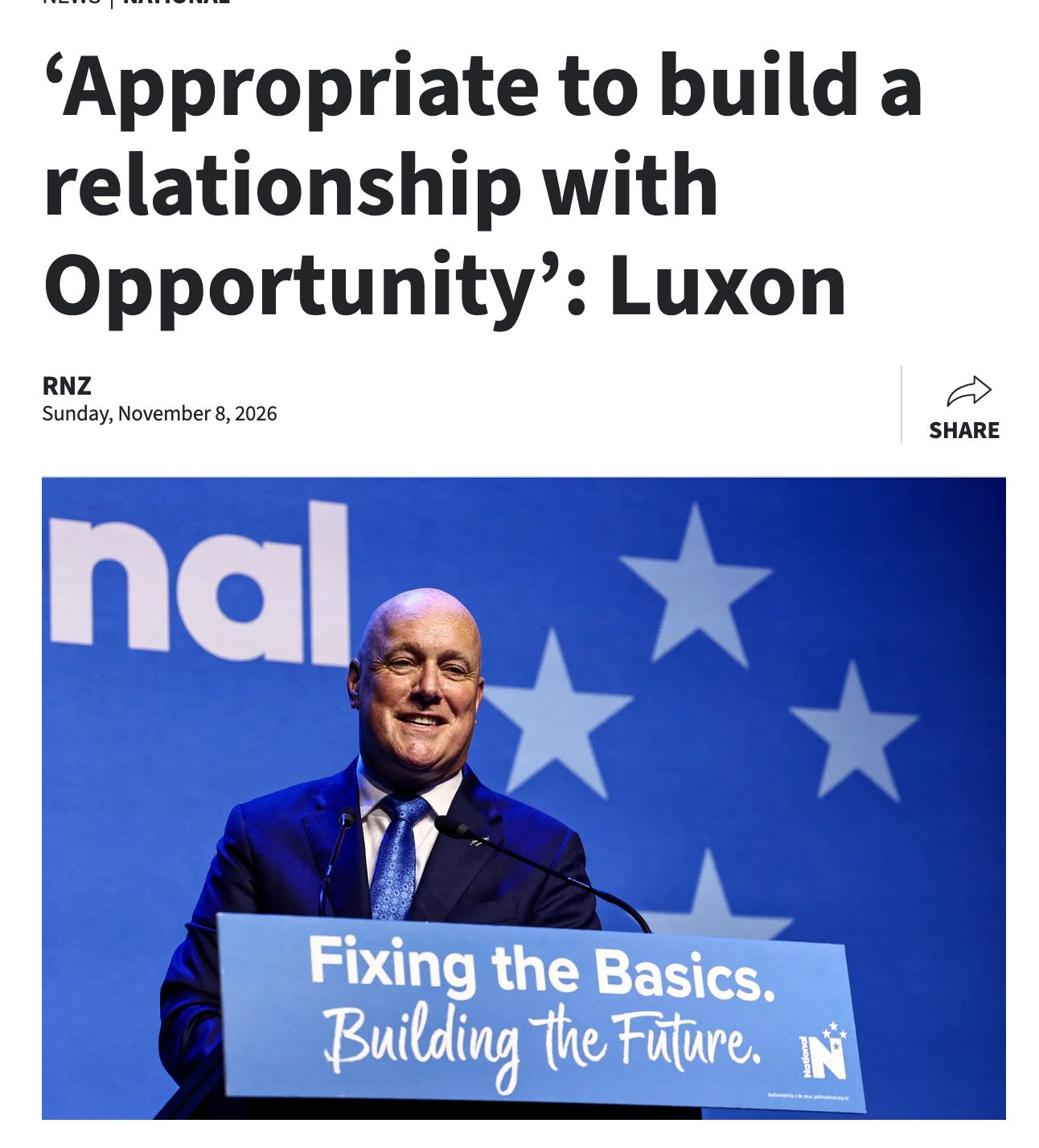
As I said before the election, a likely scenario for Opportunity would be a confidence and supply relationship with National.
And that is only if National needs Opportunity votes, which is possible post-specials.
Everyone is keeping their powder dry.
Billionaire influence and dark money in New Zeealand politics
Harry Mowbray is being more forthright – threatening to pull the purse strings from National if they don’t play ball better in future. And taking credit for the 11 seat overhang
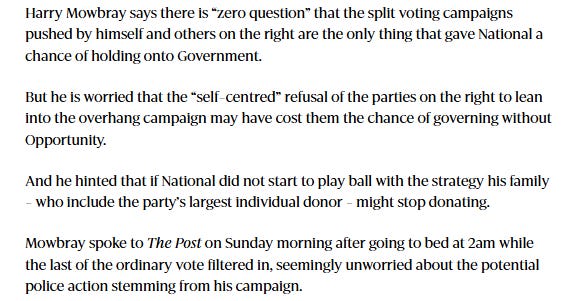
At some level, the whole situation is comical.
It reminds me of the Wright Family’s interview a few years aog, where Wright Junior said his funding of Sean Plunket’s The Platform helped his political influence – and that their family (which receive around $200 million of taxpayers’ funding yearly) had enough wealth and diverse businesses to be effectively untouchable.
The Mowbrays would surpass the Wrights in wealth and business interests, I expect.
On one level the article reads like a parody, but on the other hand, it is very real and present.
Some say this is the age where all secrets are revealed, and so it is in that reckoning that we can all see better what is under the covers.
Opportunity has a culture problem
I revealed last month that one of Dr Harpreet Singh’s anonymised, online attackers turned out to be from an Opportunity Party Maungakiekie candidate, Derrick Paull, who had used his personal, acroynm account to do it
When Dr Singh realised the account was linked to the party, Opportunity officials lied about Paull’s links to the party, claiming he was just a random low level “volunteer”.
An article by Russell Brown revealed that the Party officials and candidates are all effectively classified as volunteers, except for one or two of them, so that was a “technical lie”.
But the deception wasn’t.
It’s hard to know which Opportunity Party accounts are real, or who are the aforementioned “volunteers”
Their AGM reportedly only had 100 members so it was a small group with an oversized online presence.
It’s still troubling to have a history where doubt is easy to forment, and reports of toxic culture and power struggles remain prevalent – so I hope there are no further “examples” that need to be brought up because Opportunity have consumed more air time and oxygen than they deserve.
Their attacks on the likes of Brie Elliot by Board members and Dr Harpreeet Sinh by their candidates , and then lying about it, are all the antithesis of “clean, fresh politics”
A chameleon party is ultimately changeable – and lacks the values and rigour of an individual like James Shaw. And when the “telegenic” Qiulae Wong, former consultant, whose husband works for an AI medical company, eventually leaves, we’ll probably see an ever metamorphosing group.
Swarbrick was right on this one – if you want to get rid of the Luxon Coalitioon, vote for a left leaning party. But do so with a view to the numbers too.
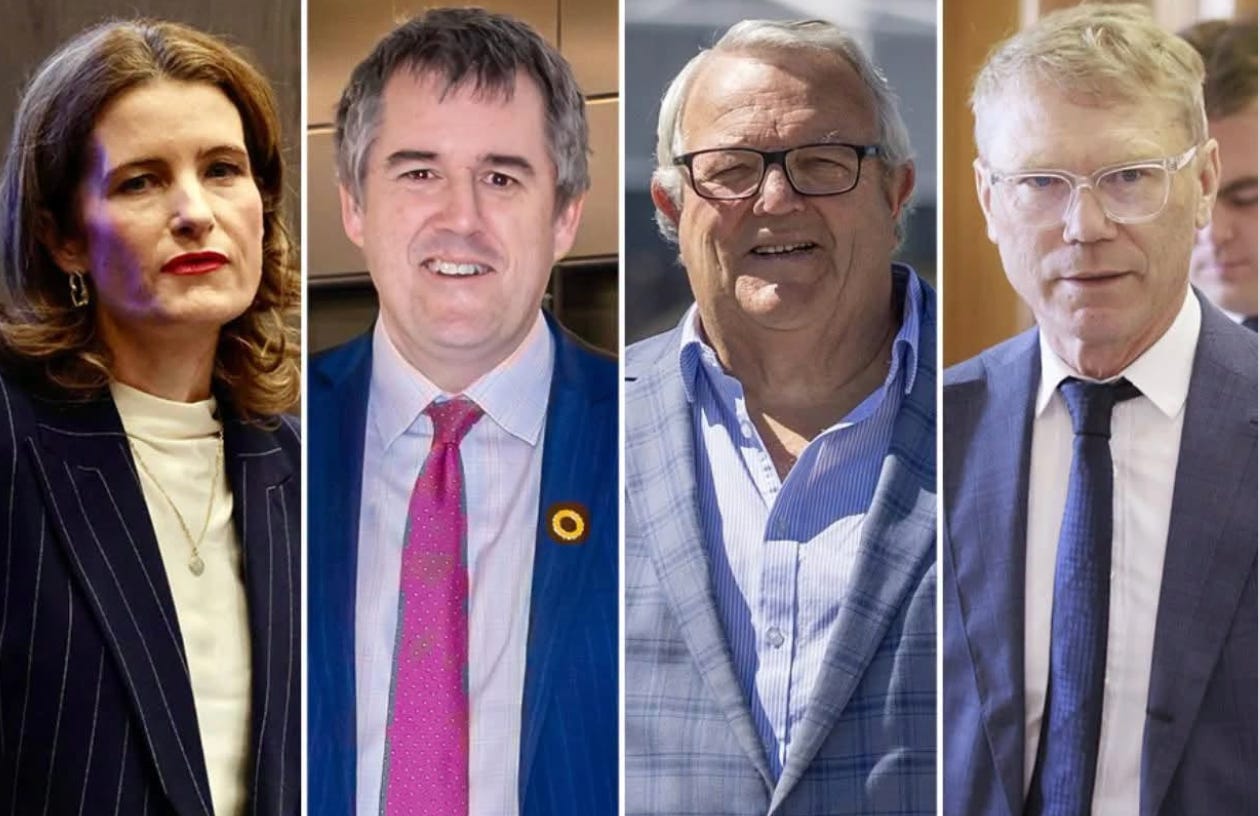
National’s Chess PIeces That Fell
Goodbye to Nicola Willis, Chris Bishop Gerry Brownlee and Paul Goldsmith
Helen Clark on Election 2026
Hipkins put the boot into the Greens a few times during the campaign, and definitely into TPM. It seemed mean-spirited to me.